AI
MetalshubTalks
AI for Raw Material Enquiries | MetalshubTalks 015 Recap
 Written bySamir Jaber
Published on
Share Post
AI
MetalshubTalks
Written bySamir Jaber
Published on
Share Post
A raw material deal rarely starts on a platform. It starts as an email, sometimes a WhatsApp message, with a specification, a quantity, delivery terms and a request for a quote. Before anyone can price it, someone retypes it, and once the offer goes out as a PDF, no system sees it again. Across dozens of enquiries a week, that adds up to a lot of retyping and commercial knowledge left in inboxes.
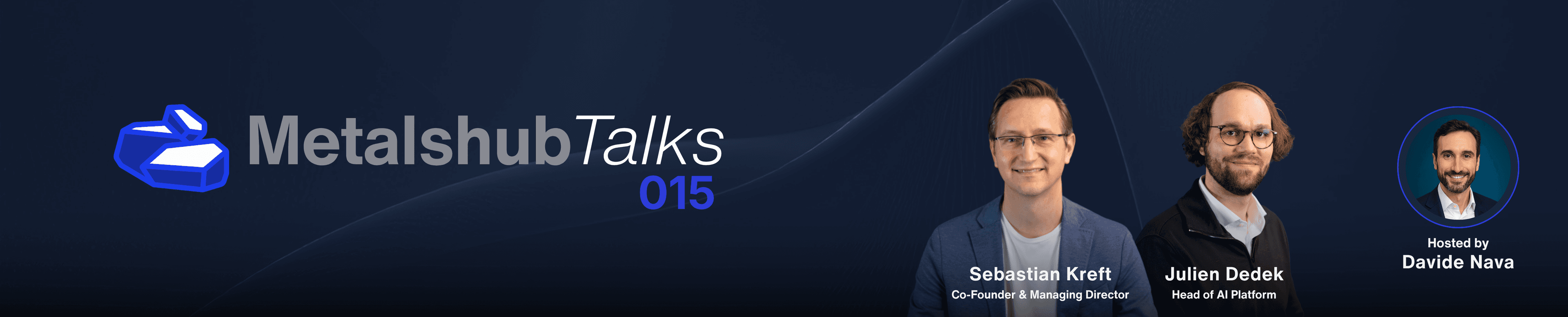
In a recent episode of MetalshubTalks, host Davide Nava sat down with Dr Sebastian Kreft, Co-Founder and Managing Director at Metalshub, and Julien Dedek, Head of Platform AI at Metalshub. They followed one enquiry for nickel cathodes from the buyer’s email to the seller’s offer: what the AI in Metalshub does, where the person still decides, and what comes next.
Dr Sebastian Kreft: In most cases, it is an email. The buyer names a quantity and specification and asks for a quote, the standard RFQ process in our industry. In Asia, messaging apps play a bigger role, and Europe has other channels too, but email still dominates.
Dr Sebastian Kreft: The initial offer, its price and terms, is one of a seller’s most important decisions. First, I run checks. Am I allowed to do business with this customer? There could be sanctions issues or outstanding debt.
Most B2B buyers also want 30 or 60 days’ payment terms, so I check whether credit insurance or an internal credit limit lets me offer open terms.
Then I work on the price, and in B2B that is more art than science. I get feedback from other customers, and I might check market indices, especially if I haven’t traded in a while. Then there is gut feeling about what keeps me in the negotiation or wins the deal.
All of this takes time, and email adds its own problems. With so many emails, it is easy to overlook one. Every enquiry looks different, so details get left out, such as which general terms apply or whether there is a shipping tolerance.
Then there is the team. Going outside a pricing mandate needs an extra approval, often in a separate email thread or on WhatsApp, so the knowledge ends up scattered.
Most sales managers even check their inbox on holiday. Deadlines still get missed, very regularly, I think, and each one is a lost sale.
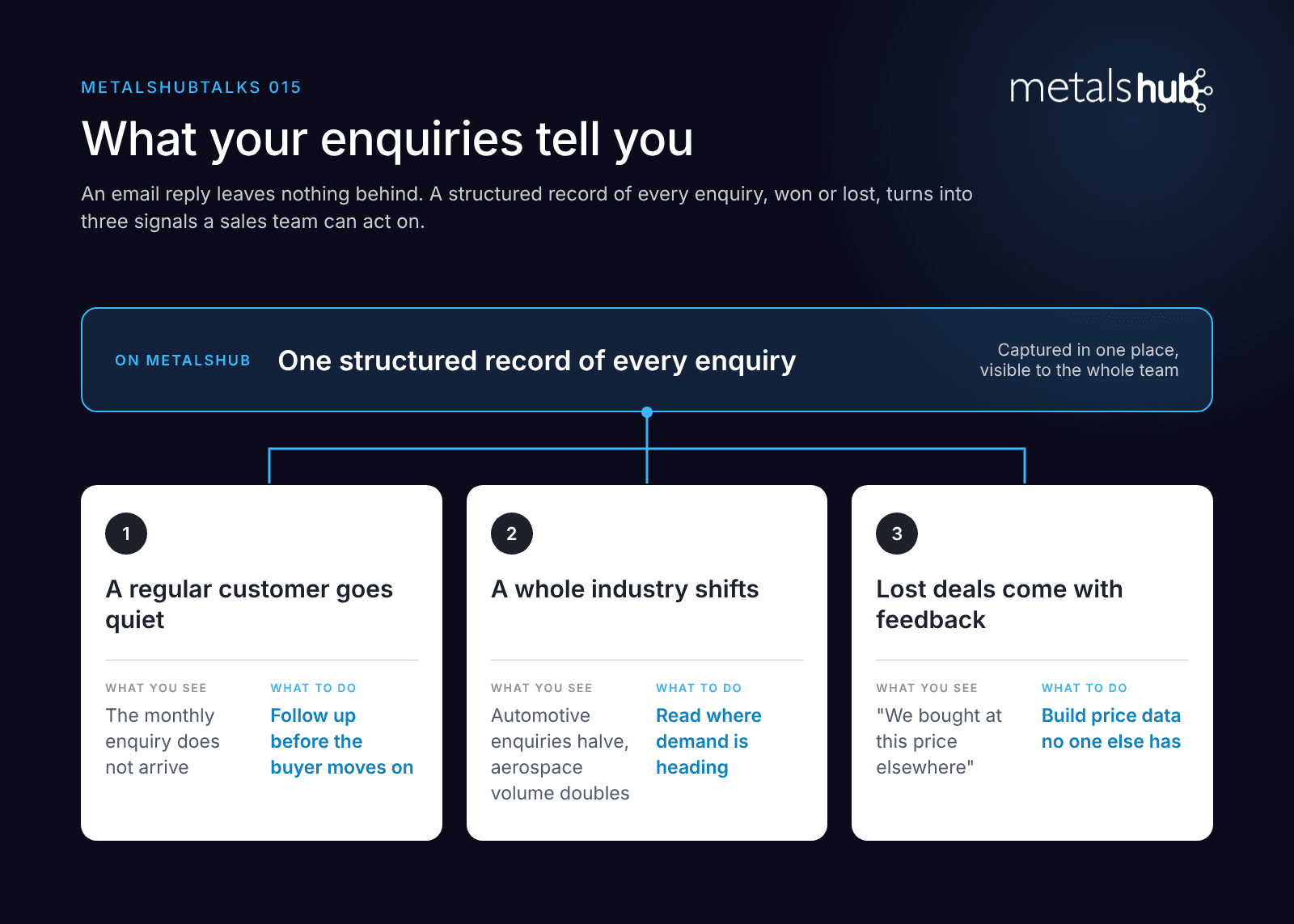
Dr Sebastian Kreft: It is a fair question, because hitting reply is easy. But there is a lot of information in your enquiries, and in most companies it is lost, because only a won enquiry becomes a deal and enters a system.
Take a customer who sends me an enquiry every month. If one month it does not come, that is a warning sign: maybe the buyer has changed, or production is down, and I should follow up. I only see that if enquiries are structured in a system where I can spot patterns.
You can also read how whole industries are moving. If automotive suppliers suddenly halve their enquiries, the sector may be struggling. If aerospace customers buy twice their usual volume, that industry is probably doing well. These signals inform my decisions as a seller.
The third reason is the enquiries I do not win. When I win, I know the price we agreed on, but not whether I could have sold higher. The best information comes from the deals I lose. Buyers often give feedback to the companies that quoted: very specific (“we bought at this price elsewhere”), less specific (“your price was one to two dollars too high”), or none at all. Recording it builds a proprietary database of how prices move that not everyone in the market has.
There is also the people side. If I am promoted or move category, my successor finds every enquiry’s history in one database rather than in my inbox.
Julien Dedek: Imagine it is Monday morning, and a buyer emails for a quote for full-plate nickel cathodes, with chemistry, packaging, delivery period, price basis and payment terms. Quite a normal enquiry.
You copy the email, go to Incoming enquiries in Metalshub and choose Add enquiry with Metalshub AI. You select the company and product, paste in the email, optionally attach documents, and click Generate draft.
In the background, we send the text to a large language model from Google, which fills in every field Metalshub needs. If you have traded with this buyer on Metalshub before, your historical data fills in context the email leaves out.
The result is a draft marked with a small AI icon. Because AI can make mistakes, an overview flags any missing mandatory fields. In the demo, none were, but you still check each field against the email. Then you publish, and the enquiry sits in your list, visible to your colleagues.
Then you quote as usual: set the price, for example, a EUR 200 premium, the validity and anything still open, such as origin, and submit. To reply by email, Metalshub generates the offer as a PDF on your own company template, with no Metalshub branding, ready to send to the buyer.
Julien Dedek: Around 92%, if not higher, and it keeps improving.
Dr Sebastian Kreft: We tested different AI models behind the scenes and constantly measure how well the model structures an email. As more negotiation history enters Metalshub, it gets better at filling missing fields. Even then, you want that manual check.
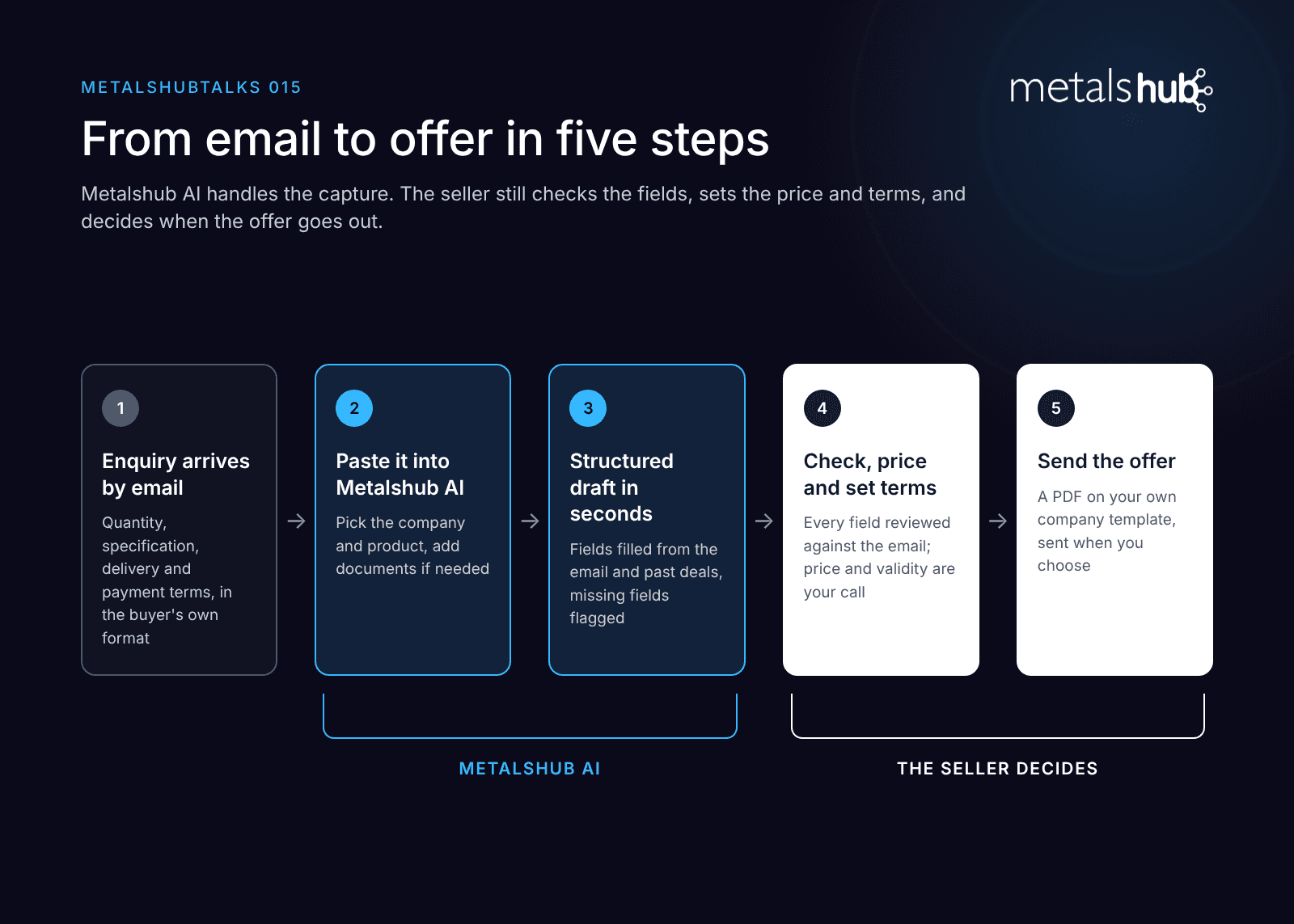
Julien Dedek: Full automation is hard, and you probably would not want it. The person checks the fields, decides the price and terms, which is not for the AI to decide, and chooses when to send the offer.
For us, it matters to be clear where the AI operates and where the human is in the loop. In the walkthrough, every AI step and every point needing your input was visible.
Dr Sebastian Kreft: It is an easy way to get started with AI. The models keep getting better, and trying it on Metalshub lets anyone see how good they have become. If your sales team does not use AI yet, we are happy to run an AI workshop with specific use cases. Our industry is sceptical of new technology and wants to see it work first, and a workshop brings sales, sales operations, finance and risk to the table.
Dr Sebastian Kreft: There are two ways of looking at AI in our industry. First, AI needs far more resources: data centres need aluminium and copper, and huge amounts of power, which needs steel, nickel and other metals. That is a strong boost in demand for metals and mining.
Second, AI will change the whole value chain, from finding deposits through mining and processing to buying and selling raw materials. It is moving faster than many expected, me included, and the models surprise us almost every month. Our first customers connecting to Metalshub through the MCP connector can now do things with their data they never could before.
Julien Dedek: If you do not focus on AI now, you will be left behind. Your competitors are building it into their workflows, and pre-AI workflows will show in your sales. Start with one workflow, rebuild it end to end with AI in mind, then move to the next.
Dr Sebastian Kreft: Some of the productivity gains come from simple things. Last week we experimented with the Metalshub chat: buyers ask some questions again and again, such as whether a seller accepts other payment terms, and a well-instructed AI agent could answer them automatically.
Julien Dedek: Our MCP connector, demonstrated in MetalshubTalks 010, is in beta. There is a waitlist on the platform, and we are happy to help your IT team on a call.
For buyers, offer capture is coming soon: the same workflow applied to offers. A buyer pastes an emailed offer into Metalshub and gets a structured offer, so every negotiation sits on the platform.
We are also building Metalshub AI as a full experience in the platform, to ask questions, fill in enquiries and negotiations and, later, build agents. Companies whose IT blocks an MCP connection can use AI directly in Metalshub instead.
Dr Sebastian Kreft: Salesforce is a general CRM that works in every industry, what we call a horizontal tool. Metalshub was built by people from metals and mining for that industry alone. Selling raw materials works very differently from selling software or machinery, and that focus lets us build how the industry works into the workflow and the AI features.
You can bend a horizontal tool to fit an industry, but it takes time and money, and it brings no network. Metalshub combines workflow software with a marketplace: a network of more than 3,000 companies, vetted before they join, that you can find and trade with on the same platform.
Julien Dedek: You can paste emails into a general AI tool, but you miss the single source of truth. In Metalshub, all your enquiries sit in one place as structured data, while a general tool may pick out information that does not matter to you. Most importantly, you miss the Metalshub network.
Davide Nava: You can build almost anything with AI today. What matters is a structure and a procedure that work the same way every time, and that is what breaks if you rely on AI alone.
The slow part of a raw material deal is rarely the commercial decision. It is the typing, chasing and approving around it. With the AI built into Metalshub, a seller can turn an email into a structured enquiry in seconds, then check, price and send the offer from one place, while people keep the decisions. Every captured enquiry, won or lost, adds to a record of buyer behaviour and prices that the whole team can use.
Three steps to start with:
For more on where AI already helps raw material buyers and sellers, read our MetalshubTalks 010 recap on the state of AI in raw materials.
MetalshubTalks 015
Interested in watching the full episode? Click below and watch it for free.
Newsletter