Industrial Minerals
Battery Raw Materials
Iron & Steel
Aluminium
Copper
AI Agents on Metalshub: What MCP Actually Connects
 Written bySamir Jaber
Published on
Share Post
Industrial Minerals
Battery Raw Materials
Iron & Steel
Aluminium
Copper
Written bySamir Jaber
Published on
Share Post
A structured commercial context layer serves as the core foundation for enterprise AI in raw materials trading. We recently published our Metalshub AI vision, establishing that model performance matters far less than giving AI systems access to verified, structured business context. Having a context layer only generates real value once an enterprise’s internal tools can securely reach it.
I sat down with our Head of AI Platform at Metalshub, Julien Dedek, to discuss the technical mechanism that makes this connection possible: the Model Context Protocol (MCP).
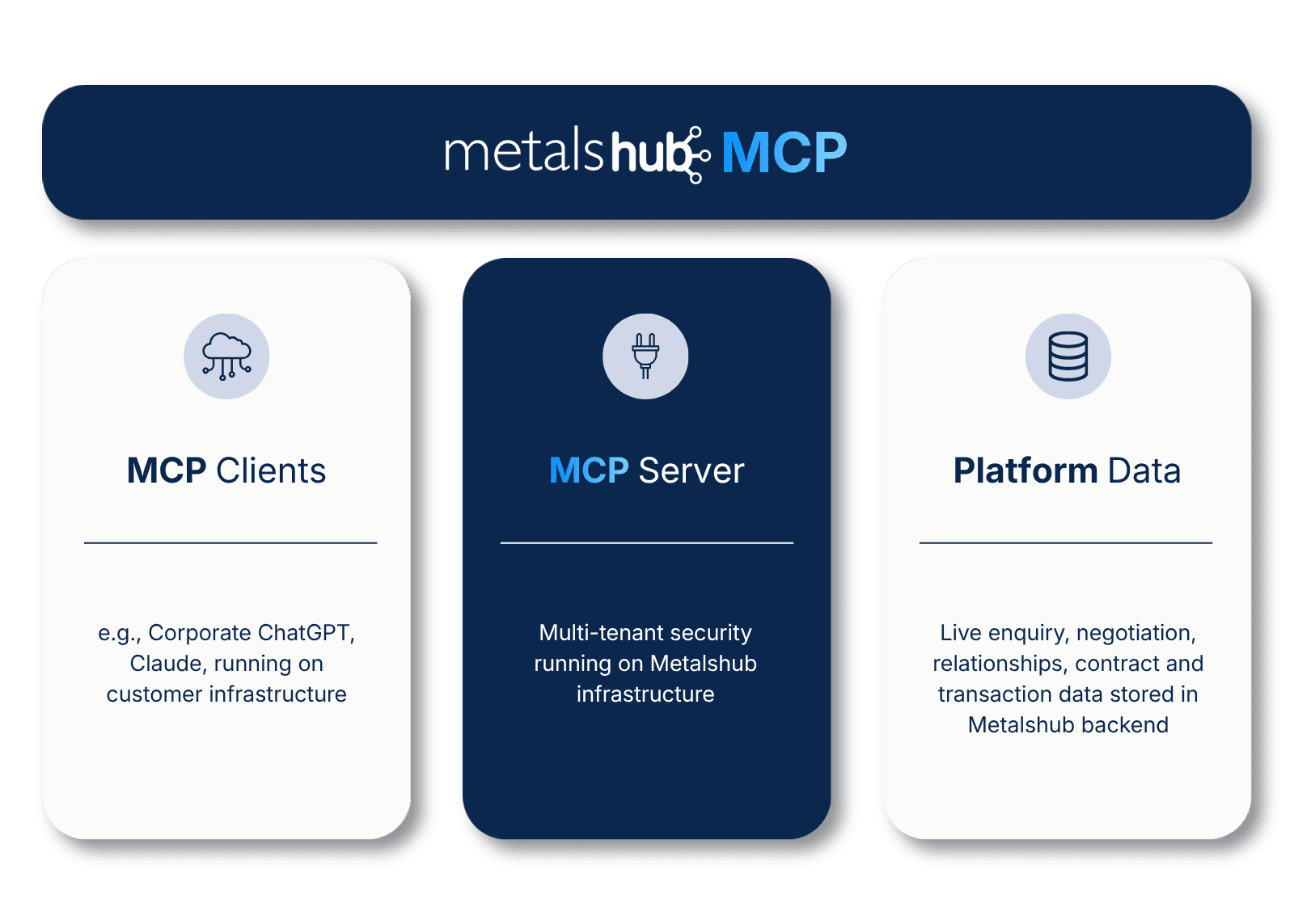
The Model Context Protocol (MCP) is an open standard designed to connect AI models directly to external data sources. It is not a vendor-locked or proprietary integration.
Thus far, connecting corporate AI to external business software, platforms, and tools has required custom integrations across ERPs, CRMs, and document archives. Each integration had to be built individually per customer, making implementation relatively slow and expensive to repeat. MCP replaces this approach with a single governed interface exposed once. Any MCP client running on customer infrastructure, such as Corporate ChatGPT, Claude, or Microsoft Copilot, can query platform data using standardised calls.
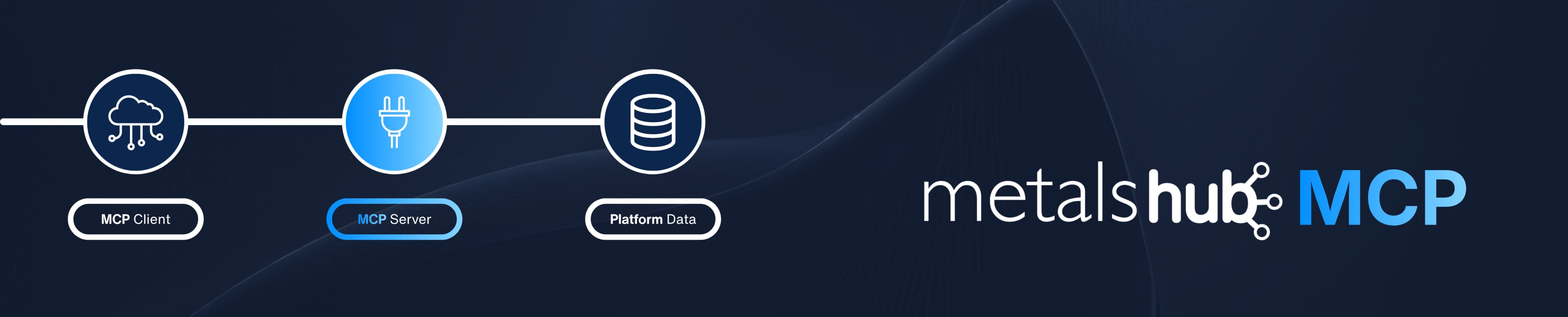
Architecturally, an MCP client, whether deployed on customer infrastructure or used through interfaces like ChatGPT or Claude, communicates directly with an MCP Server operating on Metalshub infrastructure. The server enforces multi-tenant security policies before exposing backend platform data, including live enquiries, negotiation terms, counterparty relationships, and executed contracts.
This setup changes how models retrieve information. Rather than feeding entire documents into a prompt window, the assistant retrieves specific data points on demand.
“We’re moving away from a dump-and-read approach, which hits context limits fast, to surgical retrieval: the MCP client queries only the specific data it needs for the task, not every document we have.”
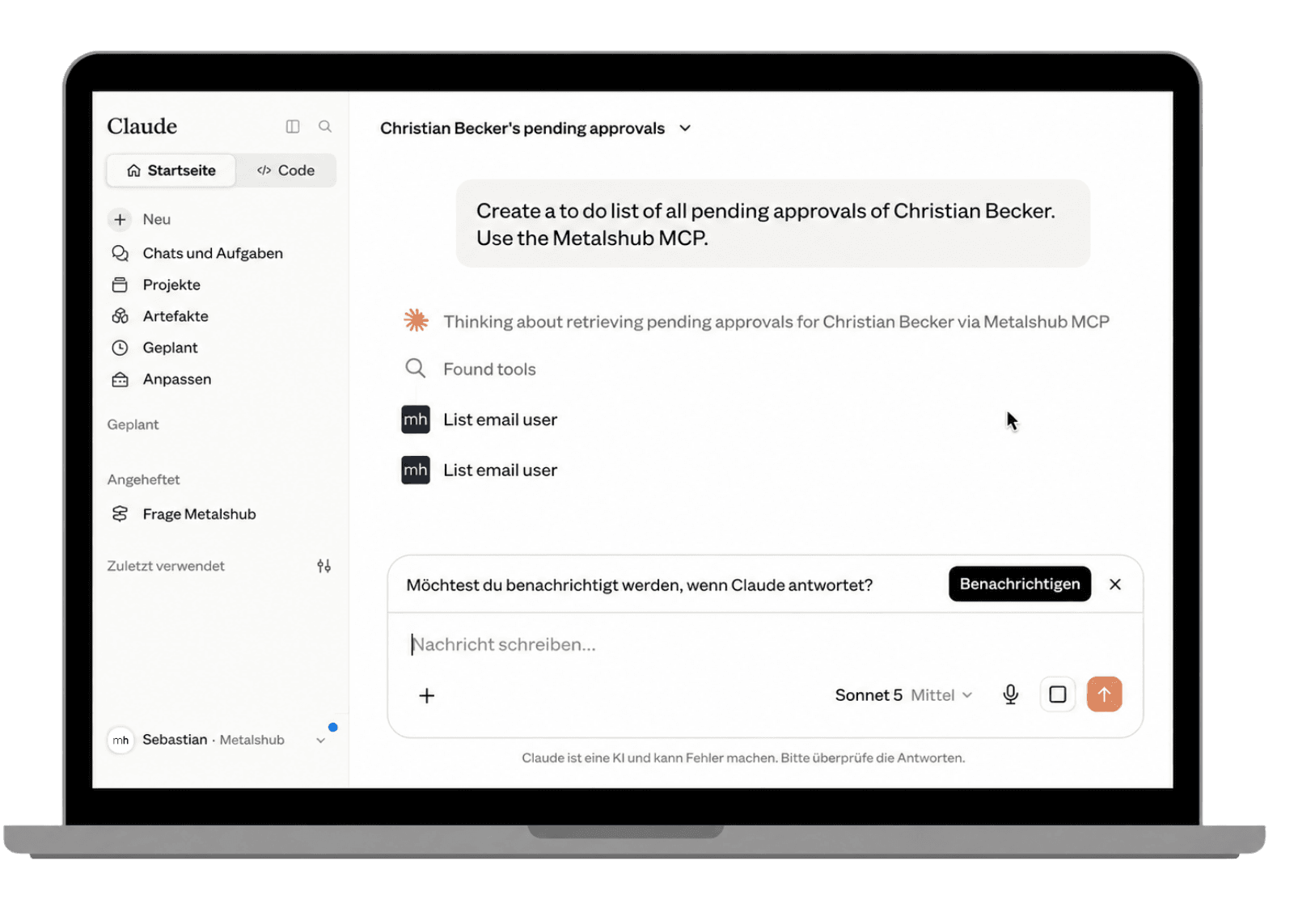
By connecting your AI tools directly to live Metalshub data, you unlock two powerful capabilities.
Simply chat with your AI to get precise, context-aware insights, such as:
Instruct your AI to handle operational workflows, such as:
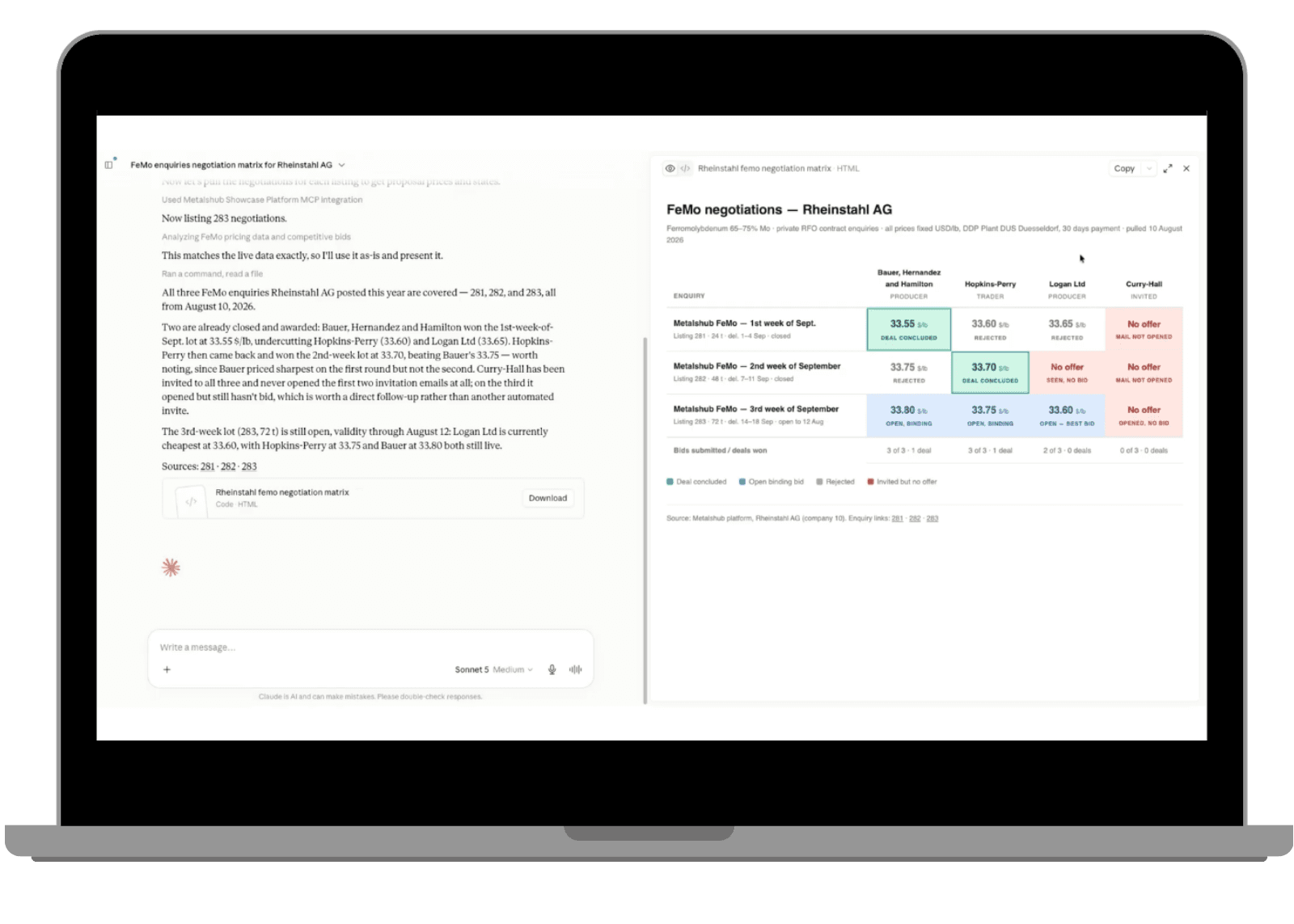
“The agent can draft a counter-offer in seconds, but you keep control. We believe a final human review is essential to ensure quality and compliance.”
Strict data governance dictates how information flows through MCP. A customer’s commercial history remains isolated within their account boundary. Metalshub does not use your commercial history to train any public language models. Market-level insights or price benchmarks rely exclusively on aggregated and anonymised network data sets.
Enterprise IT administrators maintain complete control over the connection configuration. They choose which internal systems connect, which language models process the data, and whether the connection permits read-only queries or action-based steps.
“Your commercial history is yours,” says Dedek. “It’s never used to train a shared model, and it never leaves the fence.” Access operates on explicit corporate authentication paired with granular permissions. Administrators can modify or revoke data access scopes at any time without impacting core platform operations.
Establishing an MCP connection follows a structured sequence:
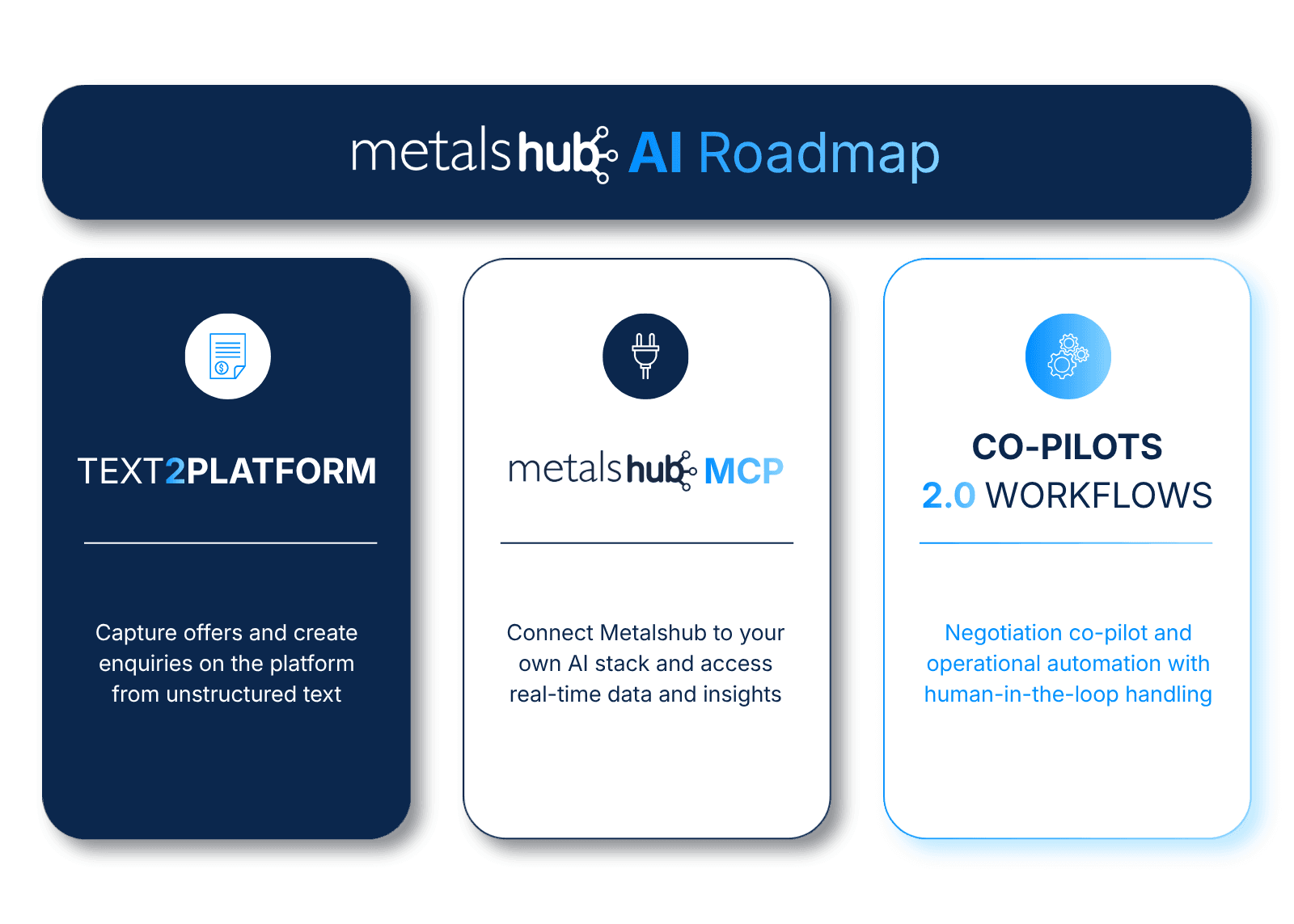
The technical roadmap follows a clear progression: Text-2-Platform data capture (live), MCP read access (rolling out), write and action capabilities (in development), and specialised agent workflows like negotiation assistance. Capabilities build systematically through four stages: read, update, act, and write.
Commercial teams preparing for these connections should begin structuring their commercial data today, as historical context cannot be backfilled automatically later. Organisations should select one commercial workflow to digitise end-to-end, select an enterprise-approved language model, and request early access to MCP connections.
A structured context layer generates value when enterprise systems connect to it securely. The Model Context Protocol provides that live connection. Watch our technical setup video or contact the Metalshub team to request early access.
We remain focused on helping industry leaders translate raw commercial activity into measurable bottom-line value. To explore this vision further and see how leading metals and mining enterprises are preparing their data stacks for the AI era, join our upcoming MetalshubTalks episode on “The State of AI for Buying and Selling Raw Materials.” In this session, our leadership team will discuss how to bridge the gap between transactional systems and enterprise AI platforms, demonstrating practical use cases and setting the stage for future AI-driven commercial operations.
METALSHUBTALKS 010
Join our upcoming AI webinar on August 25, 2026

Newsletter
insights