Iron & Steel
Aluminium
Copper
Industrial Minerals
Battery Raw Materials
How Can Raw Material Procurement Teams Use Structured Data To Improve Sourcing Performance?
 Written bySamir Jaber
Published on
Share Post
Iron & Steel
Aluminium
Copper
Industrial Minerals
Battery Raw Materials
Written bySamir Jaber
Published on
Share Post
In raw material procurement, decisions are often shaped by experience, relationships, and market intuition. While these remain important, they are no longer sufficient on their own. Increasing price volatility, tighter compliance requirements, and growing pressure to demonstrate savings and ESG performance are forcing procurement teams to rely more heavily on data.
The challenge goes beyond purely data and lies in the lack of a proper data structure. Supplier emails, spreadsheets, ERP extracts, and ad-hoc negotiations rarely form a coherent picture of procurement performance. To improve outcomes, procurement teams need consistent, end-to-end data across the entire sourcing process.
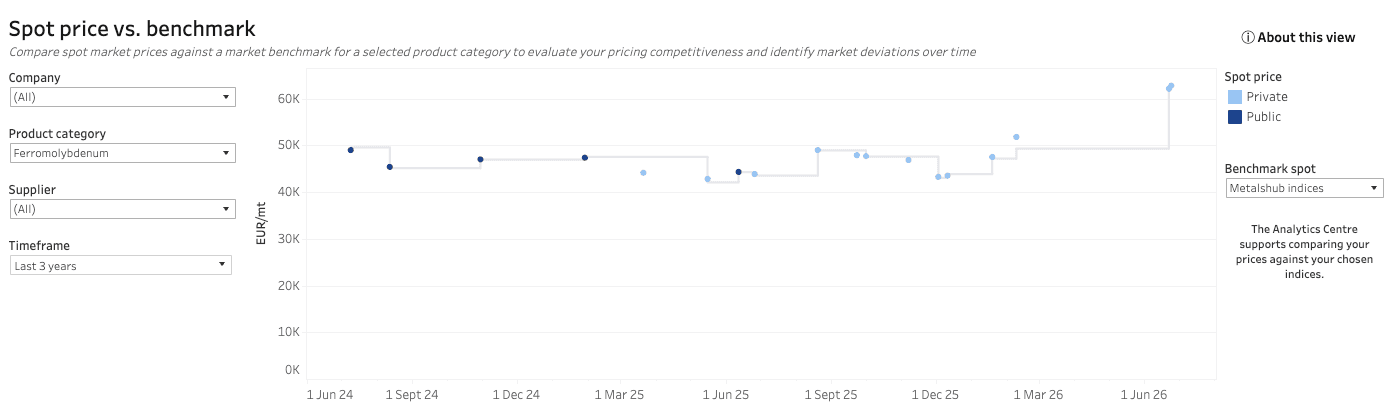
Every procurement process starts with a requirement. Yet in many organisations, demand is fragmented across emails, phone calls, and local systems. This makes it difficult to compare offers, evaluate supplier participation, or track performance over time.
Metalshub allows procurement teams to bundle demand, publish tenders and capture negotiations in one system enabling consistent data capture across categories, suppliers, and regions.
This improves operational efficiency and lays the foundation for meaningful analysis later on.
Receiving multiple offers does not automatically lead to better decisions. Raw material offers often differ in currencies, incoterms, freight assumptions, and payment terms, making direct comparison difficult and error-prone.
The Compare & Normalisation feature addresses this challenge by aligning offers on a like-for-like basis. By normalising prices for currencies, incoterms, and other commercial variables, procurement teams can compare offers objectively and identify the true cost position of each supplier.
Beyond better award decisions, this step creates clean, comparable data that feeds directly into performance and savings analysis.
Negotiations are where procurement value is often created, but they are also one of the least structured parts of the sourcing process. Without consistent documentation, it becomes difficult to understand how many negotiation rounds took place, which tactics worked, or where value was conceded.
Metalshub captures negotiation activity directly within the workflow, allowing procurement teams to analyse negotiation depth, response behaviour, and outcomes across suppliers and categories. Combined with Approval Management, this ensures that sourcing decisions remain compliant while still allowing teams to move efficiently.
Procurement does not end with the award decision. Long-term contracts, call-offs, and supplier collaboration determine whether negotiated value is actually realised.
With Contract Management, procurement teams can digitalise long-term agreements, manage alerts, and plan call-offs in a structured way. This reduces manual follow-up, improves supplier coordination, and ensures that negotiated terms are consistently applied.
At the same time, Relationships centralise supplier data, certificates, contacts, and ratings, giving procurement teams a clear view of their supplier landscape across products and regions.
Structured workflows across enquiries, offers, negotiations, and contracts generate a rich dataset. However, visibility alone does not improve performance unless it can be translated into insight.
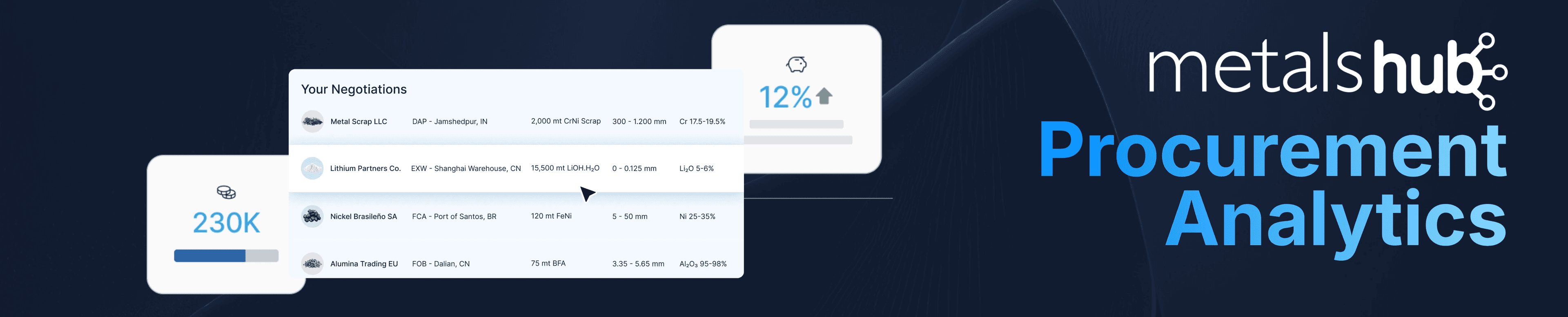
This is where the Analytics Centre for Procurement builds on the operational foundation of the Procurement Solution. By consolidating structured procurement data into purpose-built dashboards, teams gain full visibility across spend, suppliers, performance, and compliance. Directly accessible in Metalshub or via MCP in the user’s preferred AI chatbot.
Procurement managers can analyse supplier participation, offer competitiveness, negotiation outcomes, and category performance across timeframes and organisational units. Savings can be attributed transparently using clear methodologies tied to benchmarks, negotiations, and supplier competition, making results defensible in internal and external reviews.
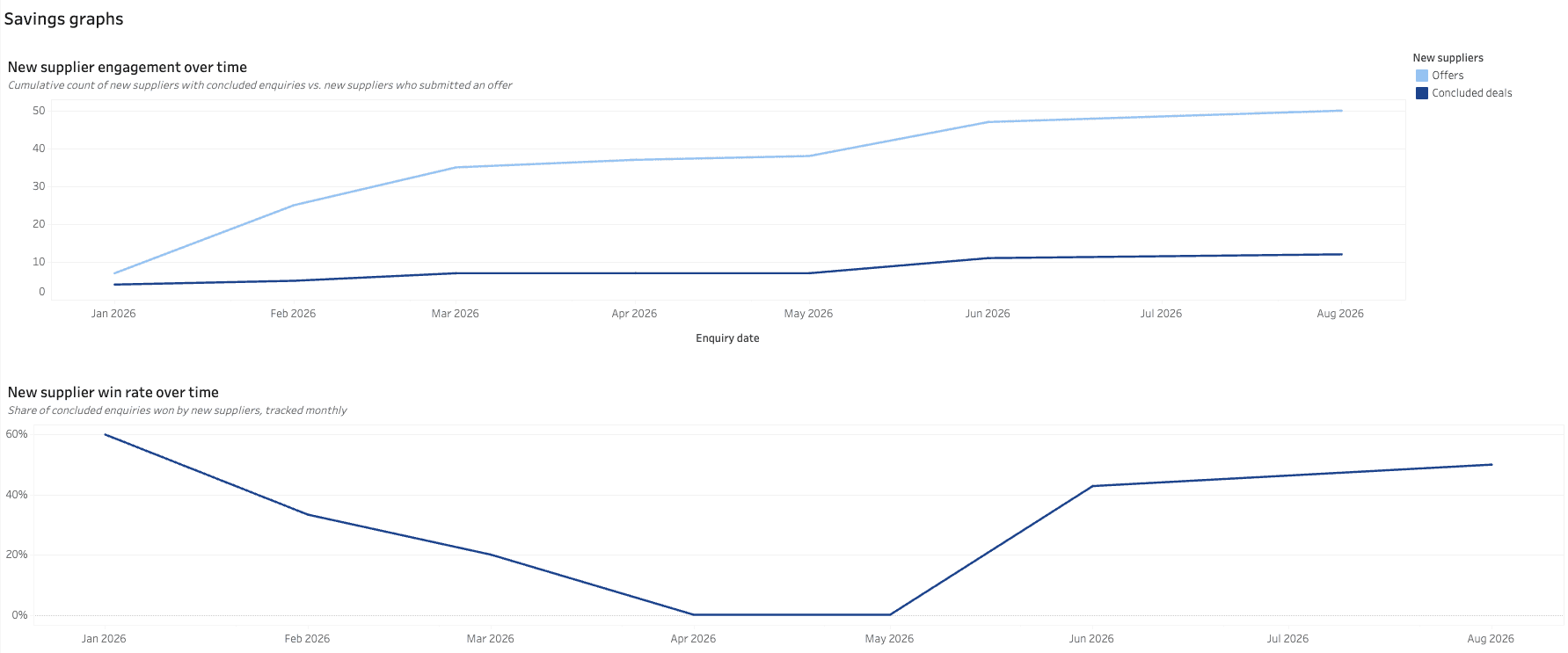
Modern procurement teams are expected to demonstrate more than price improvements. They must show measurable savings, adherence to governance processes, and progress on sustainability objectives.
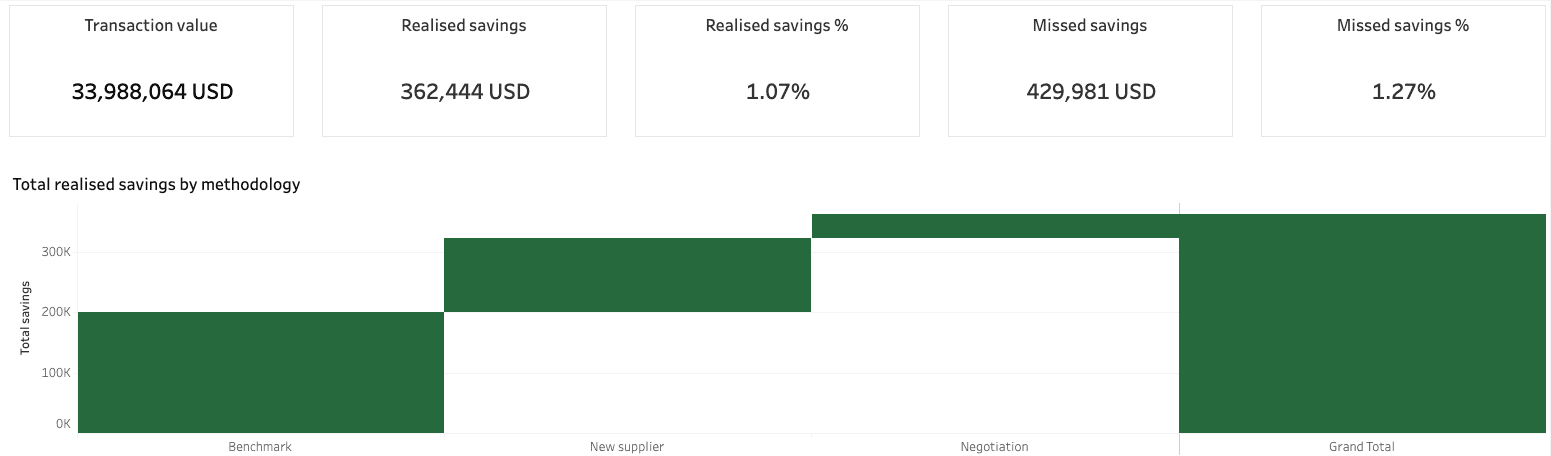
The Analytics Centre enables this by integrating Savings Dashboards, ESG Insights, and Team Analytics into a single analytical layer. Teams can track realised and missed savings, monitor supplier concentration, analyse approval behaviour, and evaluate Scope 3 emissions coverage and performance without manual reporting.
Because all metrics are based on structured, auditable data, procurement leaders can confidently use them for internal reporting, audits, and stakeholder communication.
Procurement data rarely lives in isolation. With ERP Integration, Metalshub connects procurement workflows and analytics to existing enterprise systems, ensuring consistency across financial, operational, and compliance reporting.
For teams that require deeper analysis, structured data can be exported via Raw Data Download, connected via API or visualised through Custom Dashboards, enabling tailored KPI tracking without compromising data integrity.
By managing the full source-to-contract process digitally and analysing it through a unified analytics layer, procurement teams move beyond operational execution. They gain the ability to identify performance gaps, optimise sourcing strategies, and demonstrate tangible value to the organisation.
In an environment where procurement is increasingly expected to deliver savings, resilience, and sustainability, structured data has become the foundation for better decisions and stronger outcomes across the raw material supply chain.
Newsletter
insights