Industrial Minerals
AI
Your AI Procurement Agent Needs Refractory Suppliers to Talk To
 Written bySamir Jaber
Published on
Share Post
Industrial Minerals
AI
Written bySamir Jaber
Published on
Share Post
AI tools now draft enquiries and compare offers in minutes. For buyers of magnesia, alumina and other refractory raw materials, the more useful question is which suppliers those enquiries reach.
Only 5% of European chief procurement officers reported widespread use of generative AI in procurement in 2026. Many more are testing it, and refractory raw materials buyers are among them. The trials tend to measure speed, from how fast an AI procurement agent writes an enquiry to how fast it reads the replies and builds a comparison.
Speed matters, and an agent can only compare the offers it receives, and those come from the suppliers it can reach. Pointed at a buyer’s inbox, it works faster through the same short list. Connected to a supplier network, however, it works with a much larger pool in almost the same time.
The fair starting point is that AI tools are good at a large part of a buyer’s week. They turn a specification sheet into a clean enquiry, summarise a supplier’s terms, and pull prices and quantities out of a dozen emails into one table. CPOs consider contract analysis, sourcing and market intelligence, and the drafting work around requests for quotes as the primary value areas.
Much of the work between a supplier’s first message and a signed deal is transcription. Reading an incoming enquiry and turning it into a structured record is a task a model handles well today. Drafting the offer that answers it, with commercial intelligence and decision inside, is the harder step. Metalshub co-founder Dr Sebastian Kreft and Head of Platform AI Julien Dedek explained why and how that is the case on MetalshubTalks earlier in November 2026.
For a refractory buyer handling dozens of grades of magnesia, alumina and silicon carbide, that saves real time, and more when the AI works from structured enquiry and offer data. We explain why the data behind the model decides how useful the AI is in a separate post.
The limit sits elsewhere. An AI tool working from a buyer’s inbox inherits the buyer’s address book. If six suppliers are approved for a fused magnesia grade, it writes to those six, faster and with fewer typing errors, and it cannot write to a seventh it has never heard of. Approved lists for qualified refractory grades are short and change slowly, because each new source needs testing. Finding the companies worth testing is the other half of the job. A procurement manager at a global industrial group says the company sources on Metalshub to get “the world vendor base and also better contract options to buy”.
On Metalshub, an enquiry goes to every supplier registered for that material as well as the buyer’s existing contacts, and suppliers new to the buyer can offer on open enquiries. For the refractory raw materials with the most registered suppliers, the network looked like this in October 2026.
| Material | Registered suppliers on Metalshub |
|---|---|
| Silicon carbide | 171 |
| Graphite | 102 |
| Bauxite | 90 |
| White fused alumina | 88 |
| Brown fused alumina | 86 |
| Fused magnesia | 81 |
| Dead burned magnesia | 76 |
Across 20 core refractory raw materials, the count runs from 38 to 171 suppliers per material, with a median of 69. That is the pool an enquiry can reach before the buyer adds a single contact of their own. How Many Refractory Raw Material Suppliers Are on Metalshub? has the full table, with supplier examples for each material and the mining data behind the supply base.
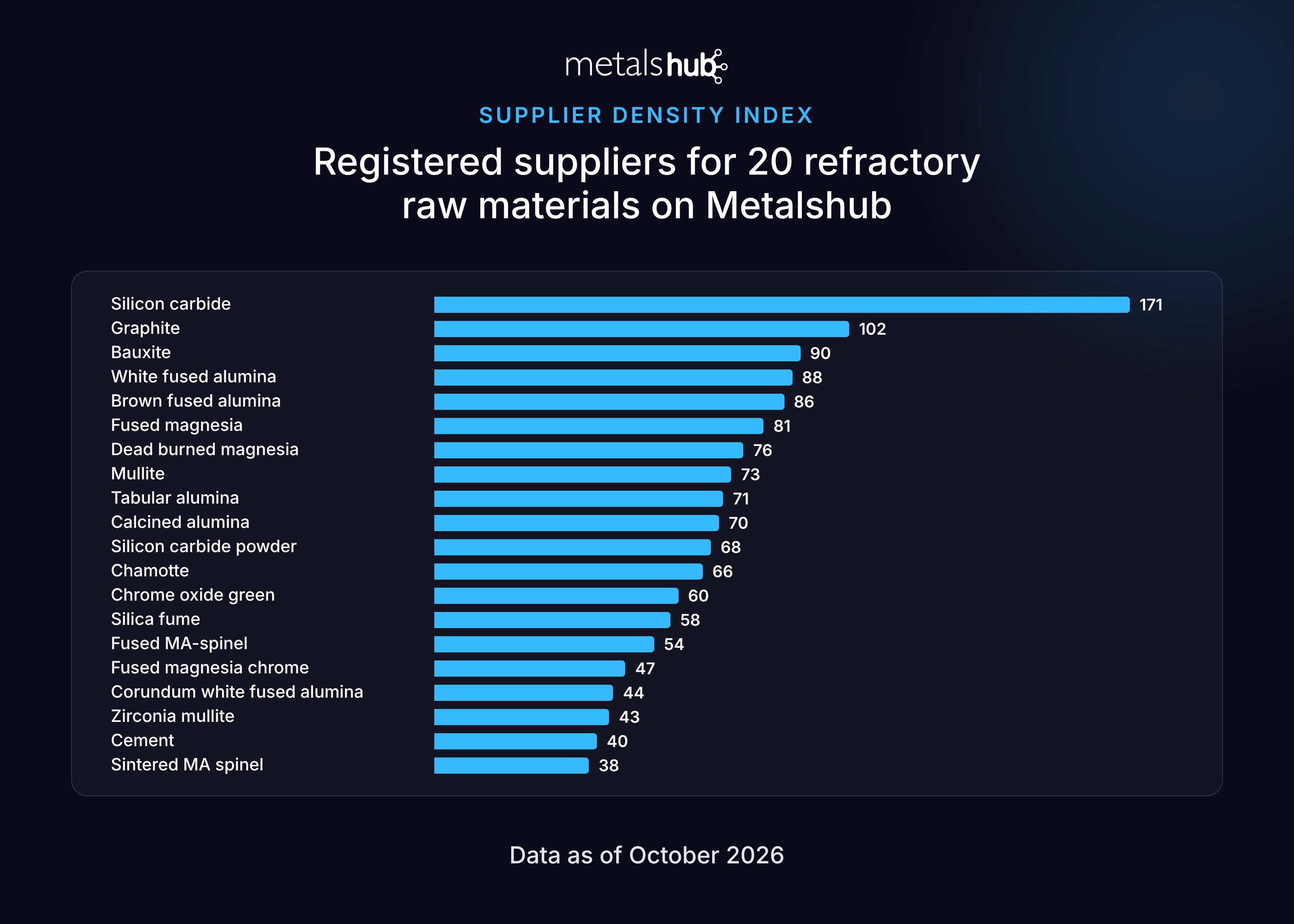
Registered suppliers per material, October 2026
Metalshub’s AI work starts with the messages buyers and suppliers already send each other. Many enquiries still arrive as an email or a WhatsApp message, and a Metalshub feature called Text2Platform reads those messages and turns them into structured enquiries and records on the platform. Once that information sits in one place, a buyer can search and compare it, and so can the buyer’s own AI assistant.
This is what the Metalshub MCP connector is for. MCP (Model Context Protocol) is an open standard that lets AI assistants such as ChatGPT, Claude and Microsoft 365 Copilot work with the data in other software. With the connector in place, a buyer can ask their assistant which suppliers offered on a grade over the past year and how their prices compared, and the answer comes from their own enquiry history on Metalshub. The assistant can also act for the buyer, for example by publishing an enquiry to the supplier network or answering an offer. We explain the setup in more detail in AI Agents on Metalshub: What MCP Actually Connects.
Each person signs in with their own Metalshub account, so their AI sees only what that account can see, and nothing that commits money or reaches a supplier goes out until a person approves it.
Metalshub is also building agents for market intelligence and negotiation support. Put together, this gives a refractory buyer one assistant that drafts the enquiry, publishes it to the full supplier network once the buyer approves, and then reads and compares the offers that come back. A demo is the quickest way to see which of these your team can use straight away.
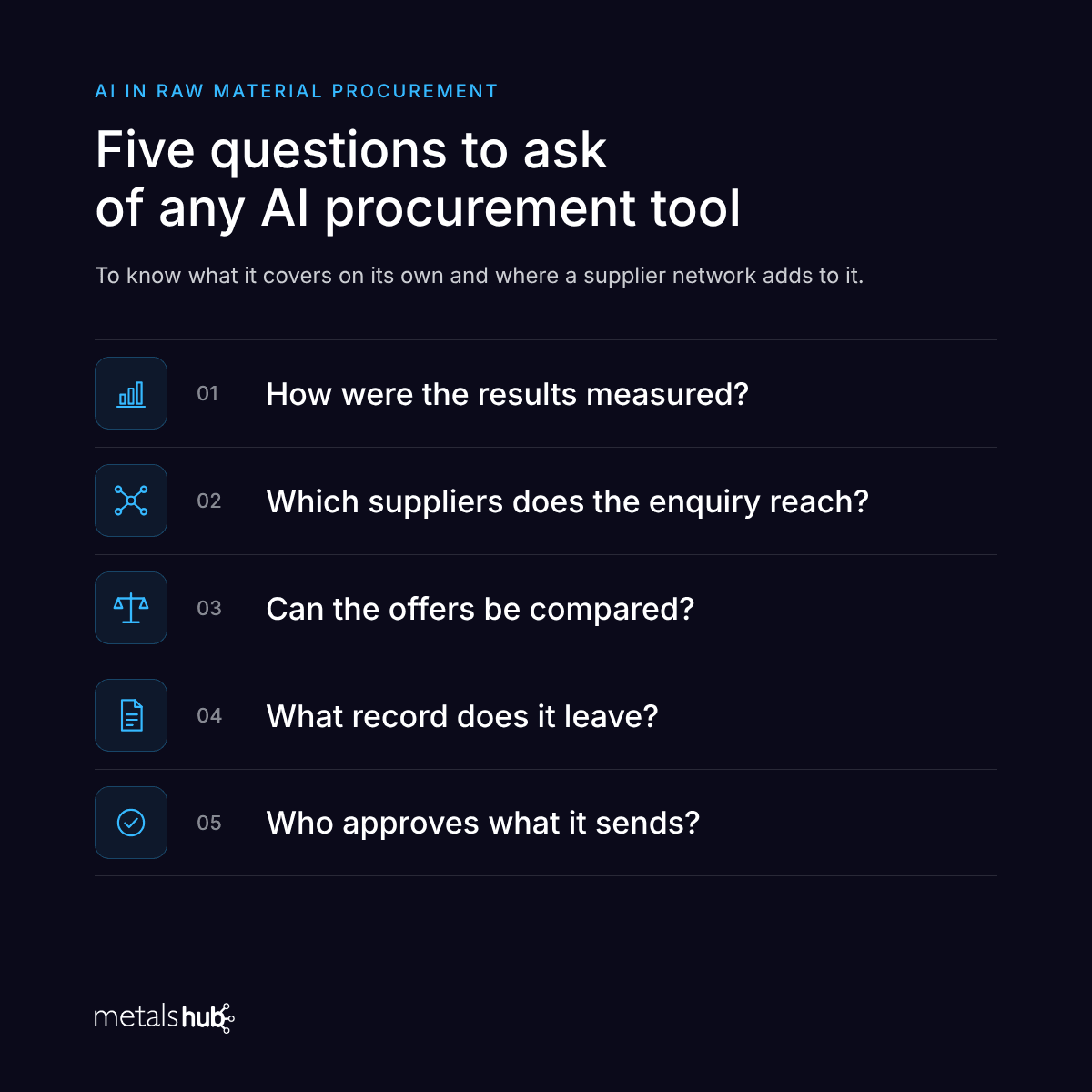
What an AI tool covers on its own, and where a supplier network adds to it.
An AI tool and a supplier network do different jobs, and most buyers will use both. When your team looks at an AI tool for sourcing, these questions show what it covers on its own and where a network adds to it.
Metalshub’s Procurement Solution gives refractory buyers the network and the record. An enquiry reaches every registered supplier for the material alongside the buyer’s own contacts, offers are compared with Metalshub’s normalisation feature, and every enquiry, offer and deal is stored in one place for the buyer’s own AI to work with.
RHI Magnesita has run more than 3,800 enquiries and executed more than €400m of procurement on Metalshub since adopting it as its central platform in December 2023, with a 2.0x return on investment.
To see how one of your materials looks on the network, test it with one enquiry. Book a demo.
The general assistants, such as ChatGPT and Claude, are strong at drafting enquiries, reading contracts and summarising offers. For raw material buying, the better question is what the AI is connected to. An assistant that can read your enquiry history and reach a wide supplier network will give better answers than one that only sees your inbox.
An AI tool can replace much of the writing and reading around sourcing. It cannot add suppliers to your list or produce offers from companies that never received your enquiry. The two do different jobs, and most refractory buyers will use both: an AI tool for the documents and a supplier network such as Metalshub for the competition, with the AI connected to the network.
Yes. Through the Metalshub MCP connector, Claude, ChatGPT and Microsoft 365 Copilot can publish an enquiry, counter an offer or accept one. Nothing that commits money or reaches a supplier goes out until a person approves it.
Each person signs in with their own Metalshub account, and the AI sees only what that account can see, such as its enquiries, offers, negotiations and contracts. A connector never grants more access than the account already has. Metalshub does not use customer data to train public AI models, and the assistant you connect follows your own company’s agreement with its provider.
81 suppliers were registered for fused magnesia as of 6 October 2026, and 76 for dead burned magnesia. Across 20 core refractory raw materials, the count runs from 38 to 171 suppliers per material, with a median of 69.
Newsletter