Industrial Minerals
How Many Refractory Raw Material Suppliers Are on Metalshub?
 Written bySamir Jaber
Published on
Share Post
Industrial Minerals
Written bySamir Jaber
Published on
Share Post
Bauxite and magnesite come from a handful of countries, and 2025 added new supply risk at the source. Metalshub enquiry data shows that the companies able to supply refractory grades run to dozens per material, and that the supplier base behind each grade is deeper than most supplier lists.
Every refractory lining starts with a small group of minerals mined in a small group of countries. In 2025, five countries mined about 89% of the world’s bauxite, and China mined about 60% of its magnesite, according to the US Geological Survey.
Such concentrated supply pushes buyers towards caution. Approved supplier lists stay short, and enquiries go to the companies a buyer already knows. It looks like the safer choice.
However, the number of countries that mine a material is one measure of supply. The number of companies able to quote a buyer for a specific grade is another, and Metalshub enquiry data from the last 12 months (as of October 2026) puts it far higher than most supplier lists. The refractory raw materials with the most registered suppliers have between 43 and 171 each, with a median of around 70. Magnesia, one of the most concentrated at the mine, drew more competing offers per enquiry than any other refractory raw material on the platform.
Bauxite is the clearest case. Guinea mined about a third of the world’s supply in 2025, ahead of Australia and China, according to the USGS. In August 2025, Guinea formalised the withdrawal of the mining licence held by Guinea Alumina Corporation, a subsidiary of Emirates Global Aluminium, and passed the concession to a state-backed company, AlCircle reported.
Magnesite follows the same pattern. China mined about 60% of world supply in 2025, and Brazil, Russia and Turkey together about a quarter, according to the USGS. Within China, the producer base is shrinking: in Liaoning, the province that produces most of the country’s magnesia, the number of magnesite-mining companies fell from 114 in 2020 to 63 in 2024, with 56 expected by the end of 2025.
A refractory producer rarely buys from the mine, though. Between the mine and the kiln, bauxite and alumina are calcined, sintered or fused, magnesite is dead-burned or fused, and every grade is sized and traded. That processing and trading layer is far wider than the mining base, and it is where a buyer’s real supply options sit.
For how each material is made and used, see our overview of types of refractory raw materials.
To see how wide that layer is, we counted, for each material, the companies registered on Metalshub to receive enquiries for it. That count shows how far a single enquiry can reach. A registered supplier is not always an active one, so we also counted the average number of offers buyers received per enquiry.
Together, these two figures make up the Supplier Density Index. The counts include producers, processors and traders, since any of them can win an order. All figures are as of October 2026.
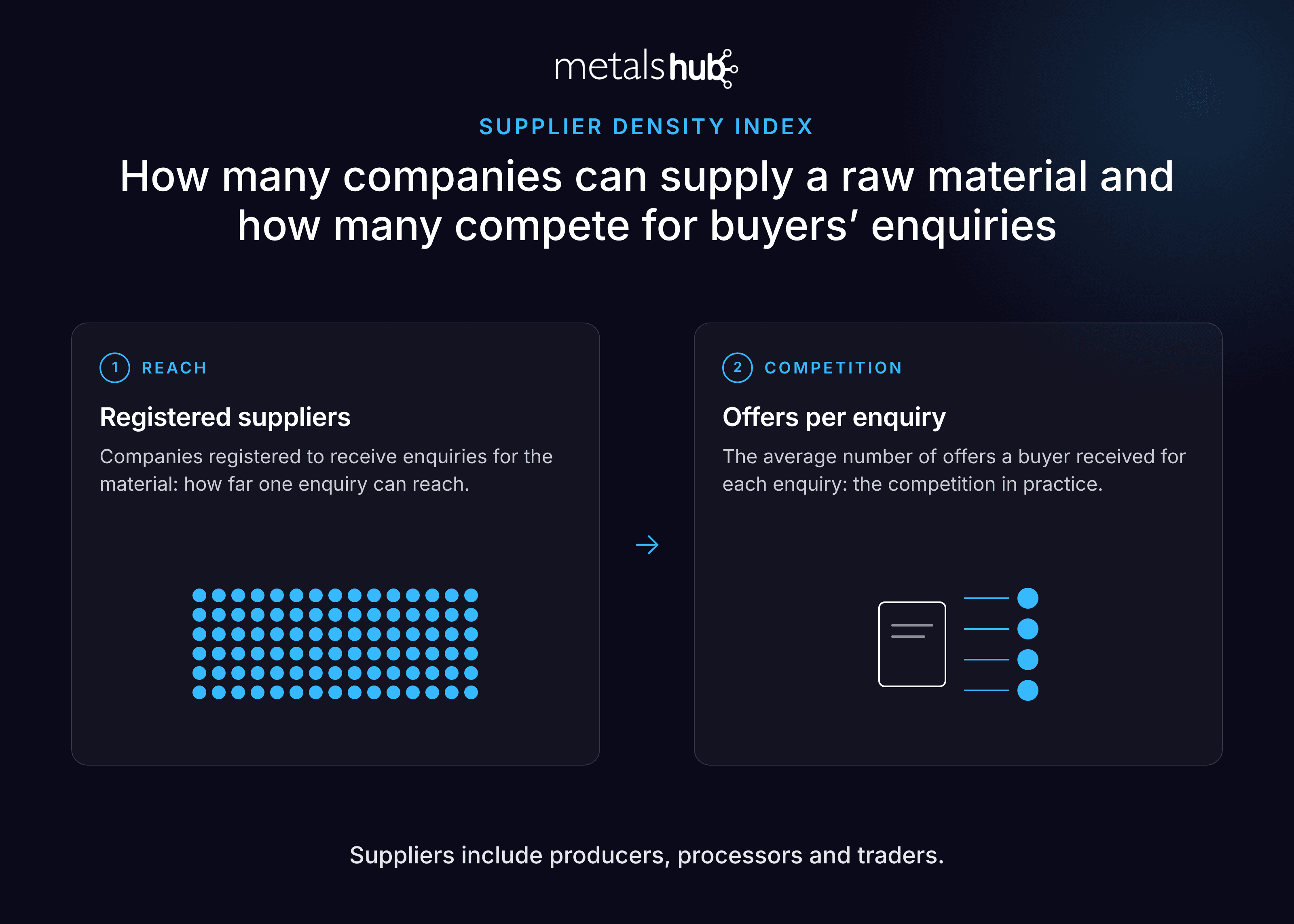
The two measures behind the Supplier Density Index
Silicon carbide has the widest base, with 171 registered suppliers, followed by graphite with 102 and bauxite with 90. Thirteen of these materials have 60 or more registered suppliers, and the median is around 70.
| Material | Registered Suppliers | Offers per Enquiry | Supplier Examples |
|---|---|---|---|
| Silicon carbide | 171 | 4.43 | FirstAlloys, ASMET, MFG |
| Graphite | 102 | 1.96 | Nacional de Grafite, Gallois, Syrah Global |
| Bauxite | 90 | 3.97 | CMP Tianjin, Euromark, Meena Refractories, Thyme |
| White fused alumina | 88 | 3.37 | Traxys, Shandong Qinai, Shinno Minerals, Xingyang Jinbo |
| Brown fused alumina | 86 | 3.08 | Elfusa, Traxys, Minchem Impex |
| Fused magnesia | 81 | 5.49 | Yingkou Liyuan, Hong Yun Mineral, Yingkou Kaining |
| Dead burned magnesia | 76 | 5.50 | Fupeng International, Normag, Minchem Impex |
| Mullite | 73 | 2.09 | Future Refractories, Lucky Enterprises, Katni Minerals |
| Tabular alumina | 71 | 2.98 | Zhejiang Zili, Trasteel, Traxys |
| Calcined alumina | 70 | 1.25 | Hindalco, ACTECH, Nabaltec |
| Silicon carbide powder | 68 | 2.34 | SIKA Brasil, Sicbras, Imerys Fused Minerals |
| Chamotte | 66 | 2.01 | Imerys Refractory Minerals, tk accelis, Euromark |
| Chrome oxide green | 60 | 2.48 | Bajaj Chemical, Cofermin, Lanxess, Vishnu Chemicals |
| Silica fume | 58 | 1.27 | Elkem, Elkem South Asia, Ferroglobe, Possehl |
| Fused MA-spinel | 54 | 3.39 | Hong Kong Southeast Minerals, Ceramics International, Xiuyan Xiangyu |
| Fused magnesia chrome | 47 | 1.90 | Hong Kong Southeast Minerals, MFG Materia |
| Corundum white fused alumina | 44 | 2.10 | Elfusa, Cremer Erzkontor, Shandong Qinai |
| Zirconia mullite | 43 | 1.73 | Fused Minerals International, Imerys, Meihekou Yuexing |
Registered suppliers are companies registered to receive enquiries for the material on Metalshub. Offers per enquiry cover the time between October 2025 and October 2026. Silicon carbide and graphite suppliers also serve steel, foundry and other buyers.
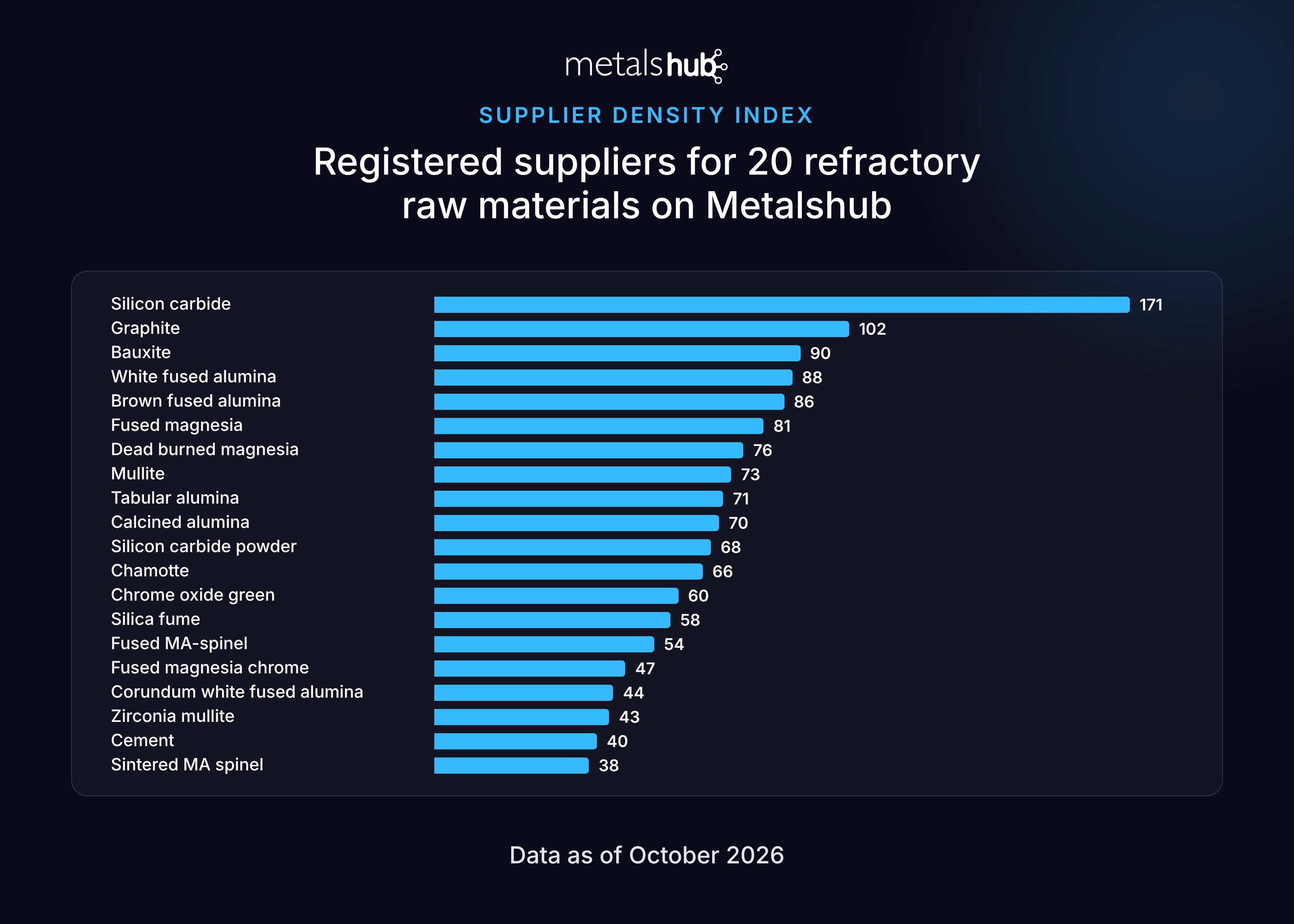
Registered suppliers per material, October 2026
One country mines most of the world’s magnesite, and its main producing province is consolidating. On Metalshub, magnesia is the most competitive refractory raw material.
Fused magnesia drew 5.49 offers per enquiry and dead burned magnesia 5.50 between October 2025 and October 2026, the highest of all 100 refractory raw materials on the platform and twice the refractory average of 2.7.
A buyer who opens a magnesia enquiry to the registered suppliers for the grade can reach companies outside their usual list, which is how buyers find new suppliers on Metalshub.
The four alumina grades shown in the table are bought by refractory producers. They form a separate market from the metallurgical-grade alumina sold to aluminium smelters.
Refractory alumina has some of the deepest supply on Metalshub. White and brown fused alumina each have more than 85 registered suppliers, and tabular and calcined alumina 71 and 70. White fused alumina enquiries drew more than three offers on average in the 12 months up to October 2026.
The reach of each enquiry is the part of supply risk a buyer controls. A wider invitation list brings more competition to an enquiry and qualified alternatives ready the day a mine or licence is lost.
AI makes a wider list easier to handle. With Metalshub’s connector for AI tools, for example, a buyer’s own assistant can work with live data from their Metalshub account, from listings and open negotiations to the offers that come back. The enquiry can reach every registered supplier for the grade, and the AI helps the buyer draft it, compare the offers and act on them faster.
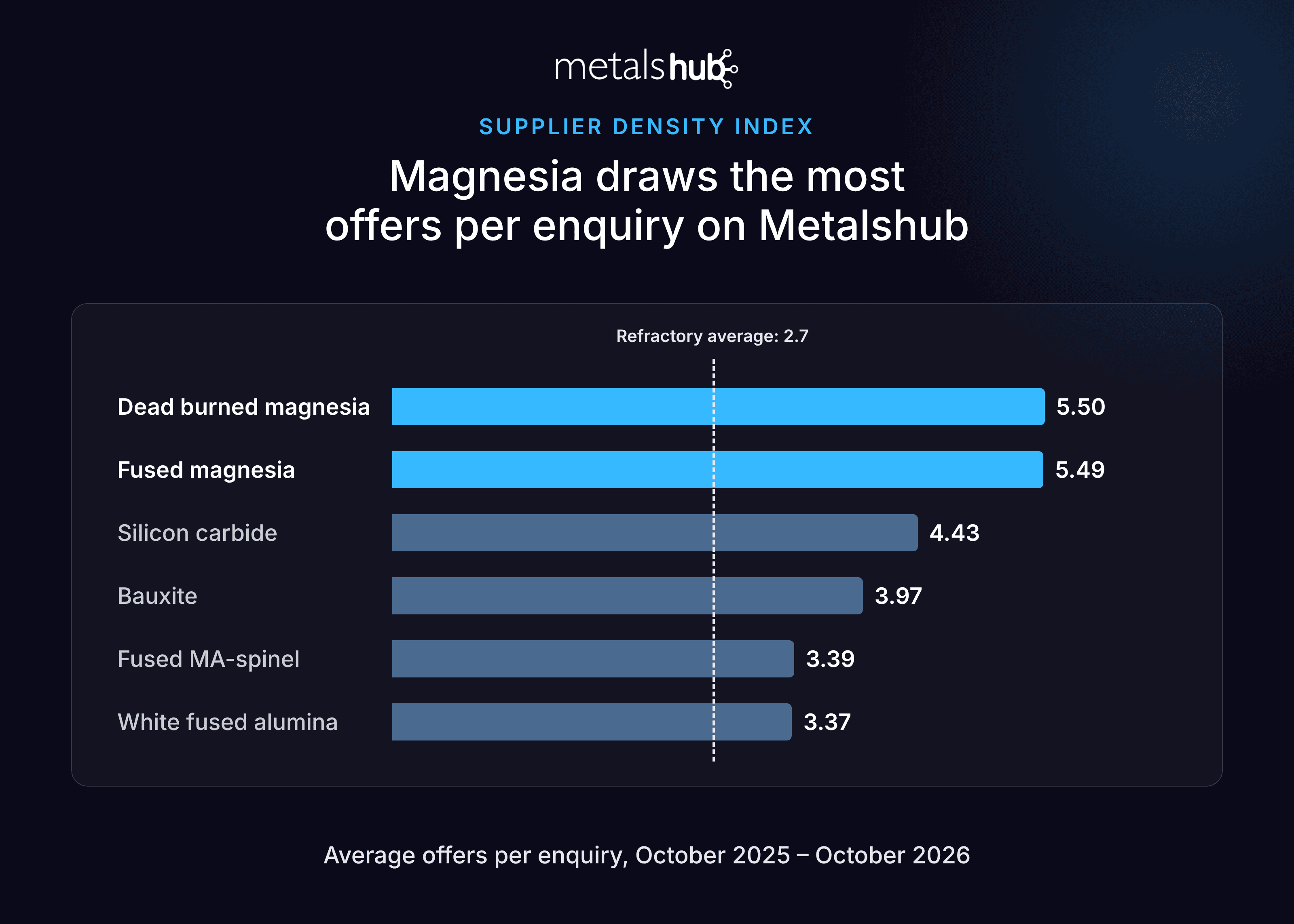
Average offers per enquiry, October 2025 – October 2026
With Metalshub’s Procurement Solution, a buyer sends one enquiry to suppliers from a vetted network of more than 3,000 companies, and new suppliers can offer on open enquiries. Offers are normalised and shown side by side, so comparing six offers takes the same effort as comparing two.
While supplier discovery in raw materials still relies largely on desk research, trade fairs and conferences, on Metalshub it happens within the enquiry itself. A buyer opens the enquiry to the registered suppliers for the grade and sees who responds, with every offer normalised side by side. If no new offer beats the current ones, the buyer stays with their existing suppliers, who also often sharpen their offers due to the digital nature of the tender. The buyer keeps every option and gains a view of the supply base they did not have before.
The supplier base is wide because suppliers find new buyers through it. Cofermin Group, a German distributor of raw materials and specialty chemicals for the refractory, foundry and construction industries, won around 30% of the offers it made in its first three months on Metalshub and gained a new customer in Latin America.
RHI Magnesita, the global leader in refractories, adopted Metalshub as its central raw material procurement platform in December 2023. Since then, teams across its entities have launched 3,800+ enquiries, concluded 2,800+ deals and uploaded 7,000+ product specifications on the platform. Procurement value executed on Metalshub has passed €400m.
This has resulted in a 2.0x ROI and a run-rate efficiency gain of more than 2% across core categories, with further upside expected as ERP integration and demand planning go live. Christian Viehweger, SVP Supply Chain & Procurement, IBP & Commercial at RHI Magnesita, describes Metalshub as “a single, transparent raw material procurement framework that scales with our growth.”
While few refractory producers buy at RHI Magnesita’s scale, the mechanism works the same way for a smaller producer: one enquiry open to the registered suppliers for the grade, with offers compared side by side.
To see how many registered suppliers there are for the materials you buy, book a demo.
The Supplier Density Index shows, for each refractory raw material, how many companies are registered to receive enquiries on Metalshub and how many offers buyers received per enquiry in the last 12 months. The counts include producers, processors and traders.
As of October 2026, 70+ suppliers were registered to receive tabular alumina enquiries on Metalshub, and buyers received 2.98 offers per enquiry on average in the previous 12 months.
Registered suppliers include producers, processors and traders such as Zhejiang Zili Advanced Materials, Elfusa, Imerys, Yingkou Liyuan and Fupeng International. The Supplier Density Index table above lists supplier examples for each material.
Dead burned magnesia and fused magnesia drew about 5.5 offers per enquiry in the last 12 months, the highest of any refractory raw material on Metalshub. Silicon carbide followed with 4.43, then bauxite with 3.97. The average across all refractory enquiries on the platform was 2.7.
Mining sits in a few countries. In 2025, five countries mined about 89% of the world’s bauxite, with Guinea alone mining about a third, and China mined about 60% of the world’s magnesite, according to the US Geological Survey.
Newsletter
insights