Battery Raw Materials
Open Trading
How Lithium Is Moving Up the Market Maturity Curve
 Written bySamir Jaber
Published on
Share Post
Battery Raw Materials
Open Trading
Written bySamir Jaber
Published on
Share Post
Fifteen years ago, lithium was a small speciality chemical sold under confidential contracts to glass, ceramics, batteries, and pharmaceutical producers. Today it is first and foremost a battery raw material with futures contracts, daily price assessments and a growing spot market. That shift has been uneven. A cargo of battery-grade lithium carbonate and a cargo of lithium hydroxide may sit at different points on the maturity curve, even when the same company sells both. Hydroxide carries the tightest qualification procedures in the market, and a seller has to be qualified by the buyer before any trade can take place. Battery-grade carbonate goes through the same process, though the requirements are usually less strict.
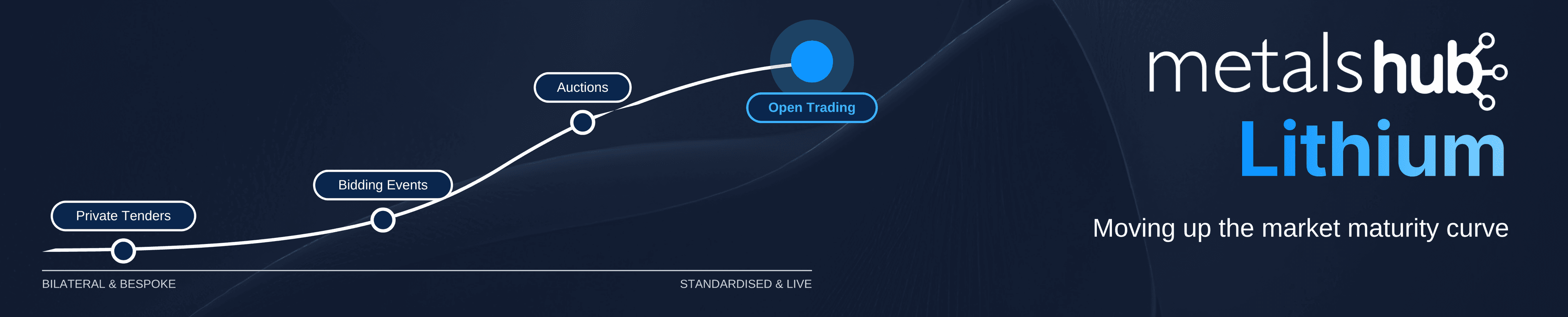
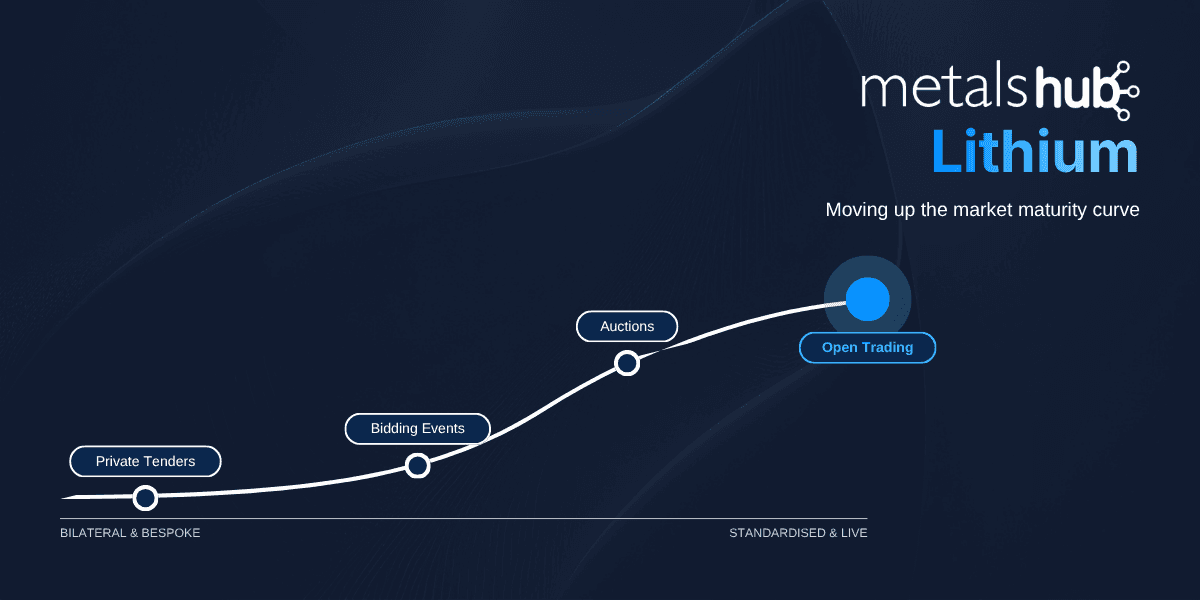
In our last article, we made the case that raw material markets do not share a single trading standard. Commodity maturity, defined by spec standardisation, number of counterparties and price visibility, decides which trading mode works best for a given material. Lithium is a good example of a market that is moving along that curve in real time.
This article maps lithium onto each trading mode that fits it, explains what is pushing the market forward, and sets out what it takes for lithium’s most standard grades to trade openly.
Demand is the obvious starting point. Market analysts forecast lithium demand to grow by 10.5% a year to 2036, driven by electric vehicles and, increasingly, energy storage. Global EV sales are projected to reach 23 million in 2026, or 28% of all car sales. The International Energy Agency expects lithium demand to rise fivefold by 2040 under today’s policy settings, and Albemarle has forecast global demand doubling from 1.8 million tonnes of lithium carbonate equivalent (LCE) in 2025 to 3.7 million tonnes by 2030. Energy storage is now the fastest-growing source of demand: global energy storage systems (ESS) shipments reached 649 GWh in 2025, up 107% year on year, and industry forecasts point to a ninefold rise in installations, to more than 2,900 GWh by 2036.
Market maturity depends on how that growth changes trading behaviour. In lithium, it has changed three things.
Supply concentration adds pressure from the other side. Australia, Chile and China account for around three-quarters of global mine production, so a single mine suspension or policy change can move spot prices within days. Buyers and sellers who can see and act on a live price are better placed to respond.
For most of its history, lithium moved almost entirely under long-term contracts (LTCs), priced through private bilateral negotiations. As a speciality chemical, lithium was worth something different in each application, so every price was negotiated to capture its value to that particular buyer, and prices could not be compared from one deal to the next. Once batteries became the dominant end use, prices became comparable enough to support a single reference price for battery-grade material, and buyers and sellers moved to index-linked LTCs.
Those indices are only as good as the spot trades behind them. When spot liquidity is thin, a handful of deals set the price for a far larger volume of contracted material, and a small shift in supply or demand causes a much larger swing in the spot price. That swing then flows straight into every contract linked to the index. A deeper spot market, with more trades between more counterparties on comparable specifications, makes the index steadier and gives LTCs a price both sides can trust.
Metalshub offers a trading mode for every stage of that shift. Each one adds spot liquidity at a different level of maturity, starting with the products that are hardest to standardise.
A cathode producer can spend months qualifying a new supplier’s material, and once approved, supply usually runs under a long-term offtake with volumes, pricing formula and specifications agreed bilaterally. Lithium hydroxide carries the strictest procedures in batteries, so sellers must be approved before they can offer material at all. Outside batteries, the pattern is stronger still: pharmaceutical-grade carbonate must meet pharmacopoeia standards and glass-ceramic producers specify low-iron grades, so each buyer prices the material by its value in that application. Speciality compounds such as lithium metal, butyllithium and lithium chloride work the same way, as do spodumene concentrates outside the SC6 specification.
In these cases, specs vary by buyer, and the pool of qualified counterparties is small and well known. Signalling intent to the wider market can move prices against you. Private Tenders keep the negotiation one-to-one or one-to-few, with full commercial control, and give buyers and sellers a digital record of every offer and decision. A seller can also run a Private Tender as a Bidding Event among a closed group of qualified buyers, to get competing bids without opening the lot to the whole market.

Lithium pricing has long been negotiated privately and bilaterally, and price opacity has been one of the industry’s most persistent complaints. Producers selling spot volumes want a fair market price, and the surest way to get one is to put the material in front of a wider pool of qualified bidders.
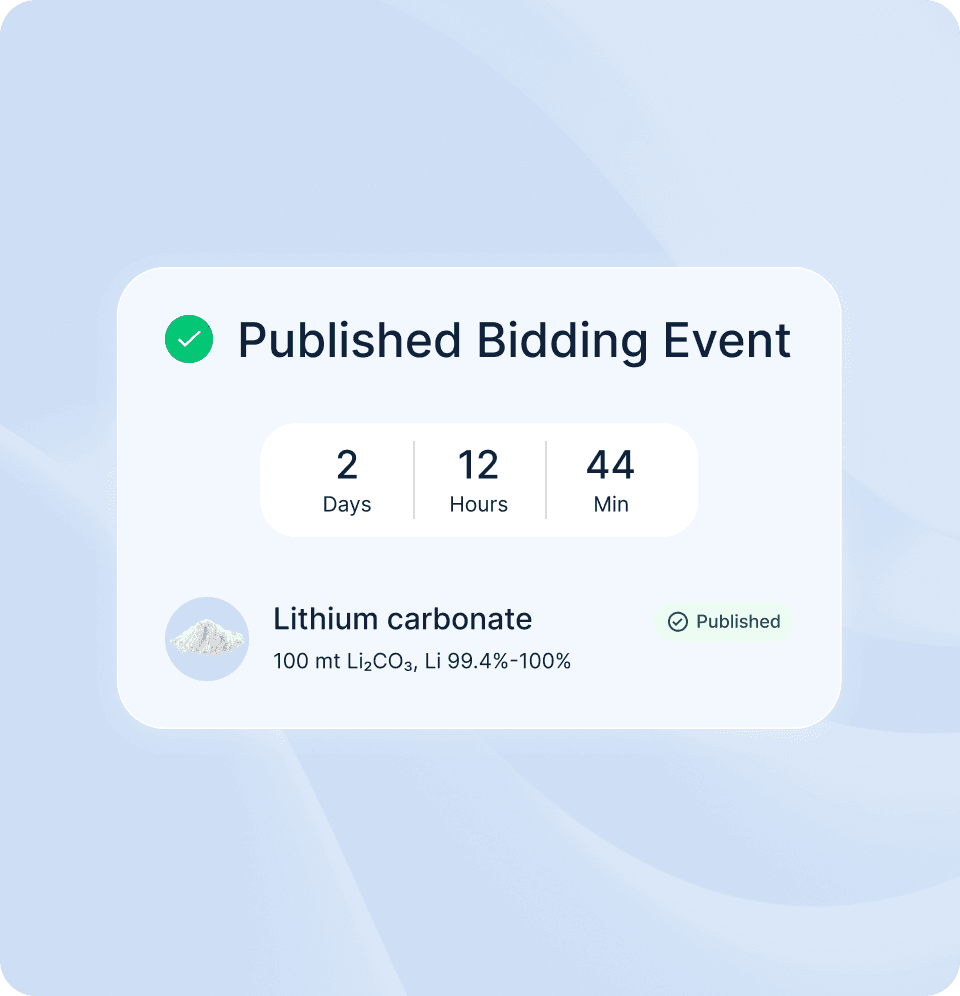
Public Tenders let a producer offer a lot to a broad group of buyers, with specifications and terms still set to fit the material. The outcome is a price formed by competition and a set of new counterparties the seller may never have reached through its existing network. Run as a Bidding Event, a Public Tender is one of the most effective price discovery tools in lithium today. Every event produces a price set by competing bids, on a known specification, at a known point in time. Several lithium producers already run Bidding Events on Metalshub for this reason.
Read how CBL runs its lithium sales on Metalshub.
Bidding Events work best when the terms attached to them are fair to both sides. Buyers participate less over time in events where the seller’s terms leave them no room to negotiate, and a thinner bidding pool produces a weaker price. Balanced terms are what keep a Bidding Event competitive.
Producer-run spodumene auctions, such as Pilbara Minerals’ Battery Material Exchange sales in 2021 and 2022, showed how much appetite exists for competitive bidding in lithium. Once the specification is fixed at SC6, bidders compete on price alone, and auction results quickly become reference points for the wider market. Metalshub runs public and private auctions on fixed specifications, giving sellers this competitive pressure without building their own platform.
Auctions need two things: a specification both sides accept and enough active counterparties to keep bidding competitive. Battery-grade carbonate and spodumene concentrate now meet both conditions for a growing share of spot volumes. Auctions also carry a risk for the seller. Because they concentrate demand into a single moment, they amplify whichever way the market is already moving. A strong result in a rising market pushes the reference price higher, while a weak one in a falling market can deepen the decline. Chosen at the right moment, an auction remains one of the quickest ways to find out where the market stands.

The most standardised lithium products are ready for live, continuous trading. Metalshub Open Trading, announced on 19 October, goes live for lithium in November. Participants post firm bids and offers for battery-grade lithium carbonate, technical-grade lithium carbonate and spodumene concentrate in US dollars per metric tonne, with standardised fields for grade, volume, Incoterm, delivery window and validity, and see every live order across the network.
Trust decides whether anonymous trading works in lithium. Buyers need to know material comes from a source they have already qualified, and sellers need to know the buyer can pay and take delivery. On Open Trading, each participant decides which companies it will trade with, and a trade can only complete when both sides have approved each other. Prices from companies a participant has not approved stay visible for reference but cannot be traded. Anonymity protects commercial positions without exposing either party to an unknown counterparty.
Every completed trade is a price agreed between two approved counterparties on a standard specification, which gives participants a clearer view of where the market stands.
Three conditions decide whether open trading in lithium produces real deals:
Metalshub Open Trading is built around these conditions, with defined validity on every order and two-way counterparty approval before any trade can be completed.
Long-term offtakes will remain the backbone of lithium supply, and spot trading will keep growing alongside them. In the same month, a producer might renew a contracted volume through a Private Tender, sell a spot lot through a Bidding Event and post spodumene concentrate on Open Trading. A cathode producer might do the reverse on the buy side.
That is why Metalshub builds every mode into one platform. Market participants want stable trading routines. Moving to a new platform every time a product changes trading mode costs time, splits their trading history and means onboarding the same partners again. On Metalshub, lithium producers, consumers and traders can move each product up the maturity curve at its own pace, with the same counterparty network, the same data and the same audit trail.
Metalshub Open Trading goes live for lithium in November 2026, with further raw materials to follow. Participants see every live bid and offer from day one. Beyond the platform, our intention is to make anonymised Open Trading prices available to everyone in the market over time, so that buyers and sellers can see where physical lithium trades, whether or not they are active on Metalshub. Read the announcement, and join Dr Frank Jackel on 12 November for MetalshubTalks 016, where he walks through how Open Trading works.
Open Trading - Lithium Market
Check out our Open Trading product page and get in touch with our team.
Newsletter
insights