Aluminium
Alumina Pricing: What It Would Take to Get It Right
 Written bySamir Jaber
Published on
Share Post

Aluminium
Written bySamir Jaber
Published on
Share Post
Platts plans to add a daily FOB Indonesia alumina assessment from November 2026. Every new price reference helps the market, and each one is only as good as the spot trades underneath it. This article sets out what a competitive alumina spot market would need.
Of the 55 to 60 million tonnes of third-party alumina traded each year, only around 10% is sold on the spot market, according to Hindalco. Global metallurgical alumina production reached 146 million tonnes in 2025. A small slice of spot cargoes sets the reference for contracts covering much of the rest.
Alumina pricing rests on that thin spot trade. Price indices are one part of the process, and they work with the data they are given. The missing part is a competitive spot market: regular, recorded sales where buyers bid against each other on comparable terms. That market would give producers, smelters and traders price discovery of their own, and give every index real trades to draw on.
Our earlier article explains why alumina benchmarks fall short, and our piece on aluminium price discovery covers the metal itself. This article looks at what it would take to price alumina properly.
Most alumina moves under long-term contracts priced off one or more indices. Price reporting agencies (PRAs) publish those indices, and each builds them from what the market reports.
Fastmarkets asks contributors to submit all their concluded transactions, weights trades by volume, and uses expert judgement to exclude numbers it sees as unrepresentative. Platts assesses firm, named bids and offers in a daily Market on Close process. CRU’s index counts concluded deals only.
With so few spot cargoes, the indices rely largely on surveys of market participants and on the reporter’s judgement, supported by whatever bid, offer and deal data exists. Neither Fastmarkets nor CRU sets a minimum amount of transaction data. When no trade is confirmed, Fastmarkets carries the last confirmed trade forward through a set of fallback steps, and CRU rolls the previous week’s price over.
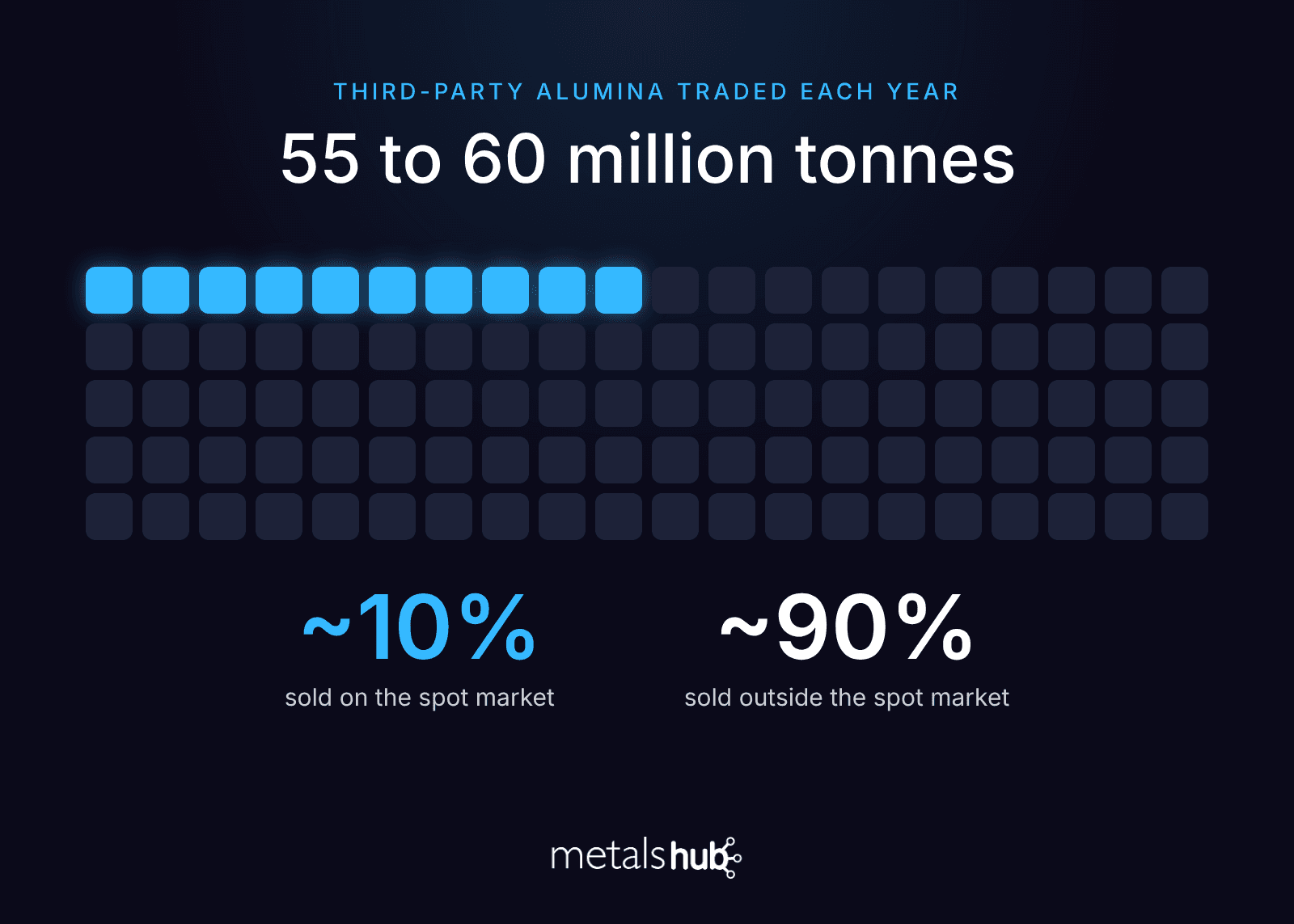
Only about a tenth of third-party alumina is sold on the spot market. Source: Hindalco, September 2026
New references keep arriving. In September 2026, Platts proposed a daily FOB Indonesia alumina assessment from 2 November 2026, giving the market another regional price point.
Exchanges have tried too. CME listed two cash-settled alumina futures in September 2016, and the LME launched its contract in March 2019. Today, the LME contract settles on the monthly average of the Platts FOB Australia assessment.
Both contracts settle against an index, so they draw on the same small pool of spot cargoes as any new assessment. They give the market useful reference points, and they grow more useful as more spot trades sit underneath them.
A price agency can only report the alumina price that the spot market makes.
A working spot market would give the indices more to report and give producers and buyers a price they set between them. It needs five things.
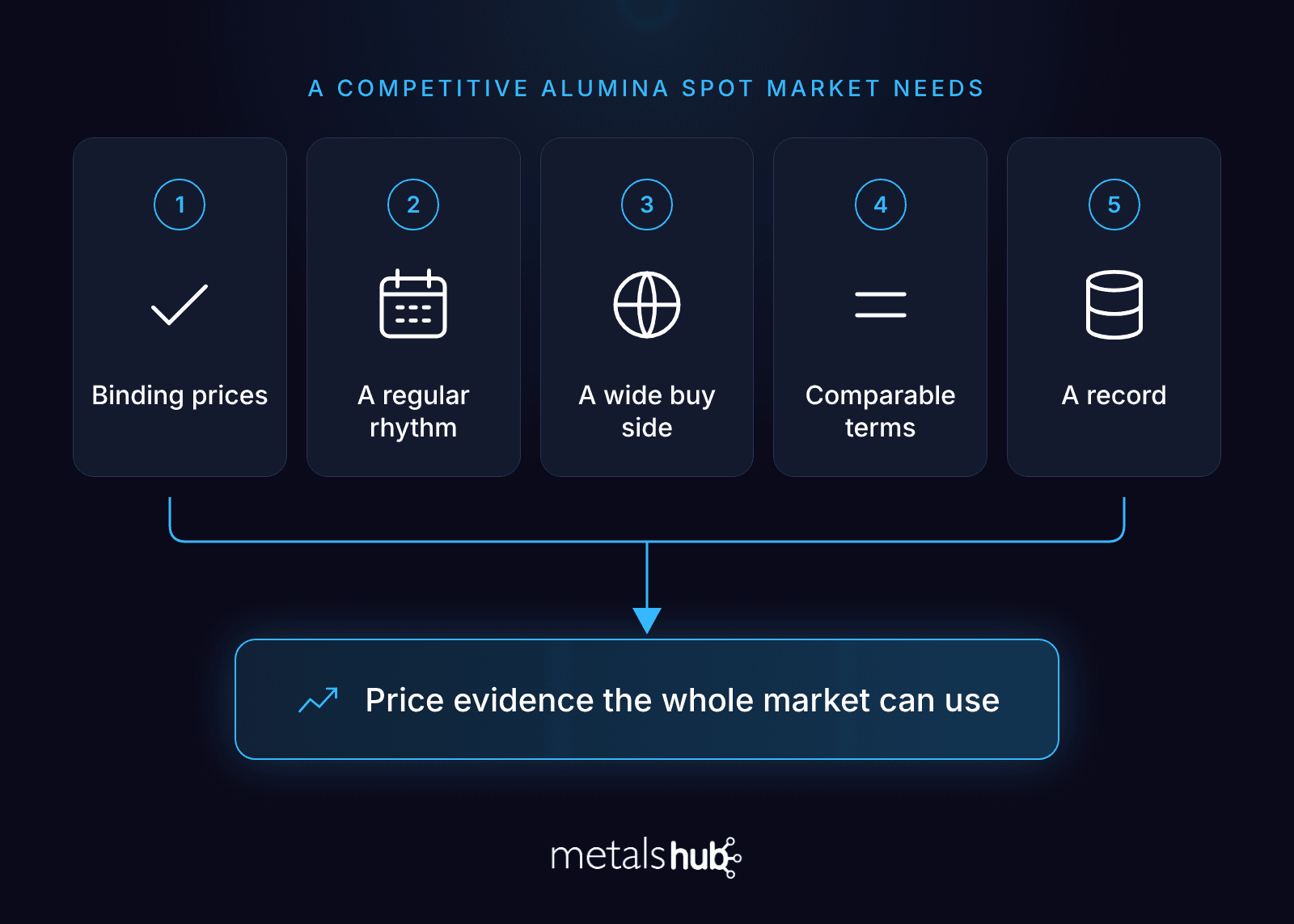
What a competitive alumina spot market needs
Producers already run something close to this by phone. One producer described its process as calling customers, asking what they will pay, then giving everyone the same price. That is a price discovery round with no record. Run as a tender, the same round leaves a record of every bid.
A common objection is that a handful of sellers leaves nothing to discover. Seller concentration is the reason the index is thin. Few cargoes reach the spot market, so each one carries a lot of weight in the price.
The competition sits on the buy side. When a producer puts a cargo to tender, smelters and traders compete for it, and the result is price evidence that does not exist today.
Spodumene shows how this works in another concentrated market. In May 2024, Fastmarkets noted that “many producers are now holding auctions for cargoes of spodumene” to improve price transparency. Pilbara Minerals’ first auction on its Battery Material Exchange, in July 2021, sold 10,000 tonnes at $1,250/dmt FOB Port Hedland, with 17 bidders placing 62 bids between $700 and $1,250/dmt. Its second auction, in September 2021, cleared 79% higher. One price reporting agency has said that auction deals, once normalised, “can help form the basis” of its spodumene assessment.
In September 2026, Hindalco Industries and Metalshub announced a partnership under which Hindalco will sell metallurgical-grade alumina from Utkal Alumina by digital tender, replacing its existing sales process for these spot sales. The first tender is expected between October and December 2026. Registered participants receive the date, quantity and specifications in advance.
“By implementing digital tenders for certain spot sales, we aim to broaden market participation, strengthen competitive price discovery and bring greater efficiency and transparency to the alumina market.”

Hugo Brodie, Head of Sustainability and Physical Market Development at the LME, said in the same release that “independent, transaction-led price references will bring greater pricing transparency.”
Each tender is planned to add recorded, competitive bids to a market that has very few. The background to the partnership was discussed in MetalshubTalks 013 on price discovery in alumina and aluminium. Read the webinar recap or watch the full episode below.
MetalshubTalks 013
Watch the full episode for an in-depth discussion on alumina price discovery
Metalshub is a digital platform for physical raw material sales and procurement, with over 3,000 companies active. For producers, the Sales Solution runs bidding events: the seller sets the material, volume, delivery terms and timing, invites qualified buyers and receives binding bids side by side. Each event leaves a record of every bid. In a private event, the producer decides who is invited.
Sellers report 100% satisfaction with price discovery bidding events on Metalshub. The smelter-grade alumina buyer network is being built ahead of Hindalco’s first tender. See how price discovery on Metalshub works for raw materials such as alumina.
Most alumina is sold under long-term contracts priced off indices from price reporting agencies such as Fastmarkets, Platts and CRU. Only around 10% of the 55 to 60 million tonnes of third-party alumina traded each year is sold spot, so the indices draw on a small number of deals, bids and offers, supported by market surveys and judgement.
CME listed alumina futures in 2016 and the LME launched a contract in 2019. Both are cash-settled against PRA assessments, so they grow more useful as more spot trades feed those assessments.
A new index adds a reference point, such as the FOB Indonesia assessment Platts plans from November 2026. It still depends on spot trades. When there are no new deals, indices such as CRU’s carry the previous price over.
A tender puts a cargo in front of competing buyers and records every bid. In spodumene, producer auctions gave the market new price points, and one price reporting agency has said normalised auction deals can help form the basis of its assessment.
Hindalco plans to sell metallurgical-grade alumina from Utkal Alumina by digital tender on Metalshub. The first tender is expected between October and December 2026, with details sent to registered participants in advance.
Newsletter
insights