AI
MetalshubTalks
Iron & Steel
Industrial Minerals
Battery Raw Materials
Deep Platforms for Physical Materials Markets | MetalshubTalks 014 Recap
 Written bySamir Jaber
Published on
Share Post
AI
MetalshubTalks
Iron & Steel
Industrial Minerals
Battery Raw Materials
Written bySamir Jaber
Published on
Share Post
What do digital platforms actually do for physical materials markets? Anyone who buys or sells raw materials knows the friction: finding the right counterparty, seeing the price, proving quality and compliance, and keeping records that hold up in an audit.
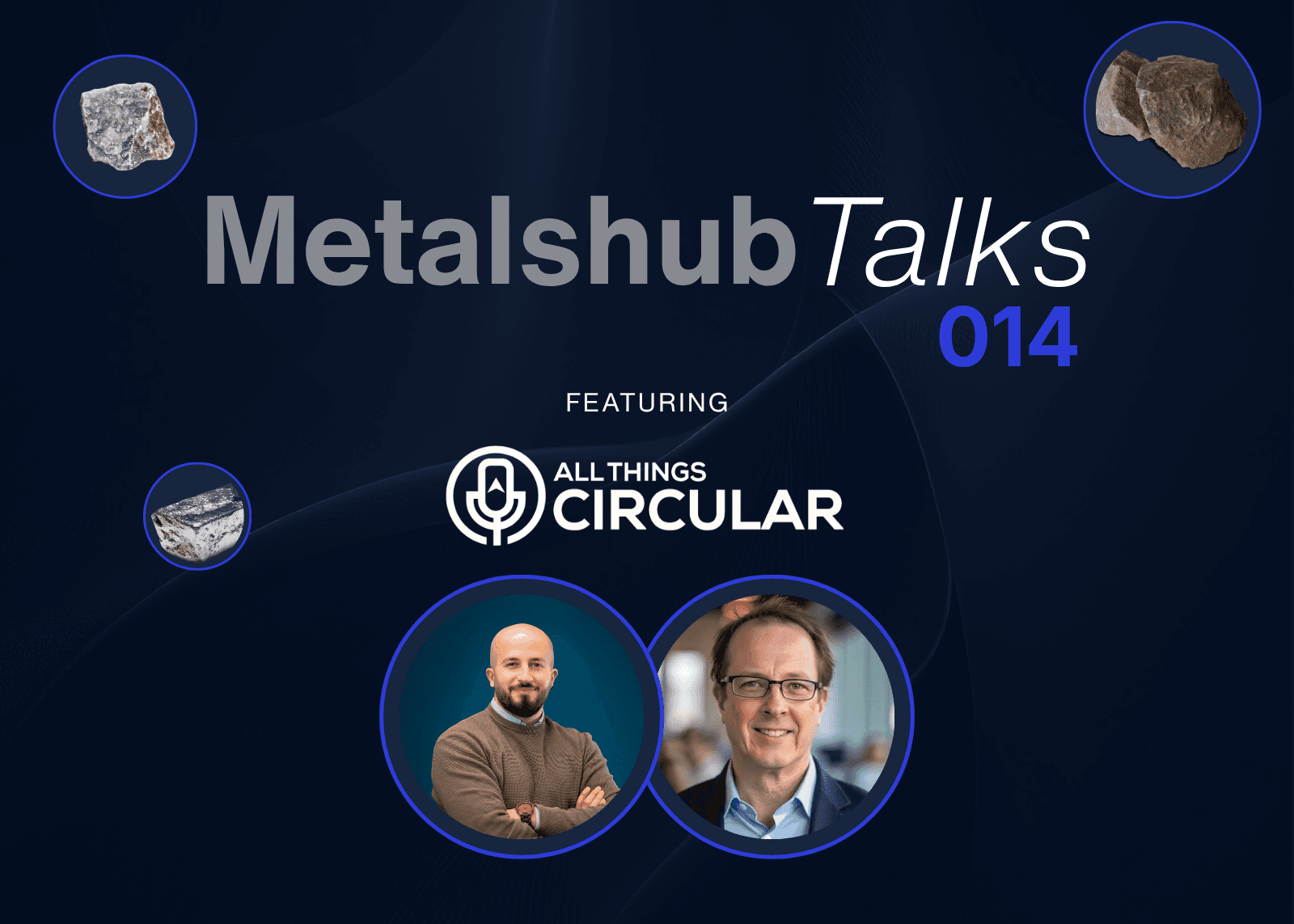
In a recent episode of MetalshubTalks, I put that question to Dr Peter C. Evans, Managing Partner at All Things Circular and Chief Economist at the Global Reverse Logistics Alliance, who tracks more than 400 circular marketplaces across 16 sectors. We looked at what separates deep platforms from shallow ones, how platform strategy works in practice, and what it means for metals, mining and recycling.
Dr Peter C. Evans: Much of our work is teaching. We have run around 21 masterclasses in nine countries because supply chain education focuses on making a new product and selling it to the first customer. Taking a product back, grading it and processing it is a different world.
Platforms have been tremendously successful in the linear economy. Alibaba and Amazon built fulfilment systems that get products to customers within hours, and I wanted to know whether platforms could do the same for the circular economy. Materials are harder than retail. They do not come in neat packages with a price and a SKU attached, which is one reason I am interested in Metalshub. About four years ago, I started building a global database, and I now track more than 400 circular marketplaces.
Dr Peter C. Evans: A platform is an intermediary in a double-sided market, with buyers on one side and sellers on the other. It neither produces nor consumes anything. It makes money from transactions and services, so it has a strong incentive to improve the information that lets buyers and sellers complete a deal. That goes back to Ronald Coase: in reality, everyone works with incomplete information.
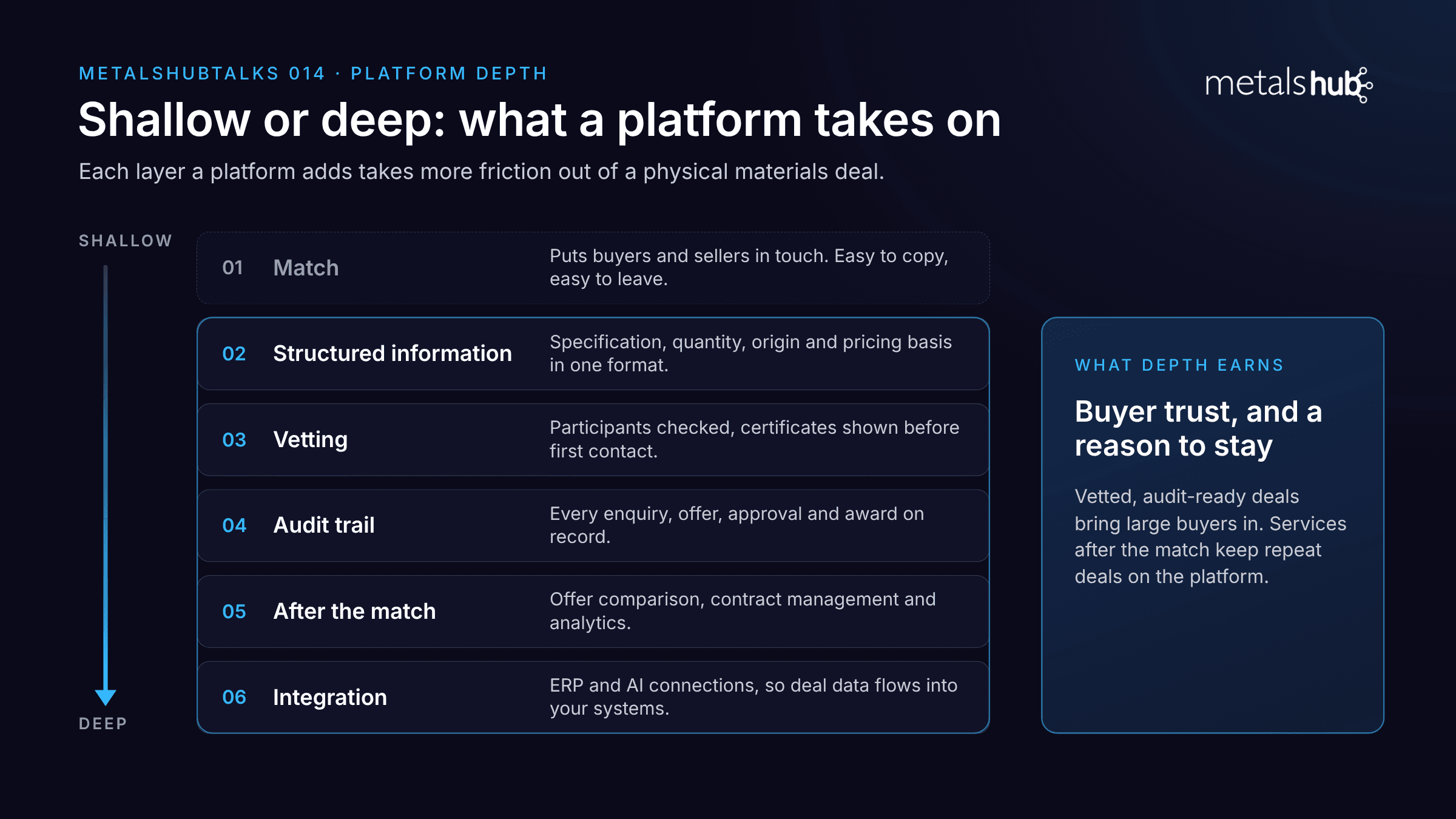
In materials, products are often not as described. Is it sold by weight or by volume? Did it come from a compliant mine or from a grey market? Platforms like Metalshub have had to structure that information so the buyer knows what is available, in what quantity and from where. Some people think platforms don’t do very much. Actually, they do a tremendous amount to make those transactions happen and reduce that friction.
Dr Peter C. Evans: There is no single type of platform. When I mapped the electronics marketplaces, I ended up with nine types, from shallow platforms that only match, like Facebook Marketplace, to deep platforms that provide a whole array of services.
One of the most consequential things a platform must do is remain neutral. We have seen incumbents with a large market position try to build their own platform. Many parties did not trust those platforms because the owner was a market participant too, and they worried it would use the information to price its own product. A broker represents one side. A platform adds value as a neutral party that helps the transaction happen.
Dr Peter C. Evans: Take the used car market, for example. In the 1970s, buying a used car was so risky that the state had to step in with lemon laws. Today, digital platforms make sure the seller documents the vehicle and reveals its maintenance history. The platform becomes a governance mechanism. If a seller does not comply, the platform can remove them, and the same goes for buyers who do not pay. There have to be consequences for bad actors. That trust is built over years, which is one of the hardest parts of launching a new platform.
Samir Jaber: That is very close to what we see in raw materials. Metalshub is industry-specific by design, so an enquiry or a bidding event carries what matters for raw materials: index pricing, specifications, delivery times and so on. Vetting starts before any conversation between participants. More than 3,000 companies are active in our pre-vetted network, and their profiles show certificates and compliance documents up front. Every enquiry, offer, approval and award is recorded, so both sides stay audit-ready.
We have seen the value of that in our own growth. Since the first deal on Metalshub in late 2017, annual GMV has grown almost a hundredfold, and total GMV on the platform is now close to €13 billion.
For more on how Metalshub keeps raw material deals compliant and audit-ready, see our risk and compliance and marketplace pages.
Dr Peter C. Evans: An example of a fragmented market is IT asset disposition companies, or ITADs. They process millions of retired phones, laptops and other devices. Some are refurbished and resold. Others reach end of life, and they contain aluminium, rare earths, gold and silver. Right now, ITADs sell that material through bilateral deals with a small network of regular buyers. A platform like Metalshub could connect them with buyers they may not even know exist.
Samir Jaber: Interesting. We see that in similar markets on Metalshub. Earlier this year, we launched a platform for recycled battery raw materials on Metalshub, targeting primarily black mass trading. Market participants have already started using it, and the main reason they give is price transparency. A bilateral deal gives you no clarity on whether the price you got is a good one.
Dr Peter C. Evans: Exactly! What we are really talking about here is liquidity. When I go to sell, will there be buyers on the other side? When I go to buy, will I find the supply? That matters a great deal for production. Europe has set, or is considering, targets for manufacturers to use a share of recycled material, and they will have to prove it. And if I need to make 10,000 units of something, I need to be sure there is enough supply.
Samir Jaber: That is one of the main goals of Metalshub in markets like these. We recently partnered with Hindalco Industries in alumina for exactly that purpose, which we covered in our last episode on alumina price discovery. The focus is on more liquidity and better price transparency.
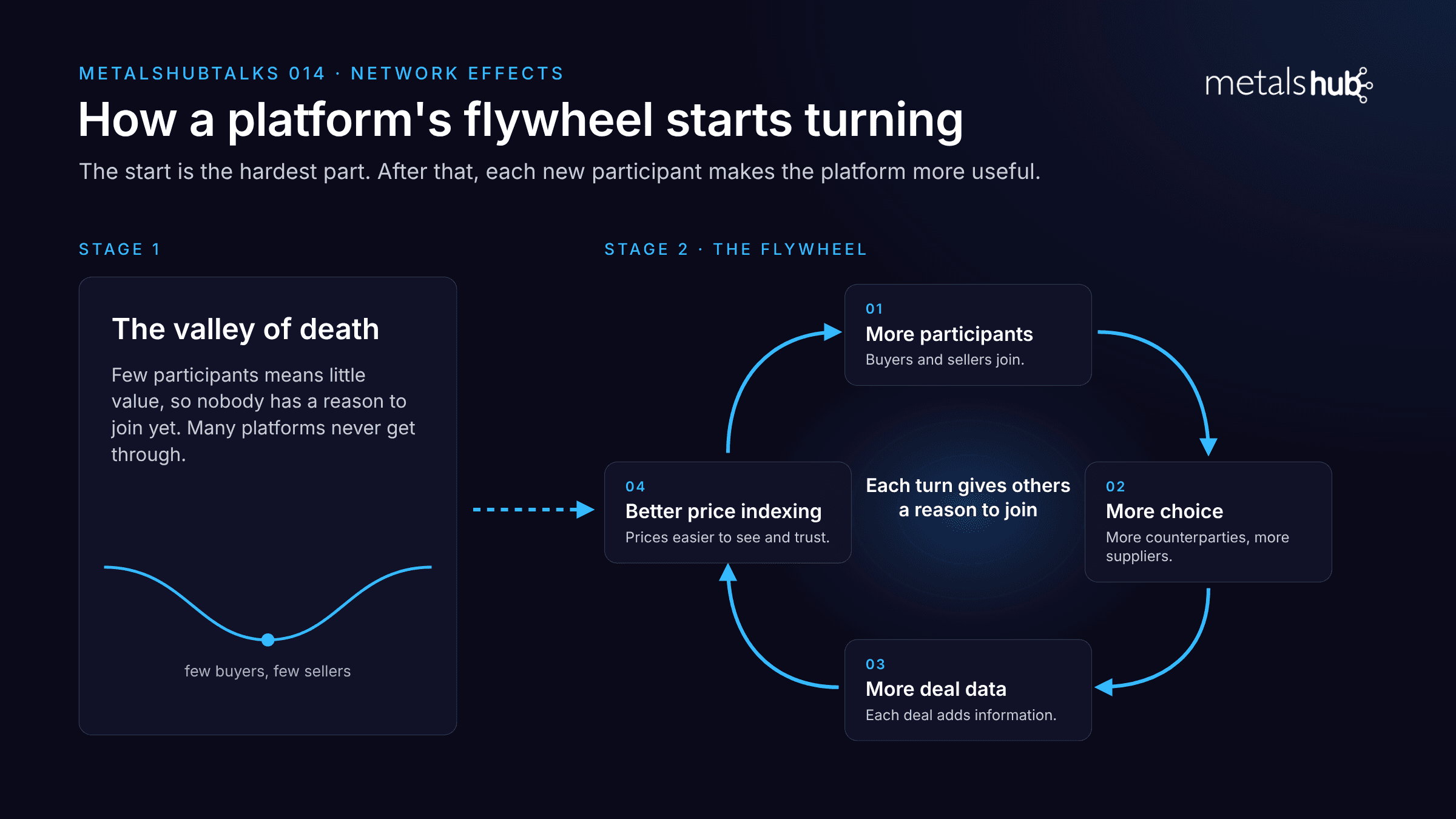
Dr Peter C. Evans: Network effects are about scale, and the hard part is the start, when there are very few participants. Some people call it the valley of death. Once you get through it, the flywheel kicks in. Sellers have more counterparties, buyers see more suppliers, and more information is collected, so price indexing gets better and better. Each of these gives others a reason to join.
The next frontier is critical minerals, where we still do not see platforms. They do not behave like commodities, and with so much interest in reducing dependence on China, the question is whether a platform can solve the problems of how those markets operate.
Matching a buyer with a seller is only the start. The platforms that last in physical markets take on the hard parts of the deal: structuring the information, vetting who takes part, keeping the audit trail and staying useful long after the first introduction. As Peter put it, materials do not come in neat packages, which is why industry-specific platforms have a job to do in metals, mining and recycling.
For buyers and sellers of raw materials, three things are worth acting on now:
MetalshubTalks 014
Interested in watching the full episode? Click below and watch it for free.
Newsletter