Iron & Steel
Aluminium
Copper
Industrial Minerals
Battery Raw Materials
How Can Raw Material Sales Teams Use Enquiry, Offer And Deal Data To Improve Commercial Outcomes?
 Written bySamir Jaber
Published on
Share Post
Iron & Steel
Aluminium
Copper
Industrial Minerals
Battery Raw Materials
Written bySamir Jaber
Published on
Share Post
The best predictor of the future is the past. While this is not always true in the cyclical world of metals and mining, the statement still holds value. Historical enquiry, offer, and transaction data can reveal patterns in customer behaviour, pricing performance, and market dynamics that help sales teams make better commercial decisions.
For sales organisations in raw materials, the most straightforward measure of commercial success is netback. Netback is calculated by taking the price achieved for a unit of material and deducting all associated costs, including transportation, financing, hedging, and, where relevant, treatment or repacking costs.
In industries where production output is often fixed, improving commercial outcomes is less about selling more volume and more about allocating material to the highest netback opportunities. Achieving this requires structured, reliable data across the entire sales process. Let’s take a closer look at how enquiry, offer, and deal data can support this.
Mining companies and raw material producers receive a constant flow of sales enquiries. A call from a US alloy producer, an email from a European steel mill, a WhatsApp from an Indian foundry, or a WeChat message from a Chinese trader. Keeping track of these enquiries across channels is challenging and often relies on individual inboxes or spreadsheets.
With Metalshub, this process becomes more structured. The Sales Solution allows sellers to capture all incoming enquiries in one place, regardless of whether they originate on Metalshub or via external channels. Coupled with our AI Text-to-Platform feature, capturing these enquiries in one system has never been easier.
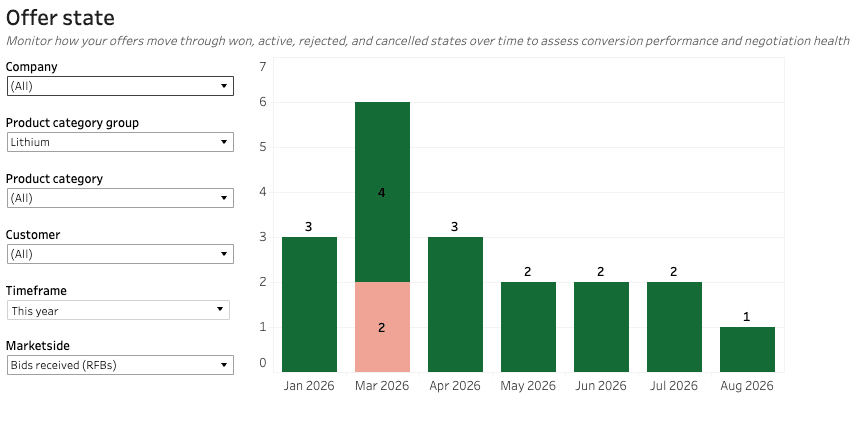
Beyond creating a more audit-proof sales process, digitised enquiries provide a rich dataset for meaningful sales analysis. Visualising incoming enquiries across products, customers, and regions enables sales managers to identify patterns, shifts in demand, and early signals of market changes.
Capturing enquiries is only the first step. To improve netbacks, sales teams also need visibility into how enquiries convert into offers and, ultimately, into deals.
Analysing enquiry-to-offer-to-deal ratios provides valuable insight into sales execution. It highlights how often enquiries are not pursued, where offers fail to convert, and which customers or products consistently underperform.
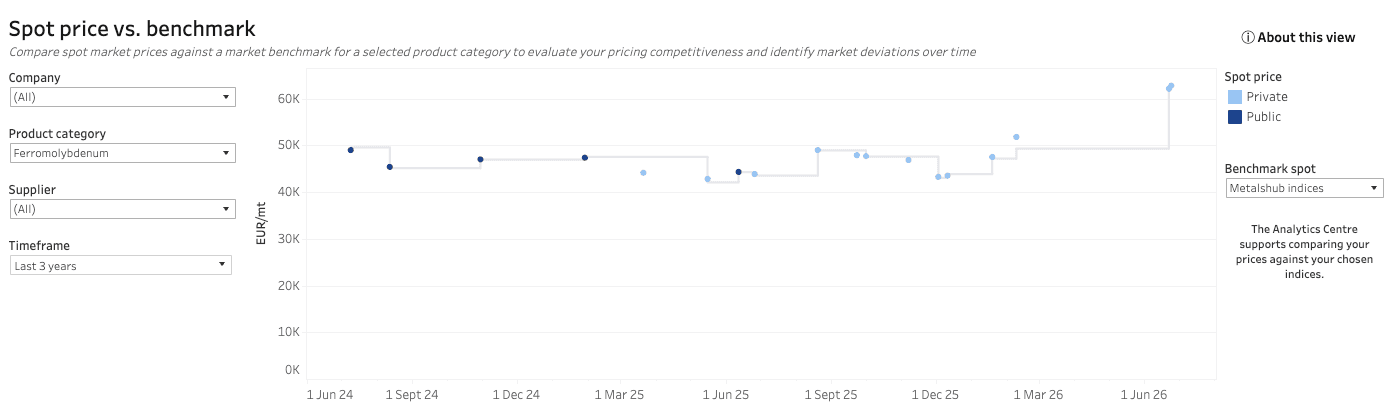
Moreover, the data will enable sales teams to measure their performance against a market reference price to better understand the value creation of the sales team.
For example, if the offer-to-win ratio for a specific account is significantly higher than the category average, it may indicate overly aggressive pricing. Conversely, low conversion rates may signal misaligned pricing, unsuitable payment terms, or changing customer preferences.
When enriched with market reference prices, this data allows sales teams to benchmark their performance against the market and assess whether value is being created through pricing decisions rather than eroded.
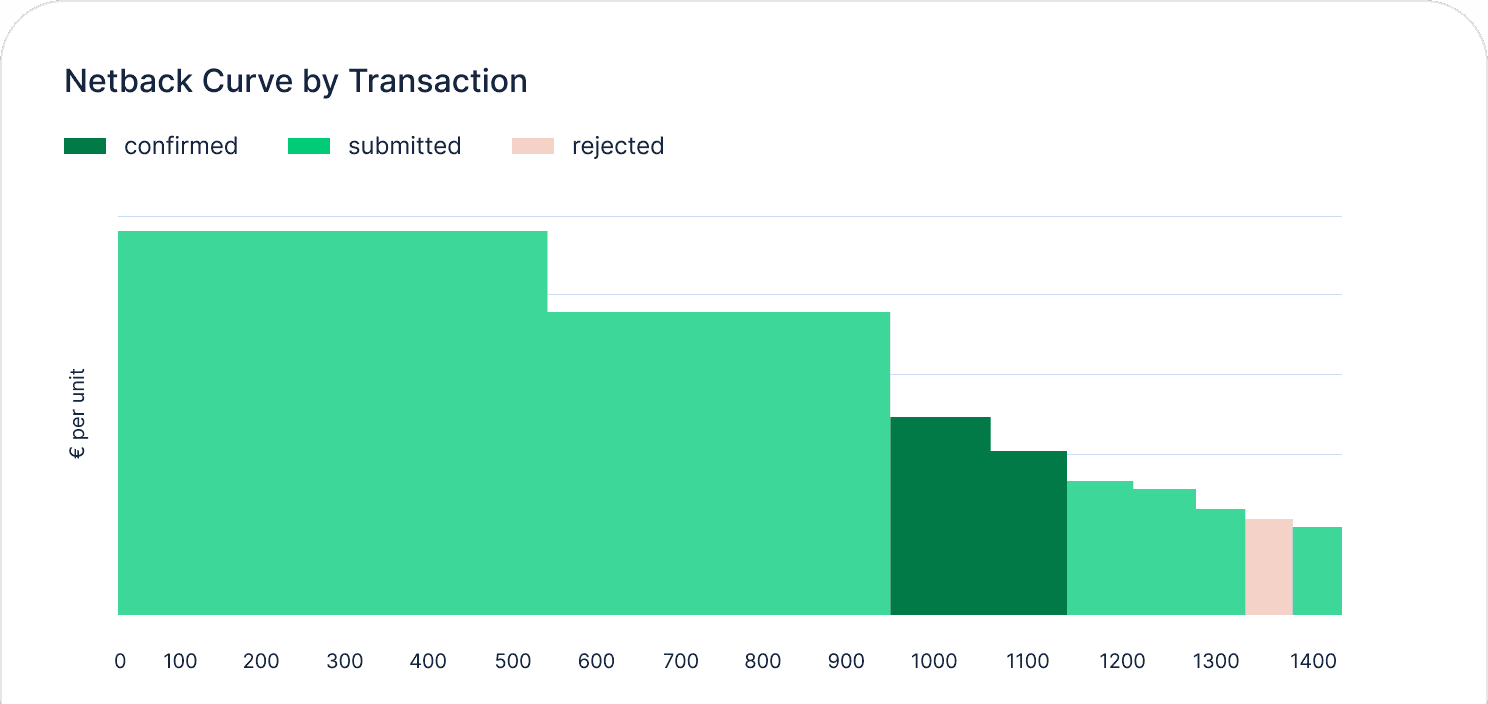
Price alone does not determine commercial success. When enquiry, offer, and deal data are combined with cost information, sales teams can build netback curves that reveal the true profitability profile of their sales book.
This analysis helps identify which customers, regions, or sales channels consistently deliver higher netbacks and which transactions underperform once costs are taken into account. Comparing netback per unit against market reference prices further sharpens this view, allowing sales managers to assess performance not just in absolute terms, but relative to prevailing market conditions.
Not only does structured sales data support individual account managers, but it also supports the entire sales team. It provides sales leaders with a comprehensive view of ongoing activity and performance across the organisation.
With full visibility across enquiries, offers, transactions, and performance metrics, leadership teams can better prioritise resources, identify risks early, and align sales execution with broader commercial objectives.
Capturing and visualising sales data is essential, but the real value lies in consistently translating this data into decisions that improve margins and execution quality.
This is where the Analytics Centre builds on the foundations of the Sales Solution. By consolidating all structured sales data into purpose-built analytics dashboards, sales teams gain full visibility across offers, deals, customers, prices, and costs in one place.
Beyond basic activity tracking, the Analytics Centre enables sales managers to analyse conversion rates, compare realised prices against benchmarks, and evaluate payment terms and customer behaviour over time. When cost components such as freight, financing, insurance, or treatment charges are included, the data support true deal-level netback analysis, making profitability transparent across the sales book. Directly accessible in Metalshub or via MCP in the user’s preferred AI chatbot.
By anchoring decisions in transaction-based market intelligence rather than static spreadsheets or isolated reports, sales teams can identify what drives profitable deals, refine offer strategies, and align execution more closely with market conditions. The result is not simply better reporting, but stronger commercial outcomes through clearer margins, improved pricing discipline, and more consistent sales performance.
With full visibility of sales activities, from enquiries to offers to transactions and profitability metrics, organisations can unlock significant business value. While it is possible to build this level of insight manually, doing so is extremely time-consuming and highly error-prone.
Industry-specific digital solutions, like the Metalshub Sales Solution, enable Sales teams to minimise administrative effort, ensure data integrity, and focus on what matters most: allocating material to the highest-value opportunities and executing deals with confidence in an increasingly competitive market.
Newsletter