Aluminium
Copper
Industrial Minerals
Battery Raw Materials
Iron & Steel
Beyond the Benchmark: Can Raw Material Teams Actually Beat the Market Index?
 Written bySamir Jaber
Published on
Share Post

Aluminium
Copper
Industrial Minerals
Battery Raw Materials
Iron & Steel
Written bySamir Jaber
Published on
Share Post
Historically, corporate leaders in the metals, mining, and manufacturing sectors have treated market indices as an absolute boundary. Executive teams frequently judge performance by how closely their teams track and match these references. This passive approach can represent a missed financial opportunity.
Metalshub experts conducted a comprehensive analysis of physical transactions conducted between 2021 and 2026. The data reveals that commodity buyers and sellers can consistently outperform broader market benchmarks. This outperformance is heavily driven by transaction structure. By moving away from traditional, ad-hoc negotiations and adopting structured digital workflows, companies unlock what we call Digital Alpha.
Digital Alpha is the measurable performance advantage achieved when transactions are executed through digital platforms.
The global raw materials landscape in 2026 requires a significantly higher level of commercial agility than in previous decades. Volatile energy markets, geopolitical fragmentation, supply concentration, and changing industrial demand patterns continue to reshape transaction dynamics across metals and mining supply chains. Under these conditions, procurement teams are placing greater emphasis on supplier access, competitive pricing, speed of execution, and market visibility. Similarly, sales teams require broader buyer access, reliable price discovery, and a clearer view of real market demand.
Benchmark price indices remain an essential component of this environment. They provide critical market orientation and support pricing transparency across global supply chains. Teams rely on these benchmarks to monitor pricing trends, structure contracts, and evaluate performance over time. Meanwhile, the growing shift to digitalisation introduces an additional dimension to commercial execution.
To understand why digital transactions consistently outperform market benchmarks, one must look at the behavioural shifts that occur during a digital event. This shift is often driven by what economists call the eBay effect.
In traditional procurement and sales, transactions are handled via bilateral emails, phone calls, and spreadsheet exchanges. These legacy processes give counterparties a sense of insulation. Suppliers often assume they understand their position based on historical relationships, which breeds static, non-competitive bidding behaviour.
When a transaction moves onto a digital platform, the structure alters counterparty behaviour. Participants enter a clearly defined, competitive setting. They understand that the process is organised, fully comparable, fair, and time-bound.
Even when a buyer invites only their existing, long-term suppliers to a Request for Offer (RfO) event, the format strips away complacency. Suppliers recognise that every line item, incoterm, and quality premium will be evaluated side by side with automated precision. They know their offer must stand on its own immediate competitiveness because the digital window closes at a specific minute. This awareness forces stronger pricing approaches that bilateral negotiations rarely extract.

Across various raw material categories, including ferroalloys, ferrous scrap, battery raw materials, and recycling materials, the multi-year data analysis identifies a clear pattern: when buyers and sellers run transactions through competitive digital tenders, they improve their ability to capture the best available market outcome and can achieve digital alpha.
In some bulk ferroalloys, for example, buyers achieved a total average outperformance of 1.84% below the market index over the multi-year study period. The structural advantage was most pronounced during the severe market disruption of 2021, when the digital platform allowed procurement teams to extract a substantial 7.9% discount against the reference index.
A similar pattern of outperformance emerged in another bulk ferroalloys category, yielding a total average improvement of 1.09% against the index. This category achieved its maximum impact during the supply-constrained environment of 2021, where structured digital events delivered a significant 5.6% market-beating discount.
Even in highly specialised alloy markets where physical liquidity is traditionally thin and pricing remains relatively opaque, platform transactions yielded a net positive performance. Across the multi-year horizon, transactions maintained a net positive delta, highlighted by a 1.8% discount below the index secured in 2022 when structured transparency forced competitive tension in an otherwise illiquid market.
This aggregate performance proves that structured digital execution does not merely track the market average, but it also actively reshapes the pricing outcome.
For procurement organisations, Digital Alpha manifests as a systematic reduction in total cost of ownership relative to the market index. This is achieved by expanding supplier access, enforcing pricing transparency, and utilising standardised workflows that allow rapid transaction cycles.
Key Procurement Levers:
The practical impact of these levers is evident across diverse procurement contexts. A prominent metal foundry, for instance, shifted its core metal alloy procurement onto the digital platform. Previously, their sourcing was constrained by traditional ways of outreach, limiting market coverage. By digitalising its RfO events, the foundry expanded its active supplier base by 240%. This massive influx of liquidity and competition directly translated into a 4.3% purchasing performance improvement relative to the market index. For the business, this structured discipline delivered a clear fourfold return on investment.
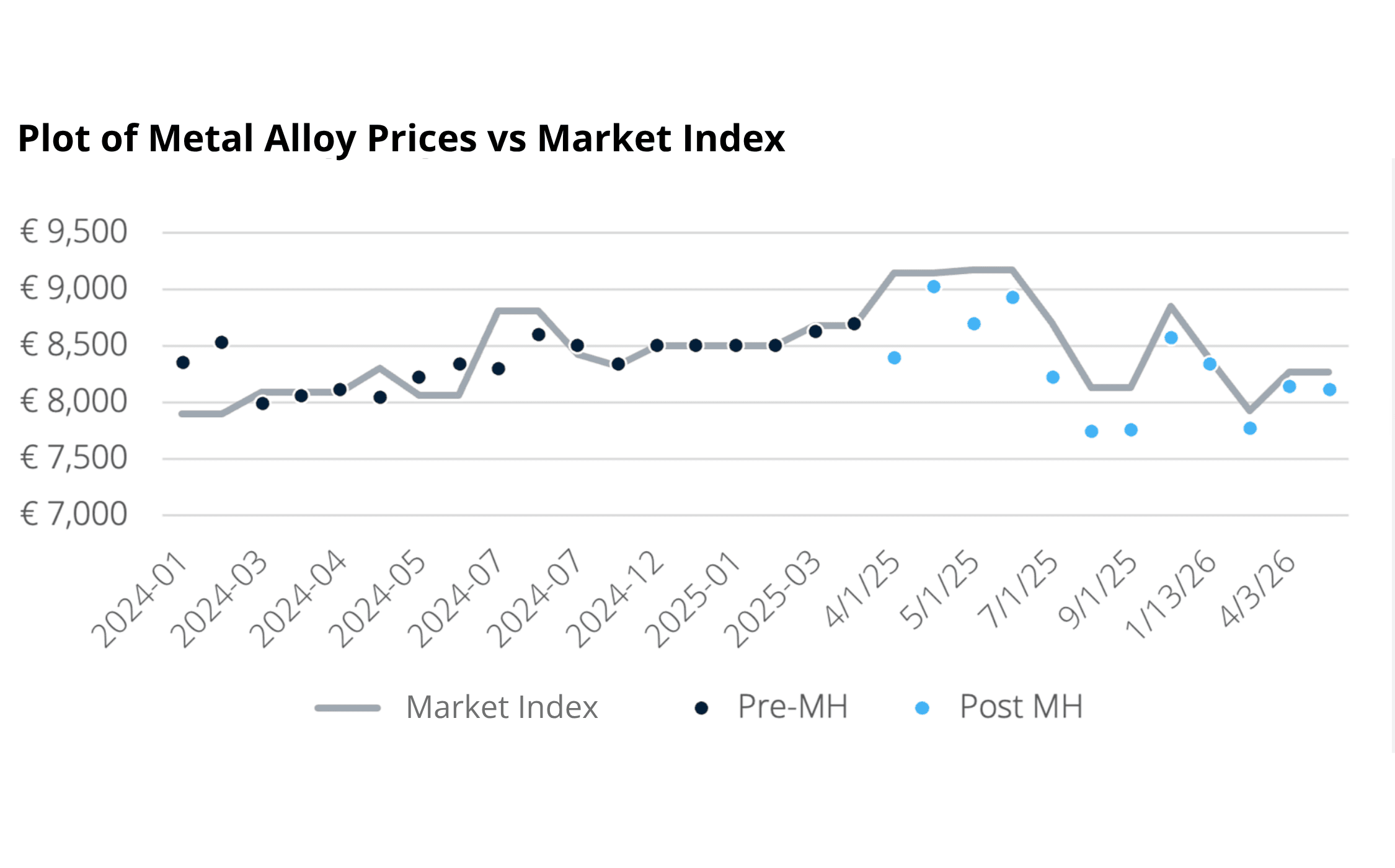
Metal alloy procurement performance versus market index after moving sourcing activity onto Metalshub (MH)
The impact is equally significant in highly fragmented raw material categories such as the scrap metal market. Another specialised foundry customer historically handled scrap procurement via traditional, offline relationships. Under that manual approach, its purchasing costs averaged 23.5% above the relevant market index due to hidden premiums and a lack of structured comparison.
After migrating its entire sourcing activity onto structured digital tenders, the company improved its purchasing performance by over 6 percentage points to reach 17.2% above the index—a clear example of achieving Digital Alpha as a result of conducting procurement via a digital platform. Beyond these direct financial savings, the structured digital workflow accelerated supplier onboarding, eliminated manual errors, and established an auditable process history that made compliance audits faster to execute while lowering key person risk.
The commercial logic of Digital Alpha operates with equal force on the commercial sales side. For producers, recyclers, and traders, digital auctions and bidding events replace passive price taking with active price discovery.
Instead of accepting passive index discounts, sales teams can leverage structured bidding events to discover where premium values exist for specific qualities, origins, or delivery windows.
In the battery materials sector, where pricing transparency is notoriously difficult to establish due to rapid market shifts, this approach has yielded immediate dividends. A leading producer introduced digital bidding events to manage spot sales. Across several consecutive bidding events, the producer achieved a 100% success rate, securing predictable volume placement while maximising value. The transaction data validates this position, showing an average price delta of 6.1% above established market benchmark references.
By replacing manual negotiations with a centralised, time-bound, digital bidding format, the seller achieved the true market value—and thus, achieved Digital Alpha. Crucially, these superior commercial outcomes are achieved independently of the market cycle. Whether a market is trending upwards or facing a sharp downturn, the structural mechanics of digital competition remain effective.
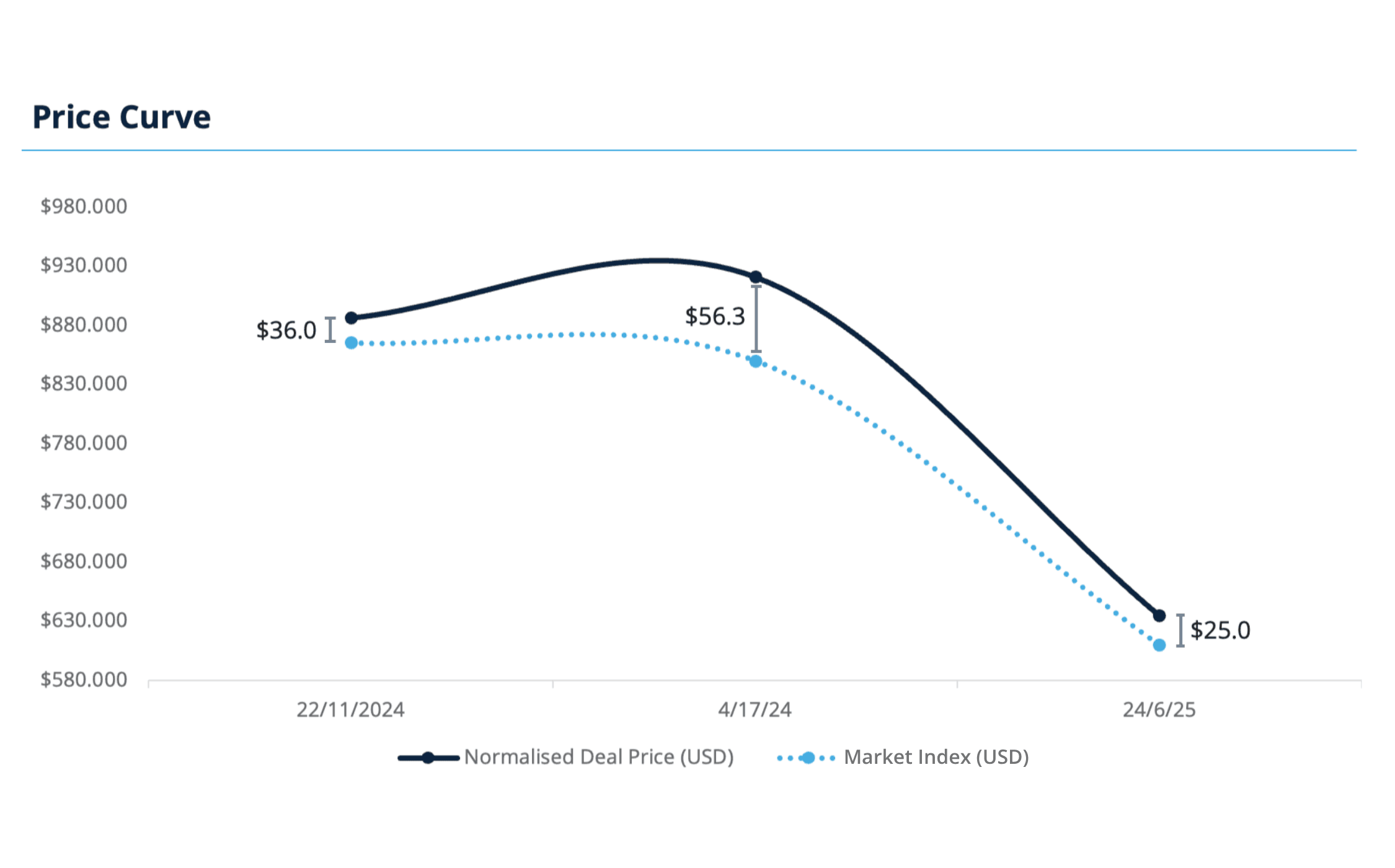
Structured battery raw material bidding events showing realised deal prices versus market index references
Furthermore, the necessity of structured price discovery becomes even higher when dealing with emerging, non-standardised material streams that completely lack a liquid public index. Batrec Industrie AG, a Switzerland-based recycling pioneer operating as a subsidiary of Veolia, faced this challenge when commercialising recycled battery materials.
To establish a true market price for 300 metric tons of NMC Black Mass, Batrec conducted a digital spot sales auction on the platform. The event successfully aggregated concentrated purchasing interest from a diverse pool of buyers across both Europe and Asia.
Gathering global demand into a single, structured digital format intensified competition, resulting in a potential revenue increase exceeding 50% compared to traditional bilateral placement. The structured auction provided a clear and auditable price signal, proving that digital competition can establish robust value definitions even for complex, circular-economy products.
These examples of Digital Alpha are increasingly prevalent across the board, with a wide range of customers realising similar commercial advantages. This shift towards structured execution is reinforced by commercial leaders who have experienced the impact on their operations firsthand.
“At SQMi, we firmly believe that bidding events via Metalshub will enable us to improve the topic of price discovery in the lithium industry. Metalshub’s existing network and expertise ensure a quick time-to-value, and the first auctions have already been a commercial success.”
Achieving commercial excellence in the current raw materials landscape requires a fundamental mindset shift. Leadership teams can no longer view market indices as a fixed constraint on performance.
The multi-year data and case studies across alloys, scrap, battery raw materials, and recycled materials confirm that the format of transaction execution directly dictates the financial outcome. The eBay effect proves that structured transparency and clear time limits force counterparties to offer their best possible terms.
Organisations that continue to rely on manual, relationship-driven spot trading will find themselves operating at a structural disadvantage. To capture hidden margin and consistently beat the index, metals and mining companies must institutionalise digital tenders, auctions, and structured workflows as standard operational protocol.
In other words, the market sets the reference price. The transaction structure determines how much value a company captures around it.
Newsletter