AI
The State of AI for Buying and Selling Raw Materials | MetalshubTalks 010 Recap
 Written byDavide Nava
Published on
Share Post

AI
Written byDavide Nava
Published on
Share Post
AI has been in every industry conversation this year. Some companies in metals, mining and recycling are running pilots, others have not started at all, and most are still working out which parts of it belong in daily practice. So far it has landed on document work, contracts and specifications, market intelligence and the operational side of mining. The commercial side, the actual buying and selling of raw materials, has moved far more slowly.
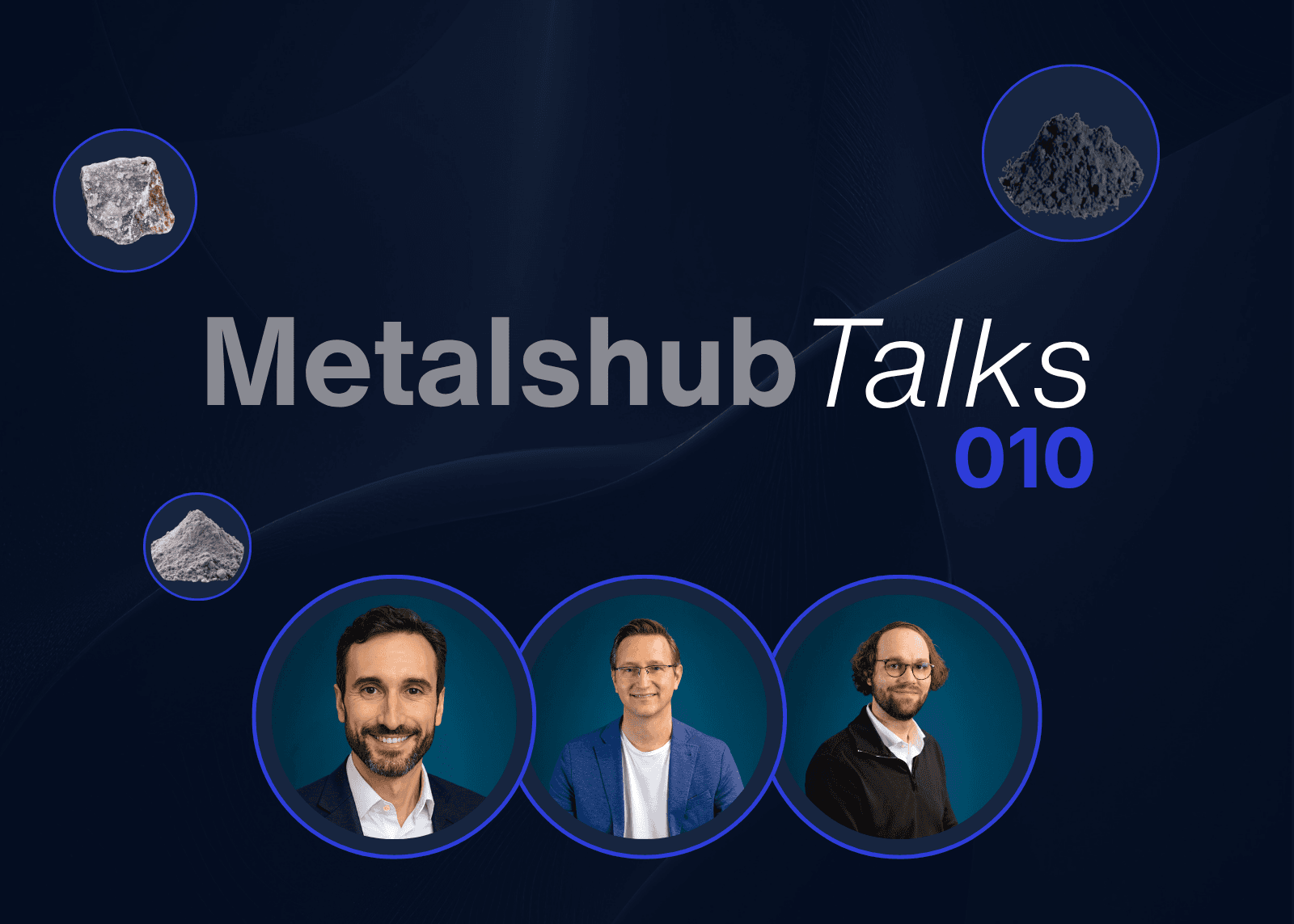
The reason sits in the data. The knowledge behind every deal lives in emails, in phone calls, in spreadsheets and in notes on somebody’s desk. The ERP holds the transaction itself. It rarely holds the picture of how you got there. In this episode of MetalshubTalks I sat down with Dr Sebastian Kreft, Co-Founder and Managing Director at Metalshub, and Julien Dedek, Head of AI Platform at Metalshub, to work out where AI genuinely helps a buyer, a seller or a trader today, what a company needs in place before any of it works, and what becomes possible once an AI assistant can reach your commercial data directly. Halfway through, Julien ran our MCP connector end to end, from an email in the inbox through to an accepted offer. MCP is a universal plug that lets an AI assistant reach data held in the platform.
Dr Sebastian Kreft: I spend a lot of my week with procurement teams and sales teams across metals and mining. Management teams broadly agree that generative AI matters and that they need to start using it in some form. Some are already running pilots on specific applications. Others have not started at all, and for those the first step is the one that counts.
Am I seeing anyone run it at scale? Not yet, and the reason is structural. Raw material transactions are very high in value and there are not many of them, so they are not a natural place to run a first pilot. Companies tend to start where transactions are frequent and individually small, because AI makes mistakes and in raw materials a mistake is expensive. That does not make this a dead end. The potential in sourcing and selling raw materials is large. It is a question of where you begin.
Dr Sebastian Kreft: In 2025 it was about asking questions. That is how most people and most companies got started, private users included: query your data, ask an AI system something, hope the answer is good.
This year the conversation has moved to agentic AI, which means using AI to get work done rather than to answer questions. That can run with a person supervising each step, and it can also run on its own. The first use cases are simple ones: confirming purchase orders and sales confirmations, making changes, generating change notifications. Further out, a market intelligence agent supporting the buyer or the seller, or a negotiation agent that works the negotiation itself.
Julien Dedek: Structured data, before anything else. The quality of the answer you get from a large language model depends on the quality of the context you feed it. If that context is scattered across a dozen places and none of it is structured, the model struggles to find the right information at all. And the amount of context a model can hold is capped, so you cannot solve the problem by feeding it everything you have.
Everything you feed a model gets split into units called tokens, and most models top out at around a million of them. A 50 megabyte spreadsheet will fill that entire window on its own. Maybe one row of it mattered for your task. You have spent the model’s whole capacity, you still cannot complete the job, and that makes it very hard to use inside a larger workflow.
All these integrations used to be extremely costly to build, and anyone who has been through an ERP project knows exactly what that means. They are not needed any more. The model reaches each source on its own.
Julien Dedek: With a chat interface you read the answer and decide what to do with it. You can judge whether it is a good answer or a bad one. That safety net disappears with agentic AI. There the model’s output feeds the next step of a workflow, so if the data was unstructured and the model picked up the wrong information, the mistake carries straight through. These systems are probabilistic, so using them for real work takes engineering to make the data reliable enough to act on.
Dr Sebastian Kreft: There are three basic questions every company has to answer for itself.
The first is governance. If the AI makes a mistake, who carries the accountability and responsibility for it?
The second is cost. Tokens cost money. I have heard of companies where AI was so successful that spending started spiralling, and they ended up limiting access to certain people or certain teams.
The third is data security. A large language model is processing your data, so you need to know what happens to that data once it reaches a third-party model.
Dr Sebastian Kreft: Metalshub is more than nine years old, and data security has been fundamental from the very beginning, because we handle raw material transactions that are high in value and commercially sensitive. We have always given customers full transparency and control, and we have never shared customer data with a third party without their permission. AI does not change that. When we introduce AI features inside the platform, customers decide whether to use them and how, so they stay in control of their own data.
Julien Dedek: From a data security perspective, the connector uses exactly the same data you already see as a Metalshub user. There is virtually no difference between what is displayed on our website and what comes back over the connector.
Dr Sebastian Kreft: There are ways to solve this at your end if data security is critical to you. Some large language models are self-hosted on your own servers and pass nothing to anybody else’s, so all the data stays with you. It is a trade-off between the performance of certain models and data security, and that is a decision every company has to make for itself.
Julien Dedek: MCP stands for Model Context Protocol. It is an open standard, created by Anthropic, the company behind Claude, and then released openly. The whole AI industry adopted it, so there is now one standard everybody works to instead of a dozen competing ones.
Think of it as a universal plug, a USB-C for AI. Whichever large language model you use can reach data through it in a secure way, from Metalshub or from anywhere else. You can connect an ERP system, a CRM system, a platform like ours.
The real value comes when you run several of these connectors side by side. Sources that used to sit in separate silos start working together, and the assistant pulls exactly what it needs from each of them to complete the job. That makes workflows possible that were not possible before.
Julien then ran the connector, which is still in development, end to end, using Claude as the assistant. Connecting it takes under a minute: three fields configured once, a login with Metalshub credentials, and one authorisation click. Behind it sits a planned set of around 125 tools, covering what a user can already do on the platform. The showcase came in three parts.
Step one: an email becomes a demand notice. An email arrives from the production department. Julien pastes the text into the assistant and asks it to create a demand notice, the internal record of what a plant needs and by when. The connector works out the product, the quantity of 24 metric tonnes and a required delivery window in the first week of the following month. It also finds that the delivery location named in the email does not exist on the account, so it stops and asks rather than inventing one. Julien names it, the assistant creates the location, and only then does it build the demand notice, with the text of the original email kept as a note against the record. As he put it, this generation of tools asks you for missing information instead of assuming it.
Step two: the demand notice becomes a published enquiry. An enquiry is the request for offers that goes out to suppliers. The assistant looks up the terms used on past enquiries for that product, pulls in the approved supplier relationships and produces a draft. Published privately, the enquiry goes only to the suppliers you invite. Published publicly, it reaches the wider Metalshub network, which is where offers arrive from suppliers you have never dealt with.
Step three: offers are compared, countered and accepted. The offers that came back are restated on the same terms and laid out in a single table: the price, whether each one can be acted on, and whether it meets the specification. Julien counters all of them at 3% below their current price. The assistant notices the delivery windows have gone stale and offers to shift them before sending. One offer is accepted, leaving the supplier to give the final confirmation that makes it a contract, and the rest are cancelled.
A person stays in the loop throughout. The first time the assistant reaches for a tool it asks permission, so you decide what it is allowed to do. It also returns a link back into the platform, so every step can be checked against the record rather than taken on trust. Two ideas came up while the demo was running. Sebastian suggested connecting the email inbox and giving the assistant a scheduled task to check it every hour, so demand notices get created without anyone opening the mail. Julien’s answer to making any of this repeatable was to write your own rules down once as a skill, so the assistant returns the platform link every time, or runs a negotiation the way your category runs it.
Dr Sebastian Kreft: We realised the connector is the foundation that gets our customers started with AI, so we built it first and we are refining it now. From there there are two ways to use it. Either you connect your own AI agent to our connector, which is what Julien has just shown, or you use the agents and copilots that we will build inside Metalshub, running on Metalshub AI tools. We understand that not everyone wants to run this through their own AI stack, so we will make both options available.
Over the years customers have told us plenty of things they would like to do in Metalshub, and each one meant significant effort for us to build a customisation for a single customer. One customer wanted to look at the last five requests for quotation on a product, see every supplier that had quoted across those five, and get a picture of how that category had moved. We could build it, but it was a significant amount of time and money.
With the connector, that customisation does not need building. The customer runs it through Claude and has it immediately. For me the value you can get out of Metalshub is going up exponentially, because you can do these customisations yourself.
Julien Dedek: And you can fit it to the workflows you already have, rather than building around somebody else’s tool.
The session ended on the question that always comes up. Will AI replace buyers, sellers and traders in this industry?
Dr Sebastian Kreft: In raw materials, for quite some time, AI will support the person rather than replace them. The transactions we deal with are usually multi-million dollar, so there will always have to be a human in the loop. And because the number of transactions is low, the benefit of automating them is smaller than the risk of one serious problem at that value.
C-parts are a different case. They are very low in value and very high in frequency, and I can see that arriving in the near future in some companies, because even when a mistake happens the impact is small and the efficiency gain is real. The same goes for the more operational procurement processes, where people are still taking information by hand and creating purchase orders in the system. A tool can do that work reliably.
None of this starts with AI. It starts with a commercial process, a digitalisation process, and structured information inside the company. Once that exists, an assistant has something reliable to work with, and everything in the showcase becomes possible on top of it. Without it, the most capable model available is reading scattered context and guessing at the answer.
The MCP connector is not publicly available. We are working with selected companies who want to test it, alongside the other AI functionality in development. If that is you, get in touch through the website.
Our next episode, Modernising Raw Material Procurement in Foundries, airs on 29 September 2026 at 15:00 CEST, in Spanish, with Eduardo Giménez of Ebroacero. Register here.
MetalshubTalks 010
Interested in watching the full episode?
Click below and watch it for free.
Newsletter
insights