Iron & Steel
Widening the Supplier Base in Foundry Ferroalloy Sourcing | MetalshubTalks 011 Recap
 Written bySamir Jaber
Published on
Share Post
Iron & Steel
Written bySamir Jaber
Published on
Share Post
A mid-sized steel foundry can place more than a thousand raw material orders a year, many of them for a few tonnes at a time, with no warehouse space to buy ahead when prices dip. Nickel and ferromolybdenum prices keep climbing, freight costs are rising with fuel, and geopolitical shocks arrive almost monthly. A buyer who still sources by phone and email from the same five or six names has little room to test the market or spread supply risk.
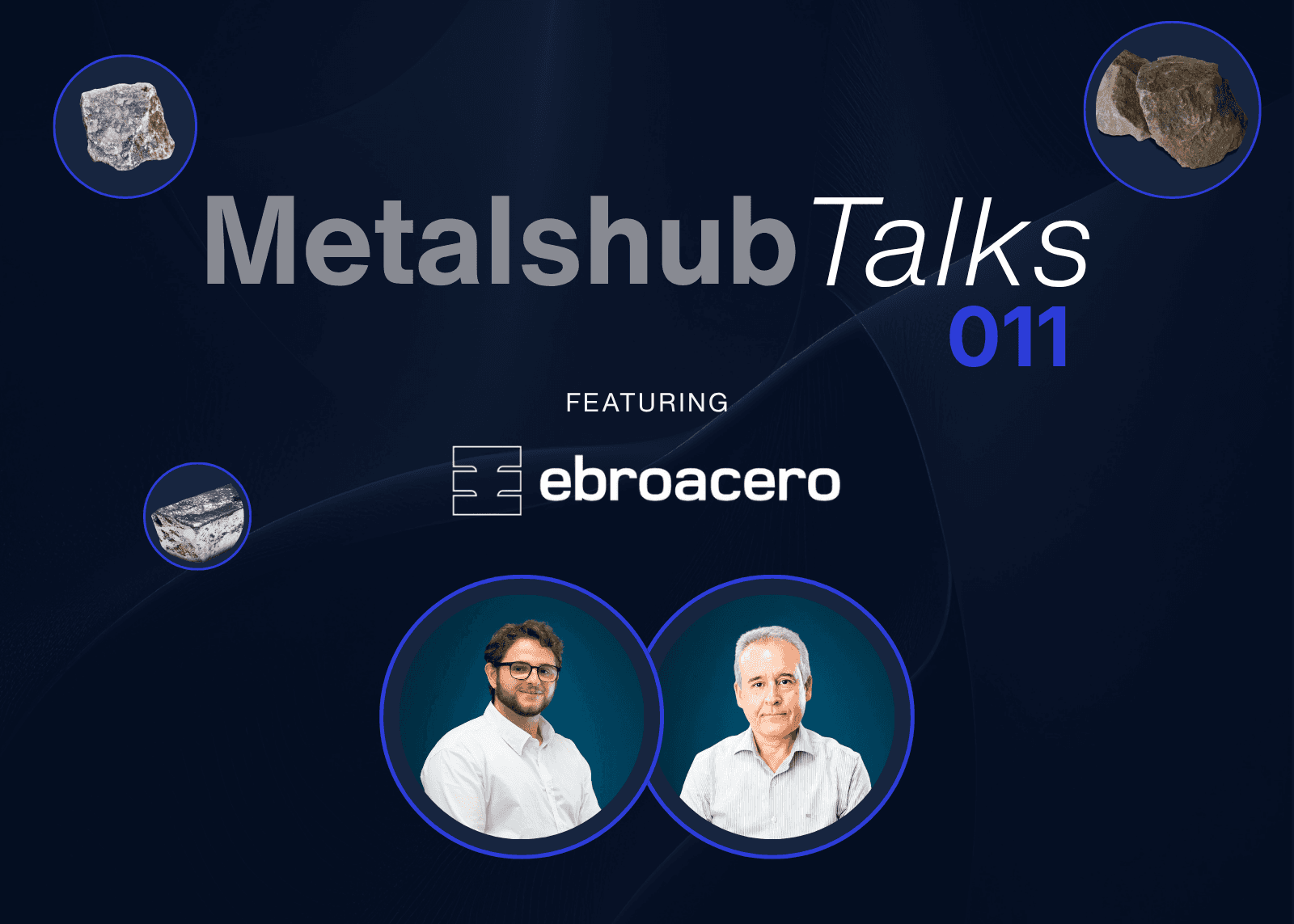
In a recent episode of MetalshubTalks, host Jordi Pla Moliner, Business Development Representative at Metalshub, sat down with Eduardo Giménez, Head of Purchasing and Human Resources at Ebroacero S.A., the steel foundry based in Zaragoza, Spain. In a conversation held in Spanish, they explored Ebroacero’s move from manual sourcing to a digital source-to-contract process in 2022: what the old process cost, how the team adopted the platform, what changed in numbers, and where the time saved now goes.
Eduardo Giménez: I am responsible for purchasing and human resources at Ebroacero, a medium-sized foundry in Zaragoza, Spain. The company was founded more than 60 years ago to meet the needs of another company, Talleres Mercier, which needed steel parts and could find few suppliers. It was originally called Siderúrgica Ebroacero, and the name was later shortened to Ebroacero.
We make components rather than long production runs. We do not work for the automotive or railway sectors. We supply several sectors, lately mainly power generation, oil, offshore and wind, and also paper and naval. Our parts weigh anything from around 50 kilograms to more than 14 tonnes, and we have a workforce of about 100 people.
This summer we acquired FTR Válvulas y Fundiciones in Torrijos, in the province of Toledo. Through it, we want to move into ductile, grey and white iron, and into stainless steel, particularly for smaller components. It also answers a practical problem: the city of Zaragoza has grown around our current site, so we have little room to expand there.
Eduardo Giménez: The market has been uncertain and volatile for several years. Geopolitical events surprise us practically every month. Raw material prices are rising, and so are logistics costs, partly because of higher fuel prices. Nickel and ferromolybdenum, for example, have been rising steadily.
A purchasing manager has to try to anticipate these moves, which is very difficult, because the information you rely on keeps changing. Our space is also limited. We have little storage capacity, so we buy often and in small quantities, and we cannot always take advantage of a good buying opportunity. That makes it harder to secure the best prices.
Eduardo Giménez: A few years ago, Ebroacero was no different from many small and medium-sized Spanish companies, where digitalisation was limited or practically non-existent.
I am responsible for both purchasing and human resources. That combination may sound unusual, but I replaced two excellent professionals who had each worked here for 40 years. To take on both roles, I had to digitalise the work. There are simply not enough hours in the day to do everything by hand.
Purchase requirements come from production. Because we do not have large warehouses, they recur often and follow our production volumes. We would contact our suppliers by email or phone, and the pool was no larger than five or six. We explained what we needed; they sent prices, and a second round refined those prices before we chose a supplier. The order went to the supplier by fax in the early days and later by email. We saved the documents to build the purchasing file, waited for the delivery note to arrive with the goods, then the invoice, processed the payment and closed the file.
It was laborious. A company of our size handles around 1,200 purchase orders a year with a small team. All that paperwork left room for errors, both when requesting offers and when filing documents, and storing the paper took up a lot of space.
Our first step was a document-management system to cut paper and build a digital archive. The next step for purchasing was Metalshub, so that we could work more efficiently and save a great deal of time.
Eduardo Giménez: The supplier base was quite rigid. There were occasional exceptions, but five or six is not a guess. I checked the average for the three years before we started using Metalshub, and it was around six suppliers. Today I think we use about 14 suppliers through the platform.
Eduardo Giménez: I cannot remember exactly when we first made contact, because during a digital transformation you research many options and compare a lot of platforms.
One of the first challenges with a tool like Metalshub is overcoming the fear of doing things differently. You have to accept that you will not keep working the way you did before. In my case, necessity played a big part. I had to change how I worked, or I could not have managed the workload left by the colleagues I replaced.
There is another point. Buying from a supplier you do not know is a risk, and you rarely have time to qualify them beyond what their website tells you. The platform gives you confidence. You know the supplier has passed Metalshub’s screening, and you can see a good deal of information about them, including downloadable ISO certificates and other documents. That gives you peace of mind.
A purchase is a commitment, and in purchasing we do not like unnecessary risks. That matters in our business because we make heavy components. Imagine a 14-tonne casting that has to be scrapped because the material did not meet the specification. The cost to the company’s results could be substantial. You need to be confident before you take that step, and the platform has to give you that confidence.
Eduardo Giménez: Ease of use was a major factor. From the first transactions, the offers came in, and the platform laid them out in a structured comparison, which made the process simple. Most importantly, you are formalising a contract, and so far we have not had a problem with any transaction we have completed.
New suppliers also appear. Companies like ours tend to stay loyal to suppliers who serve them well, and the best ferroalloy supplier we had before the platform is still our best supplier today. A few suppliers chose not to move to the platform, whether because of company policy, hesitation or something else, but most of our existing suppliers use it.
Eduardo Giménez: We are using a platform that preaches transparency, so we want to be transparent too. That is why our enquiries are public, and we do not restrict them. Our usual suppliers accepted the approach well because they are still the suppliers we work with. The pool is somewhat wider now, but most of our business still goes to familiar names.
Eduardo Giménez: You may lose some informal contact, such as a phone call to ask how someone is doing or how their weekend went. Often, though, that disappears because of a lack of time and the pressure of day-to-day work. Technology can make things less personal. Buying something on Amazon is not the same as going to the shop on the corner.
Eduardo Giménez: I brought a few figures with me. Before we used Metalshub, around 95% of our recurring ferroalloy purchases were split between four suppliers. Today, the same 95% is spread across 12. Before, a few suppliers accounted for a very high share of our purchases. That diversification matters in uncertain, volatile times, because a company should never rely on a single source of supply.
We estimate the time saved and redirected to other work at 50% at least, probably between 50% and 60%. We now have time we did not have before, and with the same resources we can do more and create more value for the company. When we request quotes, we used to ask five or six suppliers, and now we usually receive at least 10 or 12 offers. Given our size and the small quantities we buy, I am sure we are not a very attractive customer for many suppliers on the platform, so that matters.
I also value traceability. Everything you do on the platform is recorded, and you can go back to it when you need to. The platform also provides market information, including ferroalloy prices and freight rates, which helps us stay up to date with the market.
Eduardo Giménez: We buy ferroalloys through the platform. Other important materials, such as electrodes, resins and paints, are highly technical products and are not on the platform. The choice of those products depends heavily on the preferences of foundry professionals and on the suppliers who specialise in making them. Ferroalloys are more commodity-like products, and for those we mainly use Metalshub.
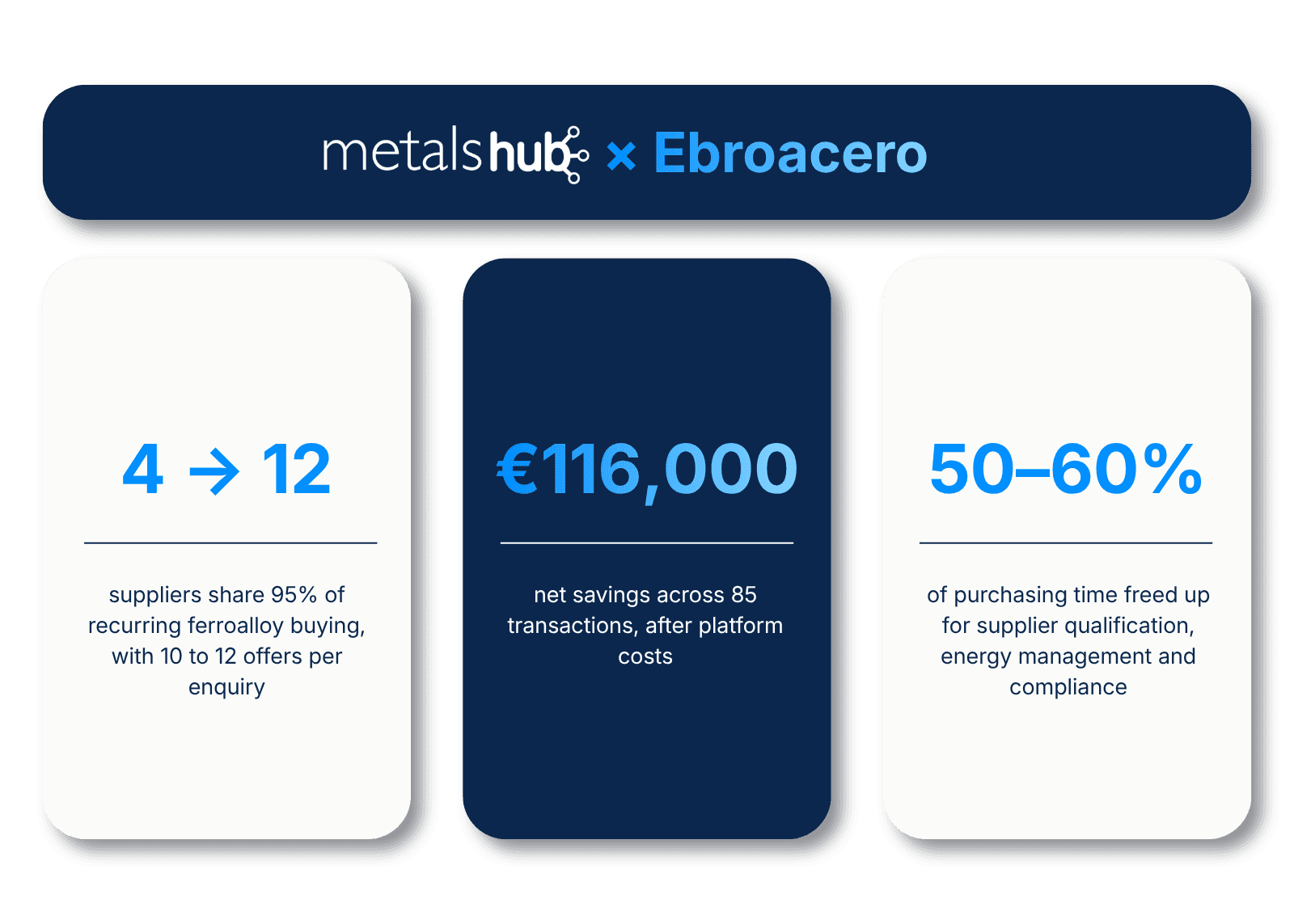
Eduardo Giménez: We estimate that across 85 transactions, we have saved €116,000 after deducting the overall cost. For us, that is a satisfactory result.
I do not remember the ROI figure presented when I signed up, but I calculate it myself and update the calculation every year. The platform is profitable for us even though we buy small quantities. I would expect it to be profitable for other foundries of our size, and probably even more so for larger ones.
Eduardo Giménez: The team is still small, and we do not plan to grow it because we do not think we need to. In purchasing, the time goes into knowing the products better, working more closely with the technical department and learning more about the business. It also gives us time to find and qualify other suppliers. We no longer live day to day. There was a time when urgent meant the next day and the distant future meant the following Monday.
Much of the time goes into work that creates value elsewhere in the company. We have held ISO 50001 energy management certification for two years, and analysing our energy consumption at the level of detail we do now would have been impossible without that time. People in purchasing and human resources also contribute to our compliance policy alongside other departments. European and Spanish legislation increasingly requires compliance policies, additional ISO certifications, equality plans and more, and we now have time to work on them.
When everything was manual, departments worked in silos. If you needed information from another department, you had to phone or walk over and ask someone to find it. Now the information sits in the system, and people retrieve what they need themselves, which makes policies that involve several departments much easier to build.
Eduardo Giménez: First, understand your current level of digitalisation. Second, overcome the fear of change. Digitalisation does not mean losing control. It means becoming more efficient, having more information with the same resources and creating more value.
Purchasing also cannot be digitalised in isolation from human resources or other departments. Digitalising purchasing is of limited use if the rest of the company’s processes stay manual. The whole business has to move forward at a similar pace, or it stops being competitive.
Eduardo Giménez: Digital models like ours will probably be common, and artificial intelligence will be part of it. AI is already arriving, and arriving powerfully. Still, I do not feel able to predict exactly what purchasing will look like in five years.
I think our stock and the stock of different suppliers will be connected in real time, and suppliers will make you offers when you reach your safety stock. We may have purchasing agents. What I cannot tell you is whether buyers will disappear or a robot will take over the role.
Jordi Pla Moliner: I do not think buyers will disappear. AI and AI agents will become more important, and sooner rather than later, but someone will still need to organise and oversee AI inside purchasing and use it as a support tool.
Eduardo Giménez: Companies of our size often spend all their time on day-to-day matters. When you are focused on the immediate workload, you have no time to improve, and if you do not improve, you lose competitiveness.
We have brought in people with specialist skills and a strong technology background who can look beyond next Monday. They are responsible for taking Ebroacero to the next stage in digitalisation, robotisation and sustainability. The rest of us run the day-to-day work and support them with our experience while they put the strategy into practice. If our vision only reaches as far as next Monday, we will not make progress.
For us, digitalisation is never an end in itself. It needs a purpose, an objective and a strategy.
“If our vision only reaches as far as next Monday, we will not make progress. For us, digitalisation is never an end in itself. It needs a purpose, an objective and a strategy.”
Ebroacero’s experience shows that digital procurement pays off for a mid-sized foundry buying in small lots. With around 1,200 orders a year, little storage and short lead times, the team spread 95% of its recurring ferroalloy purchases from four suppliers to 12, now receives 10 to 12 offers per enquiry, freed up at least half of its purchasing time and recorded €116,000 in net savings across 85 transactions. The long-standing suppliers stayed, and the best of them grew.
Eduardo was also candid about the trade-offs. Some informal contact with suppliers fades, and some suppliers find small lots and short notice hard to serve. For foundry buyers weighing the same move, three things are worth doing now:
For more on foundry procurement, read our recaps of MetalshubTalks 007 on digital procurement for foundries (with MAT Foundry Group) and MetalshubTalks 009 on digitalisation in metals foundries (Cast Metals Federation).
MetalshubTalks 011
Interested in watching the full episode?
Click below and watch it for free.
Newsletter
insights