Iron & Steel
Digitalisation in Metals Foundries | MetalshubTalks 009 Recap
 Written bySamir Jaber
Published on
Share Post
Iron & Steel
Written bySamir Jaber
Published on
Share Post
Foundries sit at the core of modern manufacturing, casting the essential components that drive aerospace, defence, automotive, and energy infrastructure. Yet, the modern foundry operates in an unforgiving climate marked by volatile energy bills, skills shortages, and tightening regulatory demands.
In a recent episode of MetalshubTalks, I sat down with Lee Marshall, Chief Executive of the Cast Metals Federation (CMF), to explore how the UK foundry landscape is evolving. From the shop floor to the purchasing department, Marshall shares how digitalisation is shifting from a tech buzzword into a critical strategy for survival, productivity, and global competitiveness.
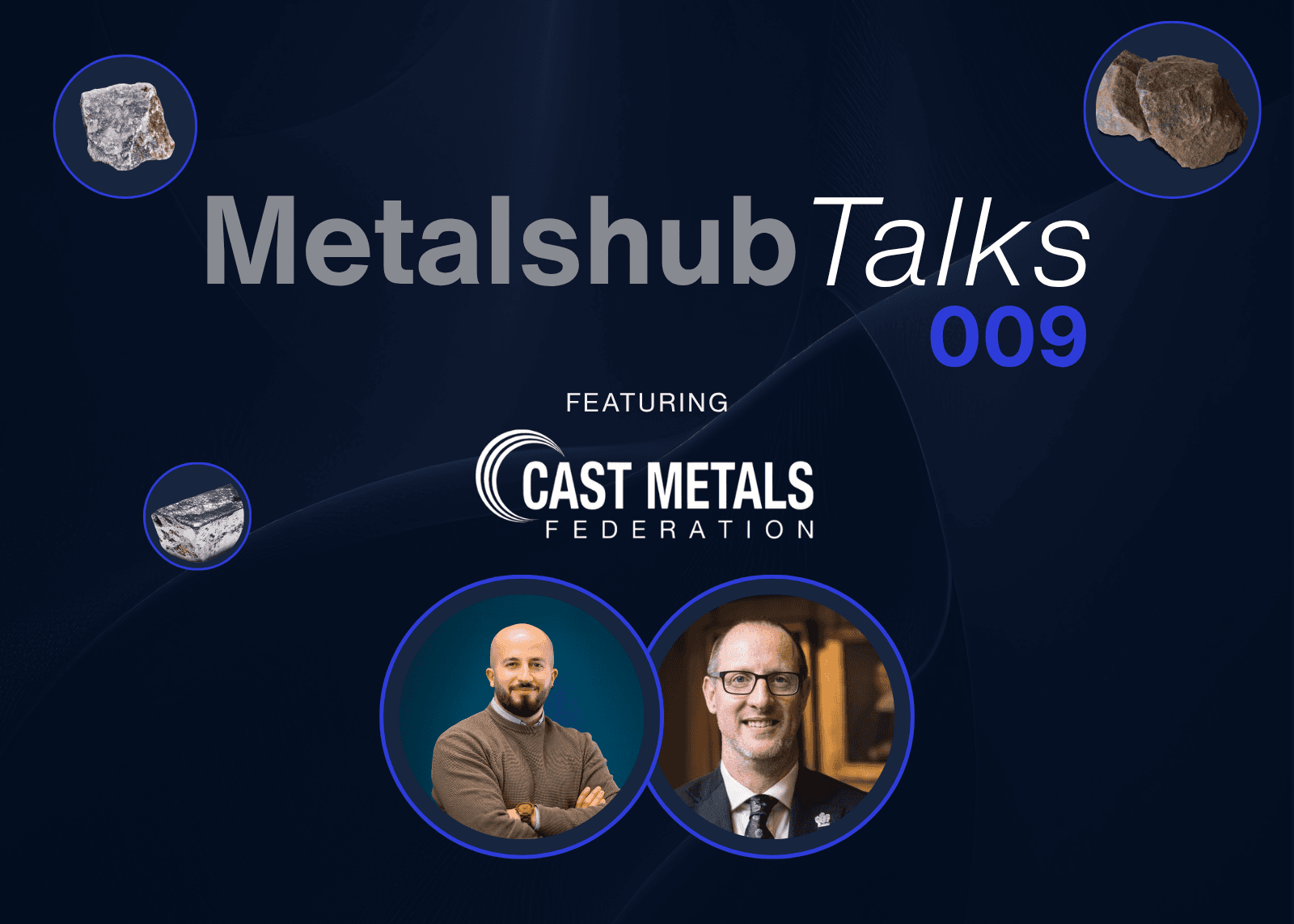
Lee Marshall: CMF is the trade association representing foundries and foundry suppliers operating across the UK. Our work is split into two primary areas.
First, we have our inward-facing services for members. This includes providing industry information, organising networking events, and fostering knowledge sharing.
Second, we have our outward-facing advocacy. We lobby policymakers across Westminster and the devolved governments in Scotland, Wales, and Northern Ireland. We also advocate for the industry higher up the manufacturing supply chain, while promoting foundries as highly technical, rewarding places to work.
Lee Marshall: Interestingly, we are in a more optimistic position now than we were 9 to 12 months ago. The latter half of 2025 felt a bit more depressed, but order books and inquiries have started to pick back up.
However, the outlook varies significantly depending on the sectors you supply:
Ultimately, while the market is stabilising, local challenges around costs and regulations remain heavy constraints.
Lee Marshall: The discussion always circles back to three main pressures: energy costs, skills, and regulation.
“We need to increase productivity… and digitalisation is driving that in the UK. Anything where digital aspects can help us pull that productivity lever is going to be incredibly valuable.”
Lee Marshall: It spans both the shop floor and the back office. On the floor, you see impressive automation—even robots pouring ladles of molten metal into moulds. We are also seeing central “mission control” desks tracking machine utilisation, maintenance cycles, and throughput.
But the real trick is moving through three distinct stages of data:
Collecting data just for the sake of it actually hurts your efficiency. You have to decide what to act on now and what to log for future use.
Samir Jaber: Static simulation has been around for years, but digital twins allow us to run virtual scenarios of the entire factory process. By pairing real-time variables, like pouring speed, mould temperature, and humidity, with Edge AI models, we can detect anomalies and correct casting defects before they physically materialise.
Lee Marshall: Regarding AI more broadly, it is currently in its “apprentice” stage. It doesn’t yet know enough to pour a perfect casting on its own because so much foundry knowledge is held in the minds of workers who have been doing this for 40 years. AI cannot replace that human expertise yet, but it can enhance and codify it over time.
Lee Marshall: Procurement is fundamental because metals are the lifeblood of a foundry. Moving procurement onto digital platforms allows for the automation of tedious tasks, faster document workflows, and even real-time bidding auctions.
Importantly, this is not about replacing people or cutting headcount. Instead, it frees up administrative capacity, so your team can focus on higher-value work, like proactive supplier management.
Furthermore, global supply chain shocks mean foundries have to rethink inventory. While everyone wants lean inventory to keep capital free, being “too lean” is a massive risk. Digital platforms give purchasing managers much better, real-time market intelligence to strike the perfect balance between lean operations and supply security.
Lee Marshall: Absolutely. Compliance is entirely a data game. When you supply highly regulated sectors like automotive or defence, you need airtight audit trails of supplier qualifications and material certifications.
With digital platforms, you can gather a single dataset and split it for multiple reporting requirements. You can pull it out for carbon reporting (such as CBAM), energy-intensity audits, or customer quality checks. Centralising this data eliminates massive back-office headaches.
Lee Marshall: It comes down to two things: a clear business case for Return on Investment (ROI) and understanding the cost of inaction.
Executives shouldn’t buy into the hype of “needing AI” just because everyone is talking about it. They need to look at their specific pain points—whether that’s scrap reduction, energy tracking, or procurement bottlenecks—and invest where the margin impact is fastest and most measurable.
At the same time, you have to ask: What is the consequence of doing nothing? If you delay your digital transition for two or three years, you risk falling so far behind the curve that you can no longer compete.
Lee Marshall: We are still in the earliest stages of adoption. The larger Tier-1 companies have the capital to invest, but many of our smaller SMEs lack the internal capacity and digital skills. That’s where CMF steps in to provide webinars, case studies, and hand-holding to help break down resistance.
In 10 years, the most competitive facilities won’t just be “foundries.” They will be highly integrated, advanced manufacturing plants with casting at their heart. They will carry out extensive value-added processes like specialised coatings, rapid prototyping via 3D-printed sand moulds, and precision finishing all under one roof.
Our ultimate USP in the UK is our technical know-how and quality. As the saying goes, “If the UK can’t cast it, it probably can’t be cast.” By integrating deeper digital tools, automated procurement, and AI over the next decade, we will secure that competitive edge on the global stage.
The future of UK foundries will not be defined by casting metal alone, but by how effectively they harness, process, and act on data. As Lee Marshall highlights, navigating global market volatility, rising energy costs, and a tightening regulatory landscape requires a strategic shift toward becoming advanced, digitally integrated manufacturing hubs.
“Digitalisation is not a technology label to collect dust on a shelf,” says Marshall. “It is an active productivity lever. In a landscape where we cannot easily change energy or labour costs, productivity is the one variable we can completely control.”
By connecting the dots between shop-floor automation, predictive defect prevention, and streamlined digital procurement, foundries can eliminate fragmentation and build real, lasting competitive advantages. The transition may still be in its early stages, but those who choose to invest wisely today—prioritising clear ROI and strong supplier management—will lead the next generation of industrial success.
MetalshubTalks 009
Interested in watching the full episode?
Click below and watch it for free.
Newsletter