Iron & Steel
Aluminium
Copper
Industrial Minerals
Battery Raw Materials
Closing the Gaps: How Digital Procurement Supports Compliance in Raw Materials
 Written bySebastian Kreft
Published on
Share Post
Iron & Steel
Aluminium
Copper
Industrial Minerals
Battery Raw Materials
Written bySebastian Kreft
Published on
Share Post
Procurement in the raw materials sector involves massive transaction volumes and a historically relationship-driven market, specifically across iron, steel, aluminium, and copper. This combination creates an environment highly vulnerable to process manipulation, transparency gaps and information leaking.
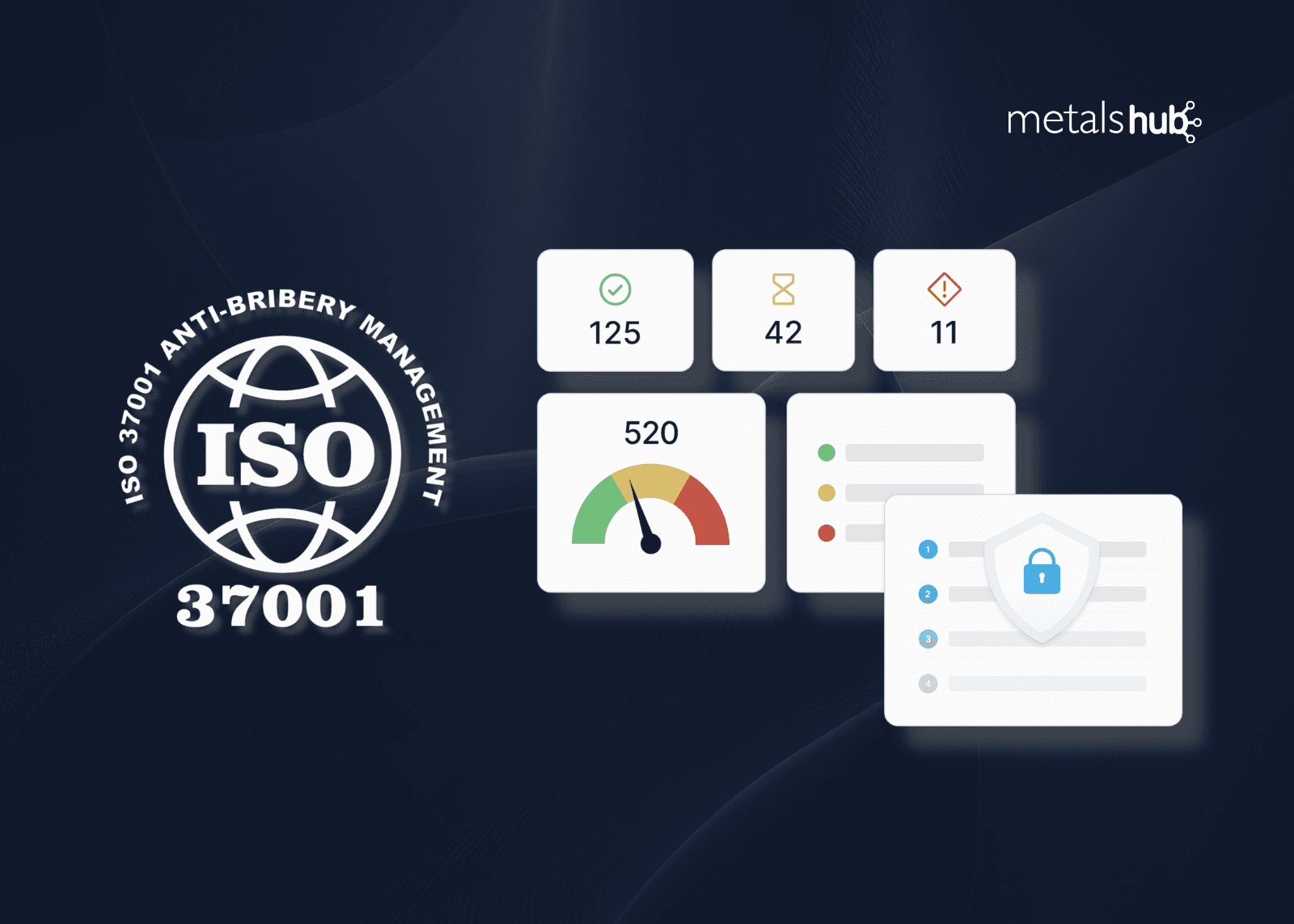
I was looking for some best practices and came across ISO 37001. This standard requires companies to establish an Anti-Bribery Management System (ABMS) that actively prevents, detects, and responds to compliance breaches. Relying on emails, WhatsApp messages, and manual spreadsheets makes passing an ISO 37001 audit incredibly difficult because these systems lack control and can be easily manipulated.
Using a specialised digital platform like Metalshub directly solves these compliance challenges by mapping its core functionalities to the key pillars of the ISO 37001 standard.
ISO 37001 mandates that organisations establish non-financial controls to mitigate bribery risks, explicitly highlighting procurement and tendering.
Under ISO 37001, a company is held liable if its suppliers engage in bribery or corrupt acts. The standard requires continuous, documented due diligence on all business relationships.
An ABMS is only as good as its proof. During an ISO 37001 audit, you must prove that your anti-corruption policies are actually being actively followed.
Raw materials procurement will always carry compliance risk. High transaction volumes, entrenched supplier relationships, and a culture of informal deal-making create exactly the conditions in which non-competitive practices and transparency gaps thrive. What ISO 37001 demands, and what platforms like Metalshub actually deliver, is a procurement environment where those risks have nowhere to hide. Every negotiation is documented, every supplier is vetted, and every award decision is traceable. That is the best way to thoroughly implement a corporate integrity policy.
Risk & Compliance
Learn more about risk & compliance with Metalshub.
Newsletter