Battery Raw Materials
Open Trading
MetalshubTalks
Open Trading on Metalshub: Firm Bids and Offers for Raw Materials | MetalshubTalks 016 Recap
 Written bySamir Jaber
Published on
Share Post
Battery Raw Materials
Open Trading
MetalshubTalks
Written bySamir Jaber
Published on
Share Post
Most physical raw materials still trade the way they have for decades, through bilateral talks, confidential contracts and published price assessments. Buyers and sellers rarely see what the rest of the market wants to buy or sell right now, and the industry has no neutral, shared place to show a firm price. Open Trading, the new trading mode on Metalshub, puts firm bids and offers from vetted companies on one screen.
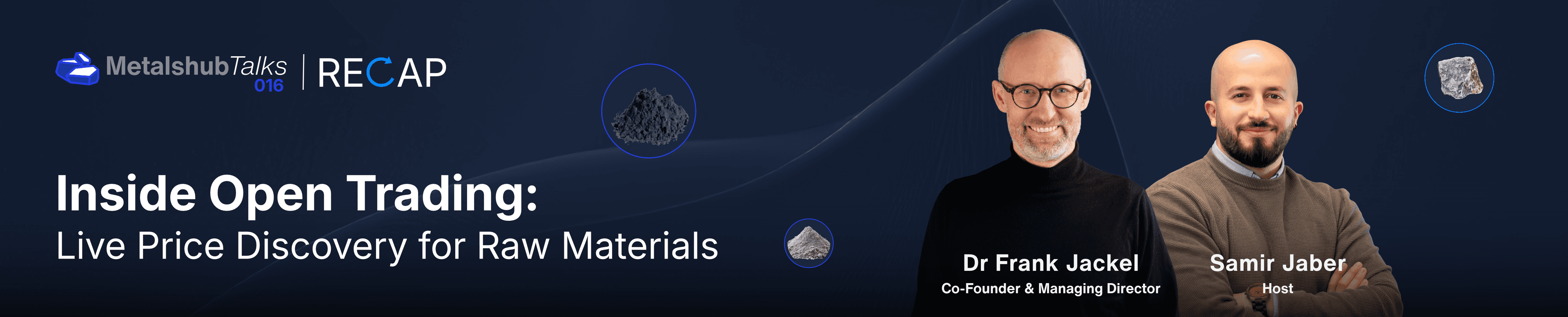
In a recent episode of MetalshubTalks, I sat down with Dr Frank Jackel, Co-Founder and Managing Director at Metalshub, to look inside Open Trading, the new trading mode on Metalshub. We explored why raw material markets need firm bids and offers on an open screen, how companies stay in control of their trading and their data, and how the product will develop with feedback from the companies that trade on it. Lithium is the first raw material on Open Trading, starting with spodumene, and more will follow. Frank also walked us through Open Trading on the platform, from posting an order to concluding a trade.
Dr Frank Jackel: Open Trading is a new idea for us only in its format. It is the natural next step of what we have done for the last ten years. Metalshub is, and always has been, a venue for physical spot trading of raw materials, and our aim has stayed the same: to make raw material markets more efficient, more open and faster. As a market matures, the companies in it need a live view of demand and supply. Open Trading gives them that, so it is a natural progression of the platform.
Dr Frank Jackel: Two things have changed in lithium. About ten years ago, it was still a chemical market, with very few participants trading in the open and most business done individually. That has changed completely. Second, the last five years have brought heavy volatility, and with it the rise of the Guangzhou Futures Exchange in China. The exchange brings a lot of liquidity, and some market participants also criticise it for adding to that volatility.
That leaves the industry with a question. Do we want retail investors and hedge funds to price our product, or should the physical market, the industrial players, price it? The market has become far more visible, and it is maturing fast, so it is time to give lithium a new tool to price material and to see what is really happening in the market. That tool is Open Trading.
Samir Jaber: So lithium is where it starts, and other raw materials will follow in time.
Dr Frank Jackel: Exactly. We start with spodumene, with technical-grade and battery-grade lithium carbonate following very shortly. Lithium hydroxide is a mid-term step, because it is still a qualification product. Buyers need to qualify each source, so it does not yet lend itself to anonymous trading, even when you approve the counterparties you buy from. We will keep discussing that with the market.
Lithium is only one part. Many other materials suit this model. Think of aluminium and the premiums around it, such as low-carbon aluminium or P1020 against the Midwest premium. Products like these could trade on an open market. What Open Trading adds is that all of it sits on one platform you already know.
Samir Jaber: One concern — or shall I say, misconception — we hear from the market is that once a company’s data is on a platform, it is immediately open and shared, without enough privacy or security. On Metalshub, each company picks the trading mode it wants for each material, moves between modes without switching platforms or onboarding counterparties again, and decides what data it shares with the market and what it keeps private. Could you explain how that works?
Dr Frank Jackel: Metalshub runs four trading modes, now including Open Trading. With anonymous term sheet trading, you can run an RFQ without revealing who you are, test the market and see what others offer. The counterparty is revealed only if you enter into a trade. Private and public RFQs suit products with a value-in-use premium, or buyers who want a specific price for their own needs, with their own Incoterms. Then we have private and public auctions, and now Open Trading.
Open Trading is meant for price discovery, and I want to be clear about that. Companies that join it want an efficient venue to trade, and they also want to contribute to market prices.
For individual pricing, such as RFQs, we do not share data with third parties unless you tell us to. Consent is always required. Nothing will ever leak to your competitors, and on Open Trading all data is anonymous: the platform never shows that one named company traded with another. We have built data security levels into the platform for this, and Metalshub runs penetration tests and other security checks all the time, so nobody sees a trade they are not eligible to see.
Dr Frank Jackel: We launch in November, only days from now, so what I am showing is the demo version on our test server, where we run the last checks.
First, the look and feel. Anyone who already works with Metalshub will find their way around Open Trading straight away. We have deliberately left out the flashing lights and up-and-down arrows you might know from stock trading or the LME. Nobody needs that here. This is a physical market where a few trades happen a day, so we keep it as simple as possible, and you can use it from your phone anywhere in the world.
Here is how it works:
Everything here is a standard grade on standard commercial terms. We are always happy to run individual demos, so reach out to us, and we will help you register for Open Trading once it is live.
Dr Frank Jackel: To establish a market for a standardised product, you need to remove bias from it. The product has to be a standard grade, with a clear methodology set out in the terms and conditions, for example, for the lithium content in spodumene. Only that makes prices comparable.
If you want an individual price for an individual product or specification, you are back at the RFQ process, which we already offer. If you have a special product, or you think you can achieve a premium over the standard grade, Open Trading is not for you. Run an RFQ. The same goes for a buyer who can offer better terms because of strong credentials: invite sellers to your RFQ. A standard product is there so that the market price is comparable and reflects the fair price the market sees today.
Which mode fits best can change over time. In some periods, companies will prefer an RFQ, and in others the market will be so active that Open Trading is the right place. The advantage of Metalshub is that you can do both on one platform: put a standard product on Open Trading, run an RFQ at the same time, and compare the results.
Dr Frank Jackel: This is the first version, and that has been our approach for the past decade. Markets change, and they move fast, sometimes faster than fast. So the right approach is to put a sound first product in the market, have people test it, see what works and what does not, and keep improving it.
The standard terms and conditions will improve too. We built them on the neutral terms we already provide for the ferroalloys market, which a large share of that market uses, even in RFQs. CIF and FOB trades of spodumene and lithium carbonate have their own needs, so we developed the lithium terms from our own experience, with legal counsel and with input from the market. We can change them over time, and we will.
Dr Frank Jackel: At the start, we will invite the companies that already use our RFQ mode to try Open Trading and see how it works for them. What helps us is that our development and engineering are in-house. We do not outsource anything, so when a company brings us a request that makes sense, we can act on it within a very short turnaround.
OPEN TRADING
You can request access below. For more on how lithium maps onto each Metalshub trading mode, read our article on the lithium market maturity curve.
Dr Frank Jackel: If most of your material is committed to long-term contracts, you are not contributing to the price your contracts use. Every company should ask itself whether it is an active participant in the market or simply a price taker. If you want reliable prices, you need to take part in the market.
A liquid spot market helps everyone, producers as much as consumers. One of the biggest problems for new and expansion projects is that the markets lack liquidity, which is why regulators and investors keep asking for offtakes, and for a producer, offtakes destroy value at some point. The more material sits in spot markets, the better for the whole industry. Liquidity also reduces volatility to some extent. We have seen large price rises and falls over the last year that came from only one or two per cent of oversupply or undersupply in the spot market. The bigger the spot market, the more reliable the price.
Dr Frank Jackel: You choose which price assessment you use, and that does not change. Metalshub is not a price index provider. Our goal is to make information available so that markets work better, because that is our mission. As a technology provider, we will never hand over data manually. Any arrangement with a price reporting agency that wants Open Trading information would be fully automated, so there is no risk of manipulation or of false information reaching anyone.
Open Trading gives physical raw material markets something they have lacked: one screen where firm bids and offers from vetted companies sit side by side, anonymous until the deal and tradable only between companies that have approved each other. For lithium buyers and sellers, it offers a way to price standard grades through the physical market, while RFQs, auctions and anonymous term sheets stay available for the deals that need them.
Three things to do or watch:
MetalshubTalks 016
Interested in watching the full episode? Click below and watch it for free.
Newsletter