Critical Raw Materials
Critical Raw Materials Act: Parliament Backs a Price Index
 Written byFrank Jackel
Published on
Share Post

Critical Raw Materials
Written byFrank Jackel
Published on
Share Post
The European Parliament wants Europe’s planned raw materials centre to back price indices built on real transactions. Here is what the vote says, what it leaves open, and why national trading platforms need to connect.
At LME Week in London in October, I shared a panel with Traxys, Albemarle and McLaren Automotive on whether digital infrastructure can help emerging metal markets. One question has stayed with me since: who sets the price in an opaque market, when there is no exchange like the LME?
For lithium and most other critical raw materials, the honest answer is uncomfortable. Futures and daily assessments exist, yet most physical volume is still agreed by phone and email, and few people can see how the final number came about.
On 20 October, the European Parliament gave its own answer. Voting on the amendments to the Critical Raw Materials Act, it asked Europe to build its prices on real trades, which is close to what we at Metalshub have been arguing for. I think it is one of the most important things Brussels has said about raw material markets in years.
The headlines were about the new European Critical Raw Materials Centre, a Union body with a proposed €2 billion fund for joint purchasing, stockpiles and new projects. Powerful tools. But when I read the text Parliament adopted, what struck me was how often it comes back to price.
Parliament wants the Centre to promote “a stable and diversified European market for critical raw materials” and to create “a European market and pricing infrastructure” for them (recitals 10a and 10b). It wants a reference price driven by the market, and it says where that price should come from: “anonymised transaction data collected through dedicated trade platforms or data aggregation mechanisms”. Two further recitals, 10e and 10z, repeat the point and call for transparent price formation, market monitoring and price indices built on anonymised market data.
While the recitals explain why, the articles turn this into duties. The Centre must “support transparent price formation, market monitoring, and market-based price indices” and “encourage the development of critical raw materials price indices”. The stated aim is to reduce Europe’s dependence on price-setting mechanisms outside the Union and the risk of manipulation. Anyone who has sold lithium or bought rare earths in recent years knows what that means.
None of this is law yet. Parliament has set its negotiating position, and it now has to agree the final text with the Council, which settled its own in March 2026. Wording will change. With 470 votes to 83, though, I would be surprised if the idea of a price built on transactions disappeared.
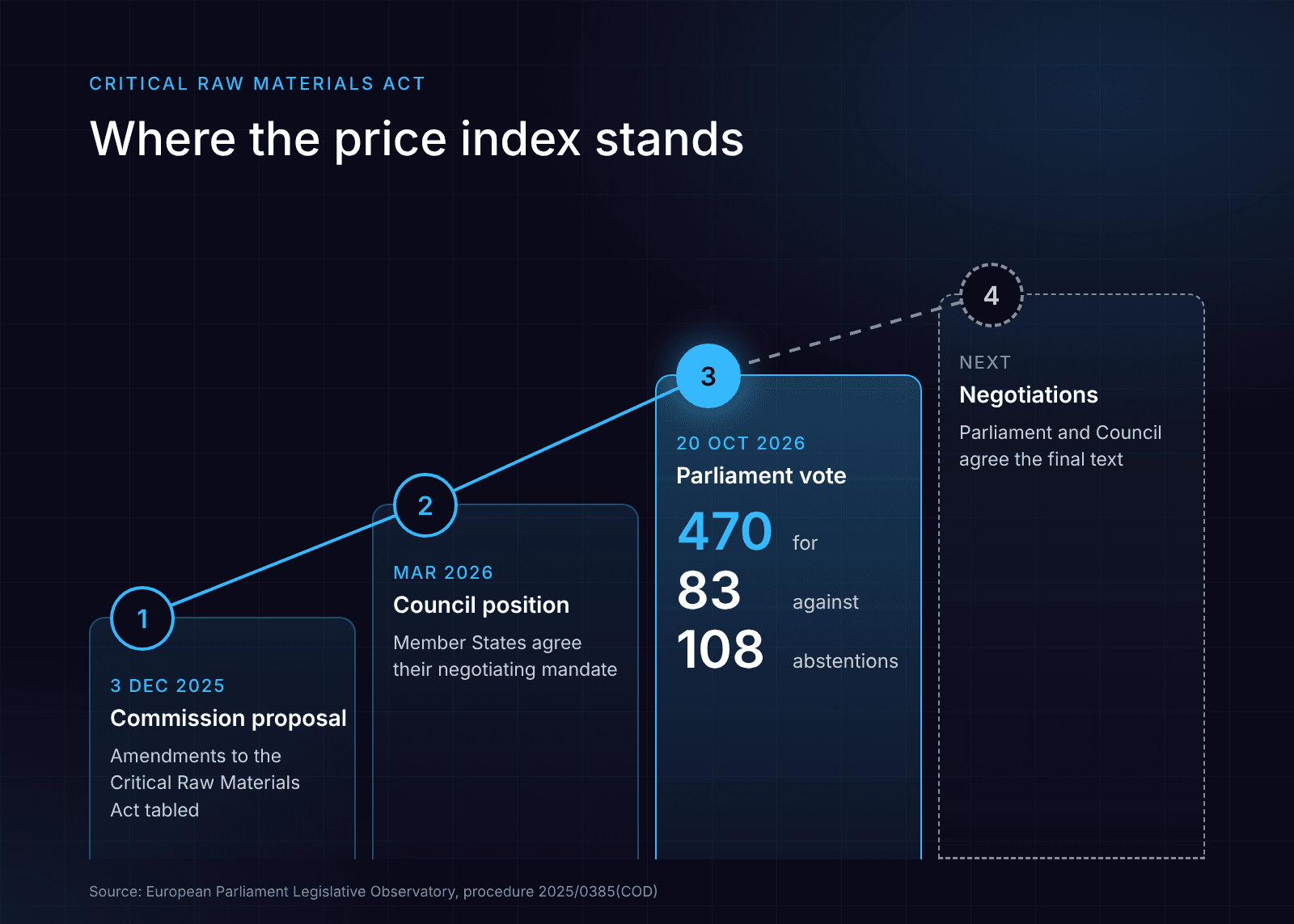
The Critical Raw Materials Act amendments, from the Commission proposal to negotiations between Parliament and the Council. Data Source: European Parliament Legislative Observatory.
Every tool Parliament wants to give the Centre, whether stockpiles, joint purchases or price floors, means spending public money at a price. For that to work, buyers, sellers and policymakers need to see how the price came about. Without that, nobody can check whether it reflects the market.
Price reporting agencies do a good job with the information they can collect, but in thin markets they depend on what a handful of companies choose to tell them. At LME Week, Peter Hannah from Albemarle put it clearly: “Understanding how a price is discovered is often just as important as the price itself.”
When buyers and sellers know the rules and can see where a market cleared, they trust the number, even while their own names stay confidential. So do investors and lenders. Bernd Schaefer, CEO of EIT RawMaterials, told Reuters that “the absence of transparency is an absolute deal breaker for many investments.” That is why I keep saying Europe needs to build markets as well as mines.
The European Investment Bank sees it the same way. Its vice-president, Nicola Beer, has proposed to Parliament a price index built on anonymised transaction data, with trades run on designated platforms and price reporting agencies validating the result. I like that split: venues produce the trades, and index providers and regulators turn them into benchmarks.
Europe is not the only one asking these questions. I travel to London regularly to talk to clients, exchanges and the UK government about how raw material markets mature. The UK’s Department for Business and Trade is preparing to procure a Critical Minerals Demand Aggregation Platform from 2027. India has adopted rules for its first electronic mineral exchange, starting with iron ore, manganese and bauxite. In Western Australia, a research project is designing a Perth Critical Minerals Exchange.
When I met a delegation from Indonesia’s Financial Services Authority (OJK) to discuss the country’s new commodity exchange, one word kept coming up, as it does in most of my conversations with policymakers: exchange. People often mean quite different things by it.
A commodity exchange such as the LME is a regulated venue for futures and other derivatives. Physical delivery only works if the material is fully fungible, and cash settlement needs an index everyone trusts. Many critical raw materials will never meet that test, because specification, origin and logistics matter too much.
They trade physically instead, through tenders and requests for quotes where the specification matters, and through auctions and open trading markets as products become more standard. That last step is the most transparency a physical market can have without becoming an exchange.
So when a government tells me it wants an exchange, my first question is what it wants to achieve, and whether an exchange is possible for that material at all.
My second question is who else it wants to trade with.
Commodity markets are global. Spodumene mined in Australia is processed in Asia and ends up in batteries made in Europe and America. If every country builds its own venue, each sees only a slice of that chain: liquidity splits, each index rests on fewer trades, and a seller has to join several platforms to reach the same buyers. The countries trying hardest to escape prices set elsewhere would lose the most.
The G7 has seen this risk. Its 2025 roadmap for standards-based markets calls for “interoperable digital infrastructure across initiatives”. That is the brief I would give Europe’s new Centre. National venues can work side by side if they share product specifications, contract terms and data formats, and if they can pool anonymised transaction data into one view of the market.
A platform cannot build a market on its own, and neither can a government. Markets need rules people trust, standards to trade against and enough companies willing to show a price. Governments can do a lot for the first two, and that is where we want to help.
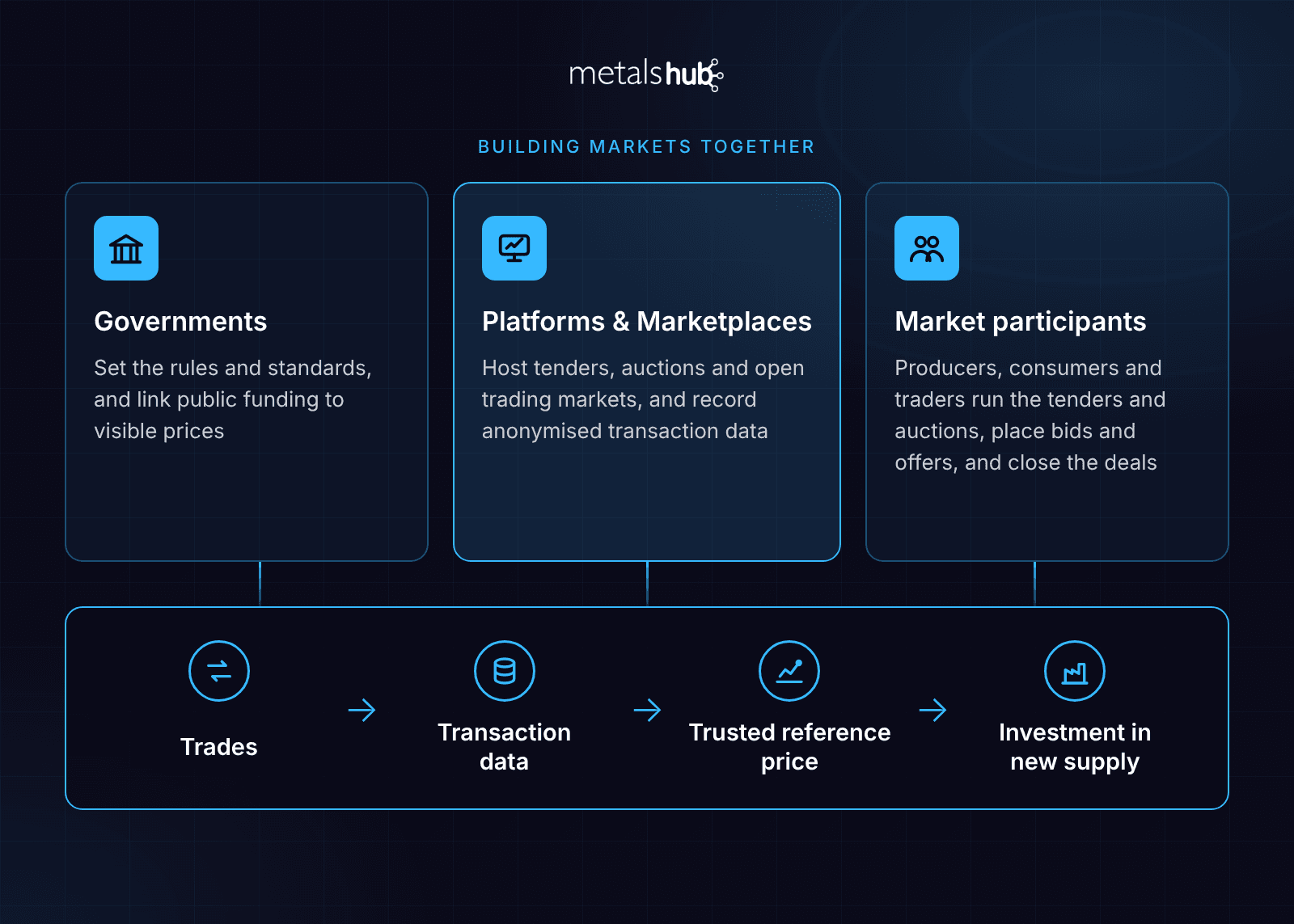
A market needs all three: rules, a venue and companies willing to take part.
Our policy paper of March 2026 proposed one practical step: link public support for new projects to trading on open digital marketplaces, along the lines of Japan’s JOGMEC, so that public money also helps form a visible price. The data to build on is already there. DERA, Germany’s mineral resources agency, publishes Metalshub prices in its monthly price reports.
We have made this case with EIT RawMaterials and, this autumn, at the BDI Resilienz-Kongress in Berlin and the EIT Rare Earth Conference in Turin. If you are working on these questions in a ministry, an agency or a development bank, we would like to hear from you.
None of this is theory for us. Albemarle began selling lithium through auctions on Metalshub in March 2024, and other lithium producers have since done the same. In the last 12 months, spodumene concentrate bidding events on the platform drew an average of 7.3 bids each, from 34 different buyers.
In November, we are adding Open Trading for lithium: firm bids and offers on one screen, visible to every vetted participant and anonymous until a deal is done between companies that have approved each other.
The technology is ready. What these markets need now is more companies willing to put part of their volume on a screen, because every trade made in the open makes the next price easier to trust, for buyers, sellers, lenders and now policymakers too.
Parliament adopted its first-reading position on amendments to the Critical Raw Materials Act, by 470 votes to 83 with 108 abstentions. The text creates a European Critical Raw Materials Centre and a proposed €2 billion fund. It now goes into negotiations with the Council.
No. Parliament’s position must be agreed with the Council, which adopted its own position in March 2026. The wording on price indices may change in those negotiations.
It is a proposed EU body with its own legal personality. Parliament wants it to run joint purchasing and stockpiles, support projects financially and monitor raw material markets in real time. It would also support market-based price indices.
Recital 10b says a price index should rest on market data, including anonymised transaction data collected through dedicated trade platforms or data aggregation mechanisms. The articles task the Centre with supporting and encouraging market-based price indices.
A commodity exchange such as the LME is a regulated venue for futures and other derivatives, with a clearing house that guarantees the trades. It needs a fully fungible material or a trusted index to settle against. Raw materials whose specification, origin and logistics matter trade physically on marketplaces instead, through tenders, auctions or open bids and offers.
The UK plans a demand aggregation platform from 2027. India has adopted rules for its first mineral exchange, Indonesia is setting up a commodity exchange starting with nickel, and Western Australia is funding research into a Perth critical minerals exchange.
Newsletter
insights