Iron & Steel
Who Will Melt Europe’s Stainless Steel? | MetalshubTalks 012 Recap
 Written bySamir Jaber
Published on
Share Post
Iron & Steel
Written bySamir Jaber
Published on
Share Post
Europe runs its stainless melt shops at around 65% of capacity, one Chinese-Indonesian group makes roughly a third of the world’s stainless steel, and the raw materials in every tonne move on ore grades, power tariffs and export quotas far from European mills. Two weeks after the industry met at the SMR International Stainless & Special Steel Conference in Offenbach, the conversation kept returning to one question: where will stainless still be melted in ten years, and who will supply the raw materials?
In a recent episode of MetalshubTalks, I sat down with Markus Moll, Managing Director of SMR Group, and Dr Sebastian Kreft, Co-Founder and Managing Director at Metalshub. We covered what stood out in Offenbach, why imported slabs are here to stay, why molybdenum topped buyers’ worries this year, what the Eskom power deal really changes for ferrochrome, and where AI is already paying off in raw material procurement.
Markus Moll: Two issues drove the discussion: geopolitics and AI. On geopolitics, one company now dominates stainless production. Tsingshan is close to 35% of global output, and approaching 40% if you only look at austenitic grades. Its message to Europe and North America is simple: why are you still melting stainless steel? We can do it much cheaper, and you can focus on downstream processing.
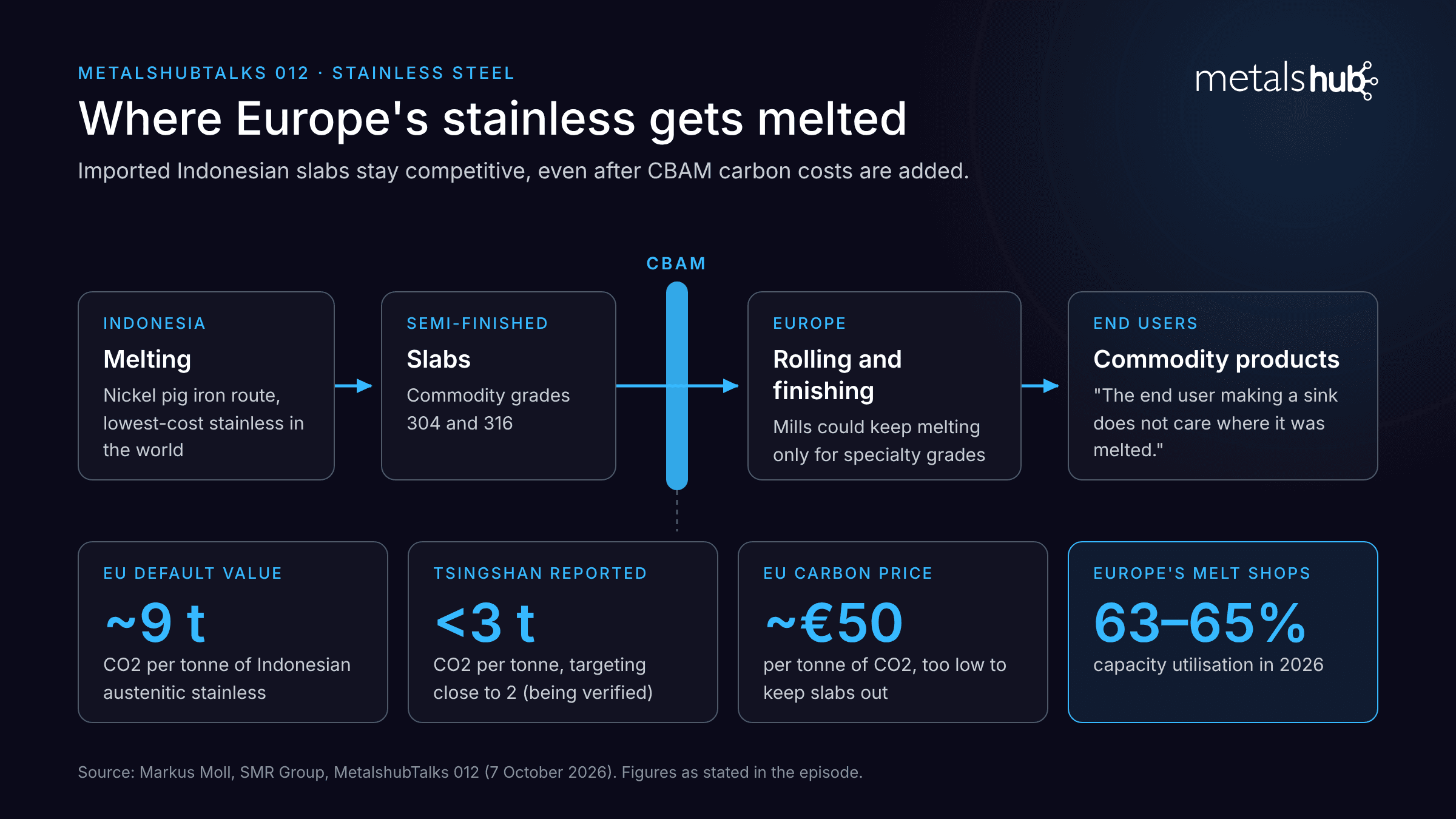
Some European producers are already testing that model by buying slabs from Indonesia. That holds back crude steel output in Europe, and the more is melted in Indonesia and China, the fewer ferroalloys are bought in Europe. Capacity utilisation in Europe is 63%, moving to 65% this year. At that level, the writing is on the wall: the industry needs consolidation in melting, hot rolling and cold finishing.
Dr Sebastian Kreft: There is no demand problem for stainless on a global level. It grows every year and is replacing carbon steel and, in some cases, aluminium, for example in battery casings for electric vehicles. The challenge for European mills is cost, above all energy costs, which put them at a disadvantage against other regions.
Markus Moll: We did the calculation, and the answer is clearly yes. The European Commission’s default value for Indonesian austenitic stainless is around nine tonnes of CO2 per tonne of steel. Tsingshan reports figures below three and is aiming for close to two, and those numbers are being verified now.
Then there is the carbon price. Germany wants to keep free certificates for industry and keep the CO2 price low to protect energy-intensive producers. That is understandable, but it takes the teeth out of CBAM. At around €50 per tonne of CO2, it will not keep CO2-intensive stainless out.
So slabs are here to stay. Until now, European mills mostly used slab purchases as a stick against scrap suppliers when scrap became expensive relative to the LME. The real decision is whether to outsource commodity grades such as 304 and 316 on a large scale. A mill with three furnaces could close two and keep one for duplex, heat-resistant and other specialty grades. For 304, the end user making a sink does not care where it was melted.
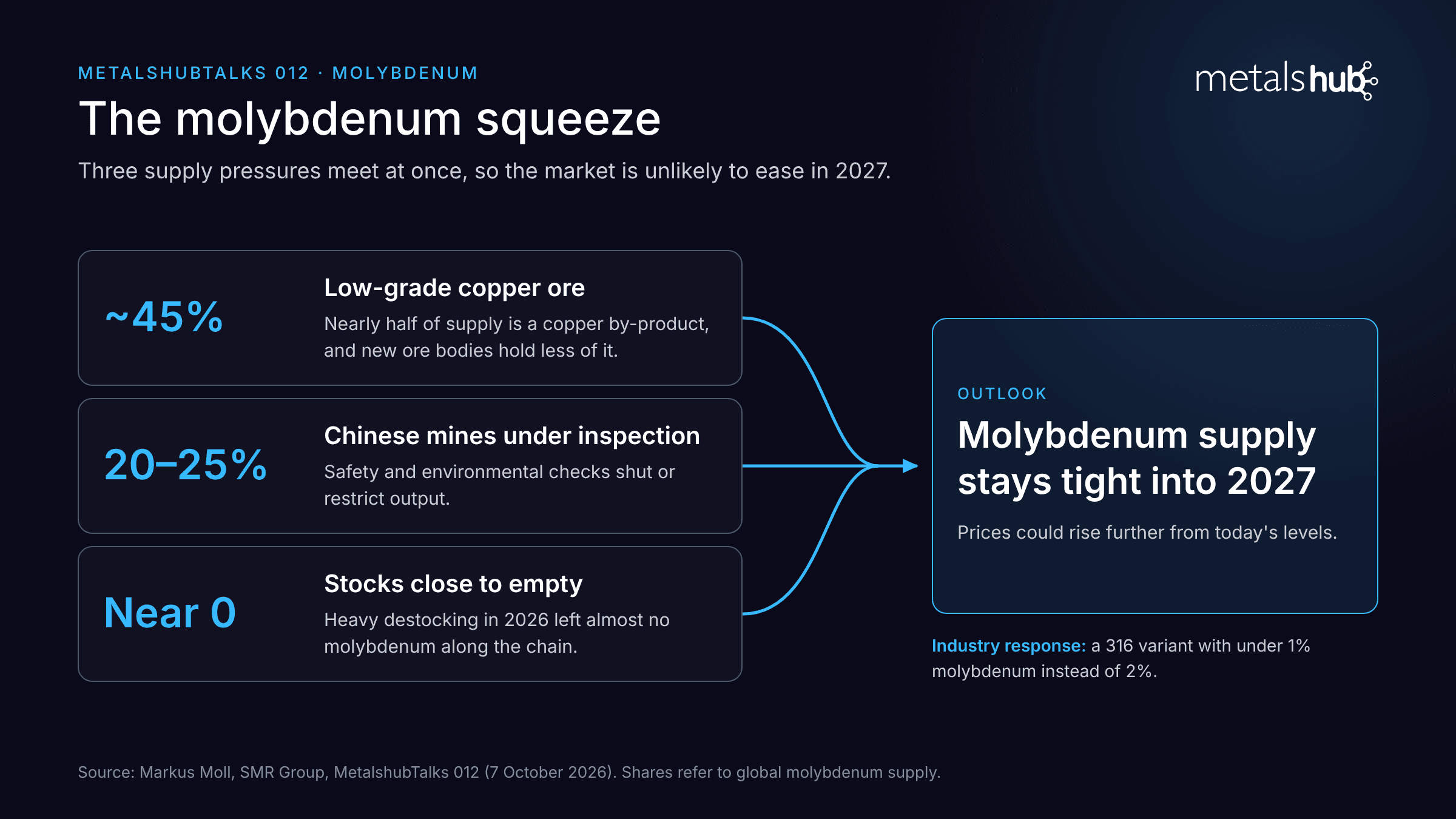
Markus Moll: The problem is on the supply side. Around 45% of all molybdenum is a by-product of copper mining, in Chile, Peru, China and the US. Copper output is rising, but mining is about ore quality. Climax, the world’s largest molybdenum producer, is moving into a low-molybdenum ore body at its US copper operations, and it will not change course because the molybdenum price is high. Copper is ten times more important to them. Climax already knows its molybdenum output will fall in 2027, and Chile and Peru are running into lower-molybdenum ore too.
China supplies 20 to 25% of the world’s moly, and many of its mines are under environmental and safety inspections after serious accidents. On top of that, heavy destocking in 2026 has left virtually no molybdenum in stock anywhere along the chain. I do not see the situation changing in 2027, and I would not be surprised if prices go even higher.
The industry is reacting. Aperam and Outokumpu have developed a 316 variant with less than 1% molybdenum instead of 2%, and some food processing companies already specify it. In aerospace, nobody will change a specification.
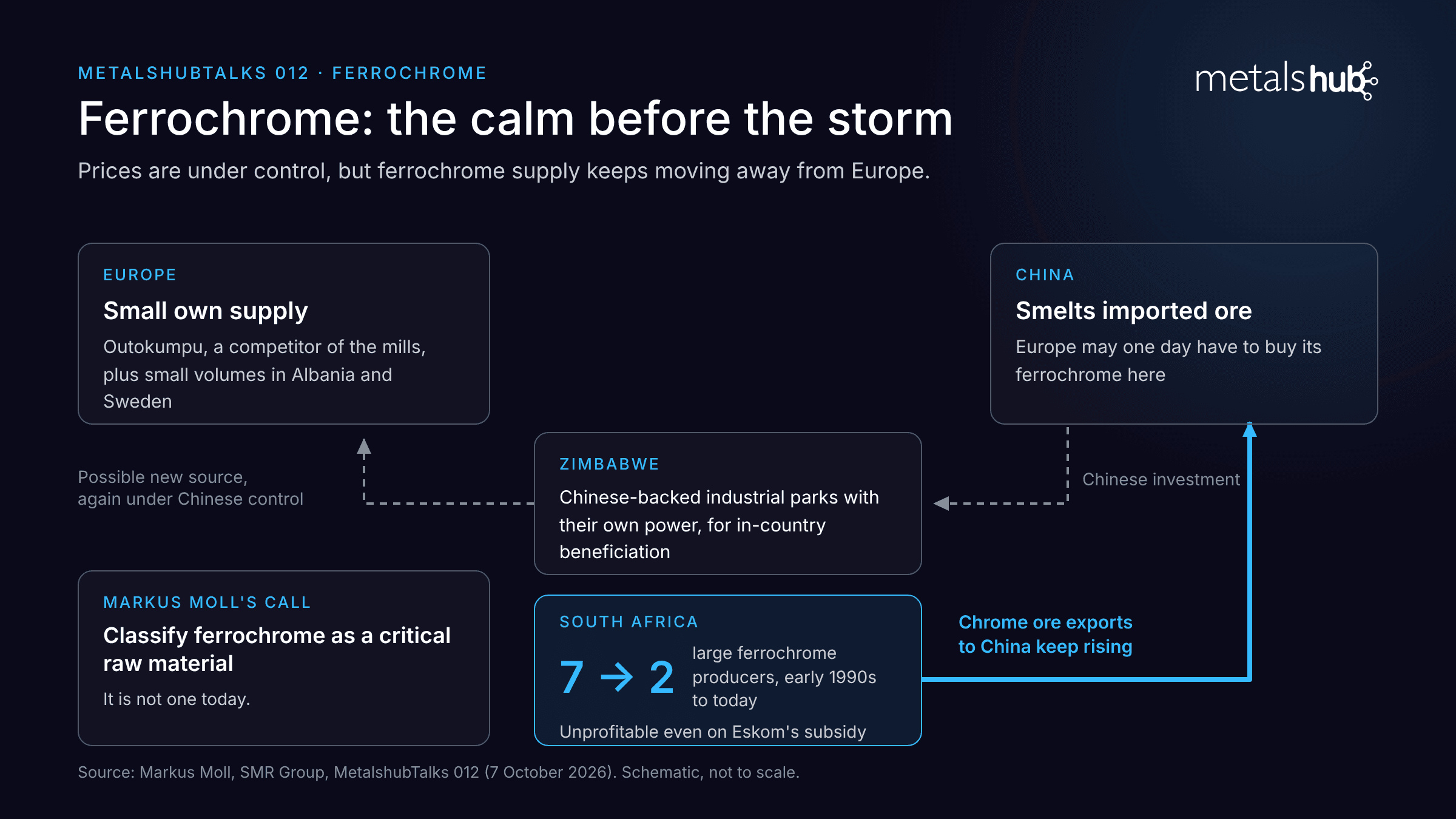
Markus Moll: I would not suggest anyone relax on chrome. The new tariff of around 62 South African cents, roughly four US cents per kilowatt-hour, is already a subsidised price, and our cost model shows South African ferrochrome producers still do not make money. So production there will keep eroding while ore exports to China keep rising.
In the early 1990s, South Africa had seven large ferrochrome producers. Now there are two: Samancor, which is controlled by Chinese interests, and Glencore, which says openly that it does not make money in chrome. In Europe, Outokumpu produces ferrochrome, but European mills should not depend on a competitor for a key input, and the other European sources are small. One day, Europe will have to buy its ferrochrome in China, and for me that is an alarm signal. Ferrochrome should be classified as a critical raw material. Prices are under control at the moment, but this is the calm before the storm.
Dr Sebastian Kreft: Zimbabwe is another country to watch. It wants to do more in-country beneficiation, turning chrome ore into ferrochrome, much as Indonesia did with nickel, and Chinese companies are investing in industrial parks there with their own power generation. That could become another source for Europe, but again with Chinese control. We covered South Africa and Zimbabwe in depth in our MetalshubTalks 008 with Sheraz Neffati of the ICDA.
Markus Moll: Nickel is the opposite case. Stocks are far too high, approaching 400,000 tonnes. Indonesian capacity built for battery materials is producing more than the market needs, because battery makers have shifted heavily towards LFP chemistry and battery demand is growing more slowly than forecast. Stainless producers are also maximising scrap use, which cuts into nickel demand. That is why the price is well below $16,000 per tonne.
At that level, many Chinese and Indonesian producers are losing money, which will trigger a supply-side reaction. I would expect the nickel price to be higher a year from now. Indonesia has cut quotas, raised them again and now adjusts them selectively, but for the moment it has lost control of the price.
Dr Sebastian Kreft: Indonesia supplies around 65% of the world’s nickel, and its politicians understand mining well. With quotas and royalties, they have real instruments to manage supply, so buyers should watch policy as closely as the market.
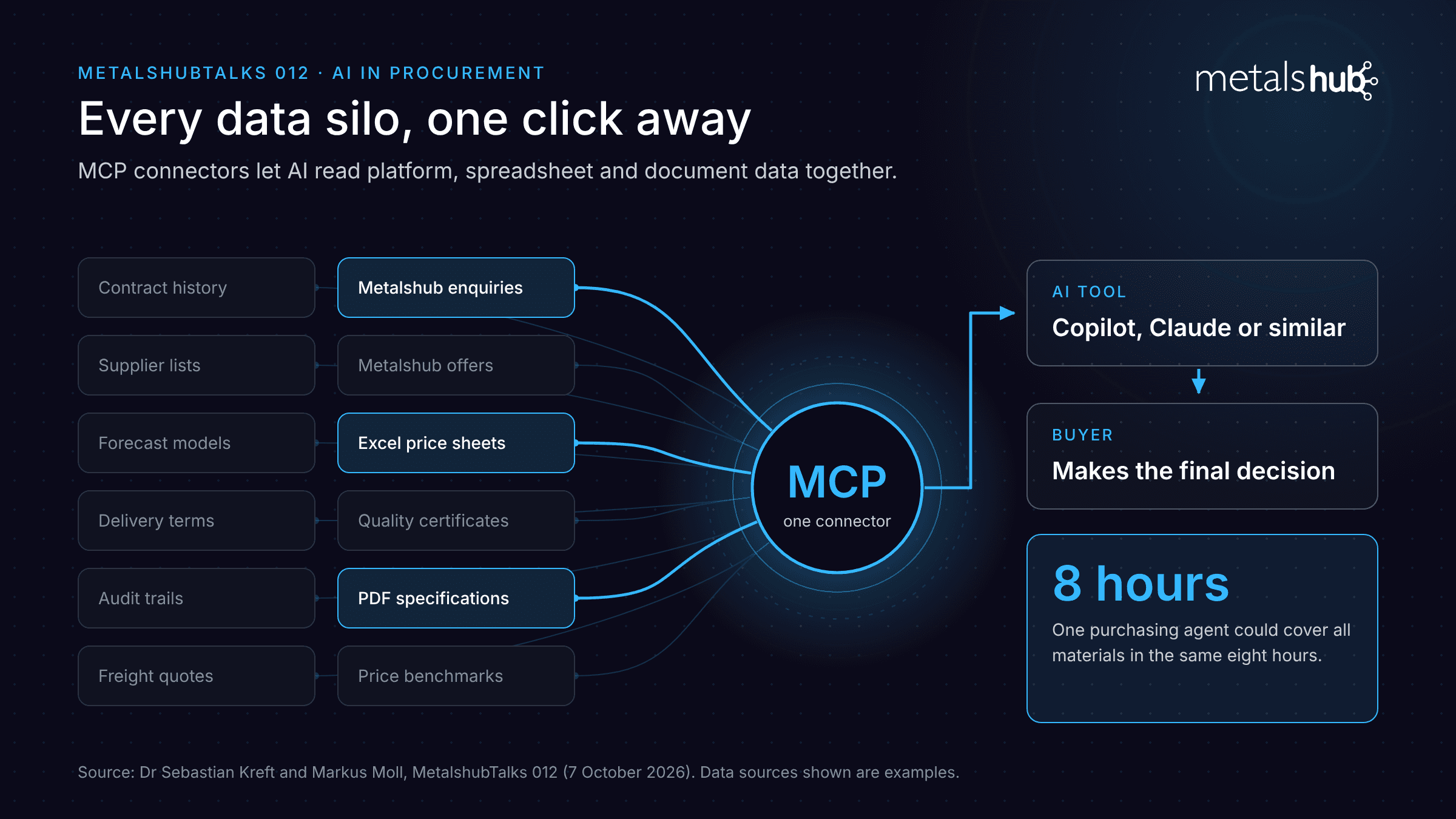
Dr Sebastian Kreft: In Offenbach, the CEOs all agreed that AI will have a huge impact on productivity and on how work gets done, and we are only at the beginning. What excites me most in our context is MCP, the standard connectors that link your AI tool to almost any data source. You can connect Metalshub to Copilot or Claude, along with your Excel sheets and the PDF files on your drive. Companies have always had data sitting in a thousand places. Now you can bring those silos together with one click, instead of a year-long IT project, and analyse everything at once.
Markus Moll: In production, AI is still a disappointment for me. For five years I have been hearing about predictive maintenance, which is low-hanging fruit. In purchasing and logistics, I see big cost and productivity gains. Take a procurement team connecting its internal AI to a platform like Metalshub. A purchasing agent who today only handles medium-carbon ferrochrome could cover everything in the same eight hours.
For now, the final decision stays with the manager, and the CEOs said the same. But over time you will see statistically who makes more mistakes. An agent with a clear target will first be not as good as a person, then as good, then better.
For more on how we see AI in raw material trading, read our AI vision and how AI agents connect to Metalshub through MCP.
Global stainless demand is healthy, but where stainless is melted, and therefore where its raw materials are bought, is now being settled by trade policy, carbon rules and state-backed investment as much as by cost. As Markus put it, geopolitics will rule our business. Sebastian’s advice for procurement teams was just as direct: risk management has never been more important.
For anyone buying or selling raw materials for stainless steel, three things are worth acting on now:
The full conversation goes further, including the audience Q&A on US mill capacity, electrical steels and whether CBAM is working.
MetalshubTalks 012
Interested in watching the full episode? Click below and watch it for free.
Newsletter