Battery Raw Materials
LFP Black Mass: From Disposal Cost to Sellable Product
 Written bySamir Jaber
Published on
Share Post
Battery Raw Materials
Written bySamir Jaber
Published on
Share Post
Two years ago, European recyclers paid to get rid of LFP black mass. Today, buyers will pay for it, but its value moves with lithium and nobody in Europe publishes a price.
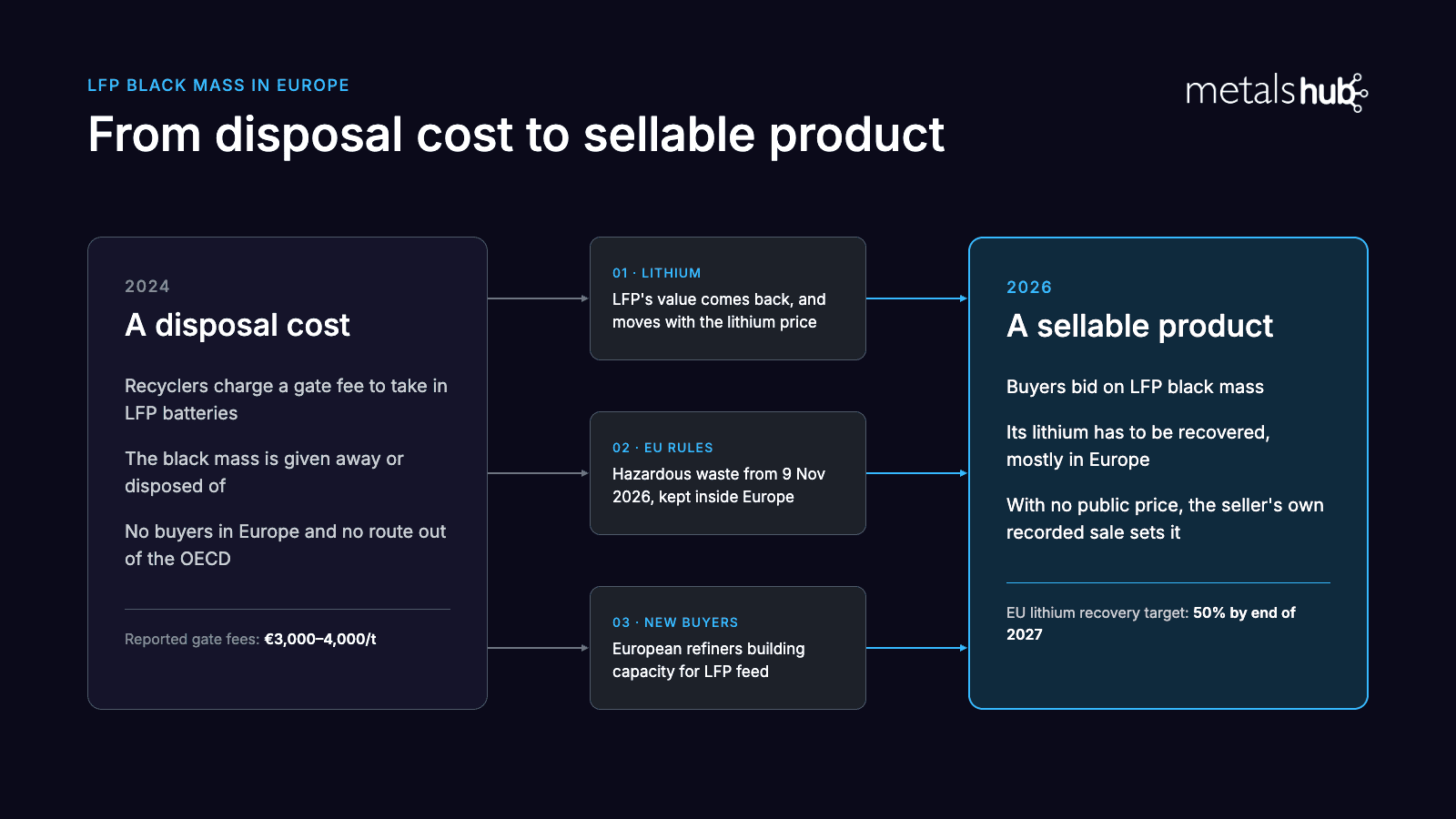
In 2024, recyclers in Europe reportedly charged gate fees of €3,000 to €4,000 a tonne to take in scrap LFP batteries, against €0 to €400 for NMC. The LFP black mass that came out the other end had almost nowhere to go. One European producer said it was selling some of its material “effectively for free” and disposing of the rest: “We hope to be paid for this material in the future.”
That future is arriving. LFP black mass now has buyers, European rules keep it inside the region, and refiners are building the capacity to process it. What the market still lacks is a price a seller can check.
Lithium, the only metal in LFP black mass that buyers pay for, has doubled and halved within a year, and no European reference tracks what the black mass itself fetches. As we argued when we set out our plan for a European black mass market, a market without reference prices is expensive for everyone in it. For a recycler with LFP material to sell, the most useful number is the one their own sale produces.
Battery recycling has always been paid for by nickel and cobalt. NMC black mass is priced on payables, a percentage of the market price of each metal it contains, and those two metals carry most of the value. LFP cells contain neither.
Benchmark calls LFP black mass “an exception to the use of payables.” Lithium is its only valuable component, present in low concentrations alongside high impurities, so the material is valued as a fixed amount based on its lithium content. With lithium prices low in 2024, that left little to pay for, or as Fastmarkets analyst Luke Sweeney put it at LME Week that year: “The lack of nickel and cobalt kills the economics of recycling LFP batteries.”
Europe also had nowhere to send the material. Importing LFP black mass into China was still illegal, most European black mass could not leave the OECD, and interest in treating LFP inside Europe was, in Fastmarkets’ words, “slim to none”. A recycler holding LFP black mass had a product with no market and a storage bill.
Three things have changed since then, and each one moves the material closer to being sellable.
Lithium prices nearly doubled in the two months around the turn of 2026, and Chinese lithium carbonate futures reached a 33-month high of 209,880 yuan a tonne on 13 May 2026. On 12 October, the most active contract closed at 104,740 yuan, about half that peak. The rise showed that LFP black mass is worth something when lithium is priced well, and the fall showed how quickly that worth can change.
The second change takes effect in a matter of weeks. Commission Delegated Decision (EU) 2025/934 lists black mass as hazardous waste under code 19 14 02*, and it applies from 9 November 2026. The Commission’s stated aim is to keep black mass in the European economy, so the classification bans its export to countries outside the OECD.
The Batteries Regulation adds a second requirement: recyclers must recover 50% of the lithium in waste batteries by the end of 2027 and 80% by the end of 2031. Taken together, the rules mean that the lithium in Europe’s LFP black mass has to be recovered, and mostly in Europe.
That recovery needs refiners, and they are starting to appear. In December 2025, cylib received €63.4 million from Germany’s economy ministry for what it calls Europe’s first dedicated recycling line for LFP batteries, at Chempark Dormagen, due to start in 2027. In Delft, the hydrometallurgical refiner Back to Battery joined Metalshub in June 2026 to sell recycled lithium carbonate and graphite and to source black mass from recyclers.
Demand is growing further afield too. Benchmark’s review of the third quarter of 2026 found that liquidity for LFP black mass grew outside China as more Asian buyers turned to LFP feed, with prices rising and gate fees becoming less common.
LFP black mass now has buyers. The harder question for a seller is what those buyers should pay.
LFP black mass is priced per point of lithium content. In China, Benchmark’s assessment of that price fell from RMB 7,350 a tonne per lithium point at the end of June 2026 to RMB 6,350 at the end of September, following lithium down. The same material lost more than a tenth of its value within one quarter.
Europe has no equivalent public figure. European black mass is expected to keep trading at a structural discount because of limited refining capacity and export restrictions, and Benchmark warns that as buying interest in LFP grows, “there could be significant shifts in the price.” Most European deals are agreed bilaterally, on assays and terms that differ from lot to lot, and the price is never published.
That leaves the seller negotiating against a buyer who usually sees more of the market than they do. It also costs the sector as a whole: without accepted reference prices, banks apply higher risk buffers and the cost of capital for recyclers rises. A grade that is only now becoming sellable needs prices on record before it can be financed like any other commodity.
So where does a seller find the price? One of the clearest answers we have comes from one recycler’s two recent sales on Metalshub.
Batrec, based in Wimmis in Switzerland and part of Veolia, recycles portable batteries rather than EV packs. Its black mass is high in cobalt and lower in nickel, which makes it hard to compare with any published index. In 2026, it began selling that material through bidding events on Metalshub’s Sales Solution.
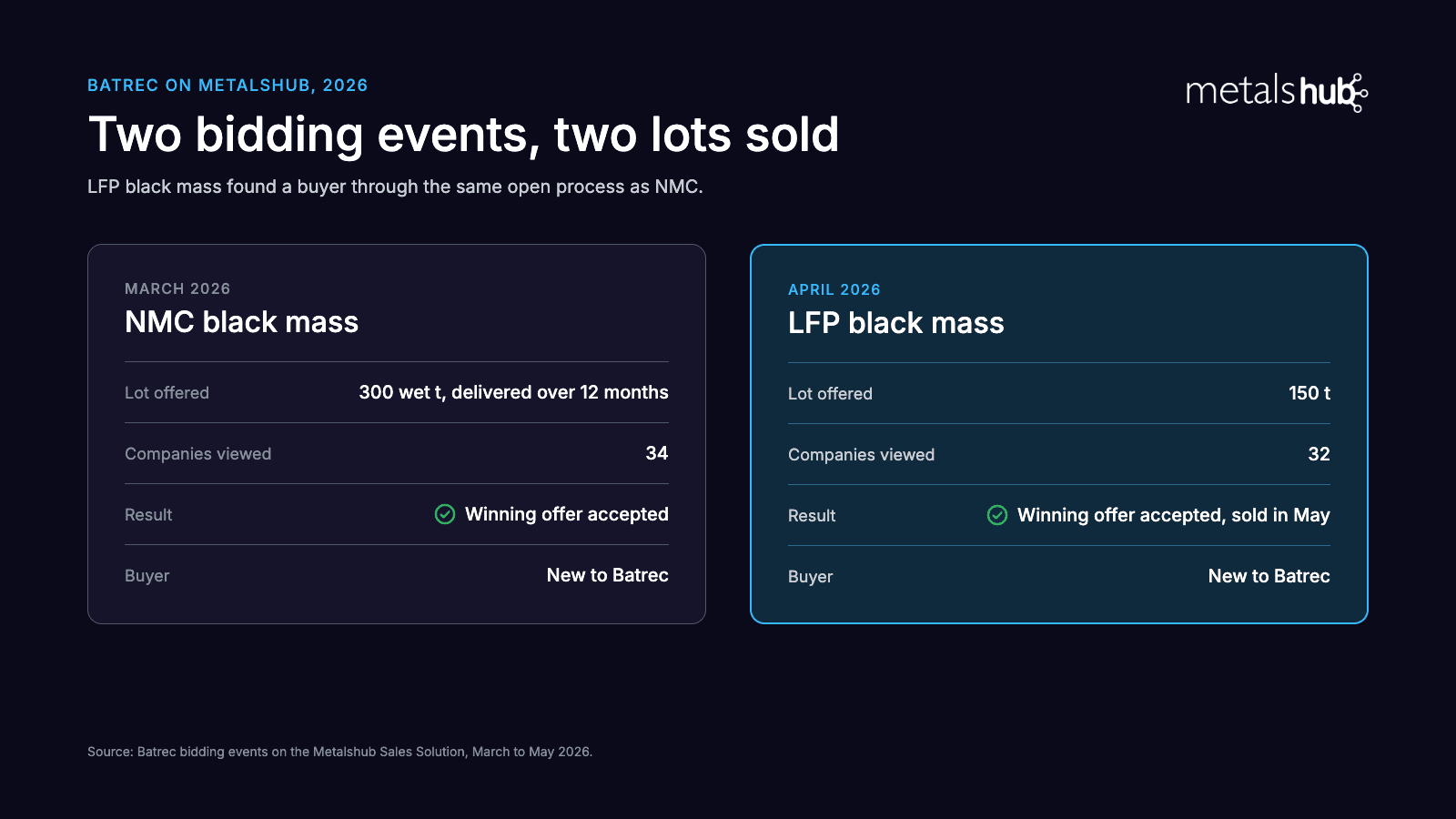
The first event, in March, offered 300 wet tonnes of NMC black mass for delivery over twelve months. 34 companies viewed it, 18 made offers, and the lot went to a buyer Batrec had not sold to before. By Batrec’s own estimate, the result pointed to more than 50% higher revenue than its previous way of selling.
In April, Batrec put 150 tonnes of LFP black mass through the same process. 32 companies viewed it, one made an offer, and the material sold in May, again to a buyer new to Batrec.
Read side by side, the two events describe the LFP market more accurately than any forecast. LFP black mass now finds a buyer through an open, competitive process, which two years ago it could not. The depth that NMC already has, with many bidders competing for the same lot, is not there yet for LFP.
Building that depth is the work of the next twelve months, and every recorded sale adds to the evidence buyers and sellers can price from. When the collaboration began, Batrec’s Head of Sales, Batteries and Metals, Anastasiia Fedosova, described its aim as helping Batrec “better understand its true value through transparent, data-driven pricing.”
For a recycler with LFP material, waiting for a European index means waiting for other people’s sales to set your price. With lithium moving as it has this year, the price that matters is the one on the day you sell. The way to find it is to put the material in front of enough buyers at once and see what they bid.
Reach matters more than it did. The buyers who will pay for LFP black mass include refiners that were not buying two years ago, and many of them will not be in a recycler’s contact book. A bidding event on Metalshub puts a lot in front of a network of over 3,000 active companies and leaves the seller in control: events can be private and invitation-only, the seller decides who sees the lot, and bids stay confidential.
The result is recorded, so the recycler can show afterwards that the price they accepted was the best offer they received. Each recorded sale is also a data point in a market that has very few, and the recyclers who run them now will shape how LFP black mass is priced in Europe once the volumes arrive.
If you produce LFP black mass in Europe and want to know what your next lot is worth, talk to us about running your first sales event.
MetalshubTalks
Watch our recent MetalshubTalks episodes with experts from Primobius and Royal Bees.
LFP black mass is the powder recovered when lithium iron phosphate batteries and production scrap are discharged, shredded and separated. Lithium is the only component buyers currently pay for, so it is worth less than NMC black mass, where nickel and cobalt carry most of the value.
It is priced on its lithium content, usually per lithium point, instead of on payables for several metals as NMC black mass is. In China, Benchmark assessed it at RMB 6,350 a tonne per lithium point at the end of September 2026. Europe has no published equivalent.
Not to countries outside the OECD. Under Delegated Decision (EU) 2025/934, which applies from 9 November 2026, black mass is classed as hazardous waste. Shipments within the EU and to other OECD countries remain possible under the prior notification and consent procedure.
No accepted European reference exists yet. Published assessments, such as Benchmark’s, cover China and Asia, and European deals are mostly agreed bilaterally without a published price. Recorded, competitive sales are the main source of price evidence for European sellers today.
Yes, and capacity is growing. Recyclers already shred LFP batteries into black mass, and cylib’s dedicated LFP line in Dormagen, Germany, is due to start in 2027. EU rules require 50% of the lithium in waste batteries to be recovered by the end of 2027 and 80% by the end of 2031.
Newsletter