Iron & Steel
Aluminium DeOx (DeOx Al): What It Is and How It’s Used
 Written bySebastian Kreft
Published on
Share Post
Iron & Steel
Written bySebastian Kreft
Published on
Share Post
Aluminium deox is deoxidation-grade aluminium used to remove dissolved oxygen from liquid steel and produce killed steel with tight cleanliness and grain control. It is typically added in the final deoxidation stage and reacts with oxygen to form stable aluminium oxide. The result is lower oxygen content, finer grain size and improved properties in demanding grades.
Taking the Basic Oxygen Furnace (BOF) production route for steel making, the molten steel typically contains between 400 to 800 ppm of oxygen when it’s ready to be tapped. To remove this oxygen and to prevent further oxidation of carbon, materials like ferromanganese, ferrosilicon or DeOx aluminium are added to the ladle as deoxidizers during tapping.
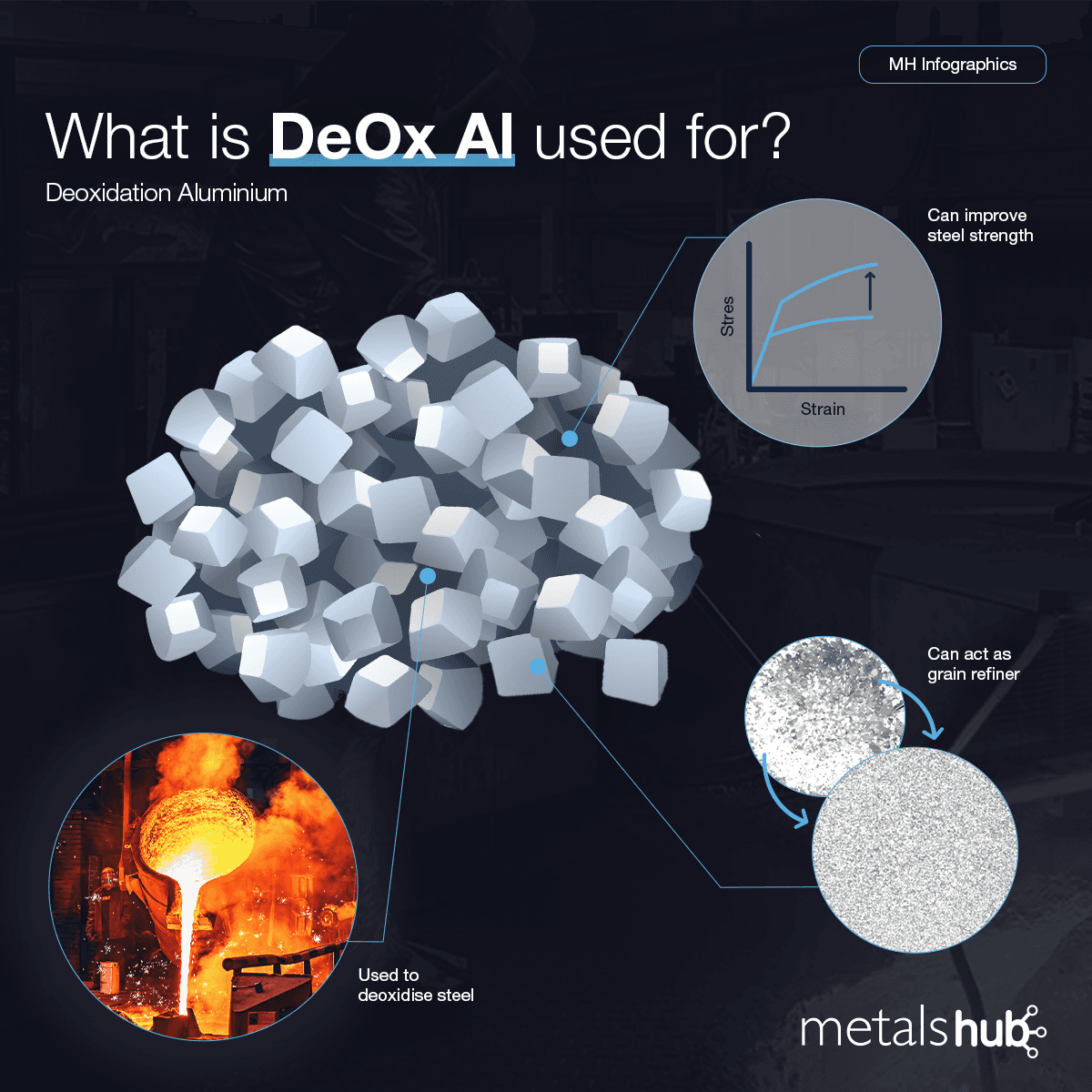
The choice of deoxidizer depends on specific requirements of the steelmaking process and the desired properties of the final steel product. Ferromanganese (FeMn) is usually added when moderate deoxidation is needed and ferrosilicon (FeSi) is used when a more powerful deoxidation effect is required – often following the use of FeMn.
DeOx aluminium is used when very strong deoxidation is needed, typically in the final stage of deoxidation, after initial additions of FeMn or FeSi. It is often used in low-carbon, high-strength steels or where a high degree of cleanliness is critical. Aluminium is a highly effective deoxidiser, as it reacts strongly with oxygen to form aluminium oxide (Al₂O₃), which helps remove oxygen very efficiently from the steel.
Aluminium also helps control the grain size in the final product, acting as a grain refiner, which improves its strength and toughness. It is frequently used in the production of grain-refined steels, needed for automotive and aerospace applications, as well as in low-carbon and high-strength alloy steels. Aluminium-killed steels (i.e., those deoxidised with aluminium) are used when minimal oxygen content is required to avoid gas-related defects.
In modern steelmaking, aluminium deoxidation is chosen in situations where precise control over oxygen content and microstructure is essential. It is used to achieve precise metallurgical outcomes that alternative deoxidisers cannot match.
In production routes where downstream processing or final mechanical properties demand extremely low dissolved oxygen, aluminium deox is used to fine-tune oxygen content to target values. This is particularly important in steel grades destined for deep-drawing, ultra-clean bearing steels, or other critical uses where microscopic inclusions can cause premature failure.
Applications such as pipelines, structural beams, and pressure vessels often specify oxygen and nitrogen limits in parts per million. Aluminium deox enables producers to meet these thresholds consistently, ensuring predictable toughness, weldability, and corrosion resistance.
When incorporated strategically, aluminium not only deoxidises but also promotes a refined ferrite grain structure. This enhances strength-to-weight ratio and formability, which are vital for producing high-end automotive panels, aerospace sheets, and precision-rolled strips.
Mills that favour aluminium-killed steels leverage secondary metallurgy steps such as argon stirring or vacuum treatment to float out and capture alumina inclusions. This combination of strong deoxidation with active cleanliness control enables reliable quality in demanding applications like electrical steels and linepipe.
Producing DeOx aluminium can take different routes. Most DeOx aluminium is produced by melting clean aluminium scrap, refining the melt to remove impurities, and casting it into shapes that support efficient addition during steelmaking. The choice of form — ingot, briquette, cone, hemisphere, granule, or wire — determines how the deoxidiser melts, reacts, and disperses in molten steel. Shape and size specifications are selected to match steelmaking routes and ladle practices, aiming for consistent reaction efficiency and minimal waste.
DeOx Al is traded globally, with specifications defined by chemical composition, shape, size, and packaging. Many producers and traders now use digital procurement platforms to access a broader supplier base, increase price transparency, and streamline negotiations.
In recent years, many companies have adopted digital solutions to streamline the buying and selling of deoxidation aluminium. Metalshub’s Procurement and Sales Solutions facilitate approximately €30 million in DeOx aluminium transactions each year, connecting buyers and sellers with standardised digital workflows. Companies such as Alcuilux Desox S.A., Hütte Klein-Reichenbach GmbH, and Shanghai Shenyun Iron Alloy Co., Ltd. use the platform to offer on competitive tenders and maintain clear records for compliance. Digitalisation of this process supports faster sourcing, improved market visibility, and better benchmarking of procurement performance over time.
Are your a DeOx supplier? Register to Metalshub!
Newsletter
insights