Aluminium
Copper
Industrial Minerals
Battery Raw Materials
Platform Comparison
Iron & Steel
Ivalua vs Metalshub: Which Platform Is Better for Raw Material Procurement?
 Written bySamir Jaber
Published on
Share Post

Aluminium
Copper
Industrial Minerals
Battery Raw Materials
Platform Comparison
Iron & Steel
Written bySamir Jaber
Published on
Share Post
Ivalua and Metalshub both help procurement teams source better, but they are built for different jobs. Ivalua is a broad source-to-pay suite that manages direct materials, indirect goods, services and tail spend across industries. Metalshub is purpose-built for raw material procurement, where buying happens by specification, chemistry, index-linked pricing and lot size across mills, smelters, foundries and recyclers.
Ivalua is a source-to-pay suite that helps large companies manage and automate purchasing across all spend categories, with particular depth in BOM-driven direct materials for manufacturers. Metalshub starts with the raw material itself, built only for sourcing physical commodities in the metals, mining, and recycling industries.
The difference is clearest when the purchase is a direct raw material. Buying metals, alloys, industrial minerals, scrap, or battery materials takes more than running sourcing events and managing a supplier portal. It runs on index-linked prices that move with the market, adjustments for chemistry and quality, tenders for specific grades and volumes, and a vetted base of commodity suppliers.
These are the everyday conventions of commodity buying, and they sit outside what a horizontal source-to-pay suite is built to do. The table below sets out how the two platforms differ for raw material procurement.
| Ivalua | Metalshub | |
| Core purpose | Source-to-pay suite across all categories of enterprise spend | Purpose-built platform for sourcing direct raw materials in metals, mining and recycling |
| Direct materials model | BOM-driven sourcing tied to production and MRP | Specification and chemistry-based buying by lot |
| Supplier discovery | Buyer’s own suppliers onboarded through a branded portal | Pre-vetted, KYC-checked metals, mining and recycling counterparties |
| Pricing logic | Negotiated prices, cost breakdowns and should-cost models | Index-linked formulas, multi-element pricing and offer normalisation |
| Price discovery | Spend analysis and benchmarking from internal data | Active supplier network for competitive price discovery |
| Tenders and auctions | Configurable RFx events and sourcing optimisation across categories | Public and private tenders, reverse auctions and digital negotiations built around raw material specs |
| Contract management | Enterprise CLM across all spend, with clause libraries and approvals | Commodity-aware contracts, call-offs against frameworks and linked certificates of analysis |
| Compliance and carbon | Configurable ESG and supplier risk reporting | Transaction-level CO₂ and CBAM-ready data in the offer workflow |
| Industry fit | Broad suite configured to each organisation | Built for the metals, mining and recycling sectors |
| ERP integration | Native multi-ERP integration hub across the S2P process | Connects to ERP and indirect procurement software via API |
| Onboarding | Commonly several months with implementation partners | Typically weeks, without third-party consultants |
Ivalua is a source-to-pay suite with more than 20 years in procurement software, based in Redwood City, California. It positions itself as a global provider of AI-powered procurement software that manages spend and suppliers on a single platform. The suite unifies intake, source-to-contract, supplier management, and procure-to-pay within a single data model. In practice, that means sourcing, contracts, eProcurement, invoicing, payments and spend analysis all sit inside one system.
Ivalua covers the full breadth of enterprise spend. The platform is built to manage indirect goods, services, direct materials and complex categories in one place, from source to pay.

Gartner named Ivalua a Leader in its 2026 Magic Quadrant for Source-to-Pay Suites. Ivalua reports that its platform serves over 500 global organisations worldwide, and its customer base is heavily weighted toward manufacturing, automotive, and other complex production industries.
Ivalua positions itself around a single, unified data model that reaches every category of spend. The platform spans the full source-to-pay cycle:
Ivalua’s direct materials capability is aimed at manufacturers sourcing the components and subassemblies that go into a finished product, where the bill of materials is the organising logic.
Independent reviews on G2 credit the platform’s configurability and depth. Reviews also mention a steep learning curve, long implementation timelines, and a heavy administration load.
Metalshub is a B2B software platform built specifically for the metals, mining, and recycling industry. It digitalises the commercial workflows involved in buying, selling, and trading physical raw materials. More than 3,000 companies use the platform, including Outokumpu, RHI Magnesita, and Metso.
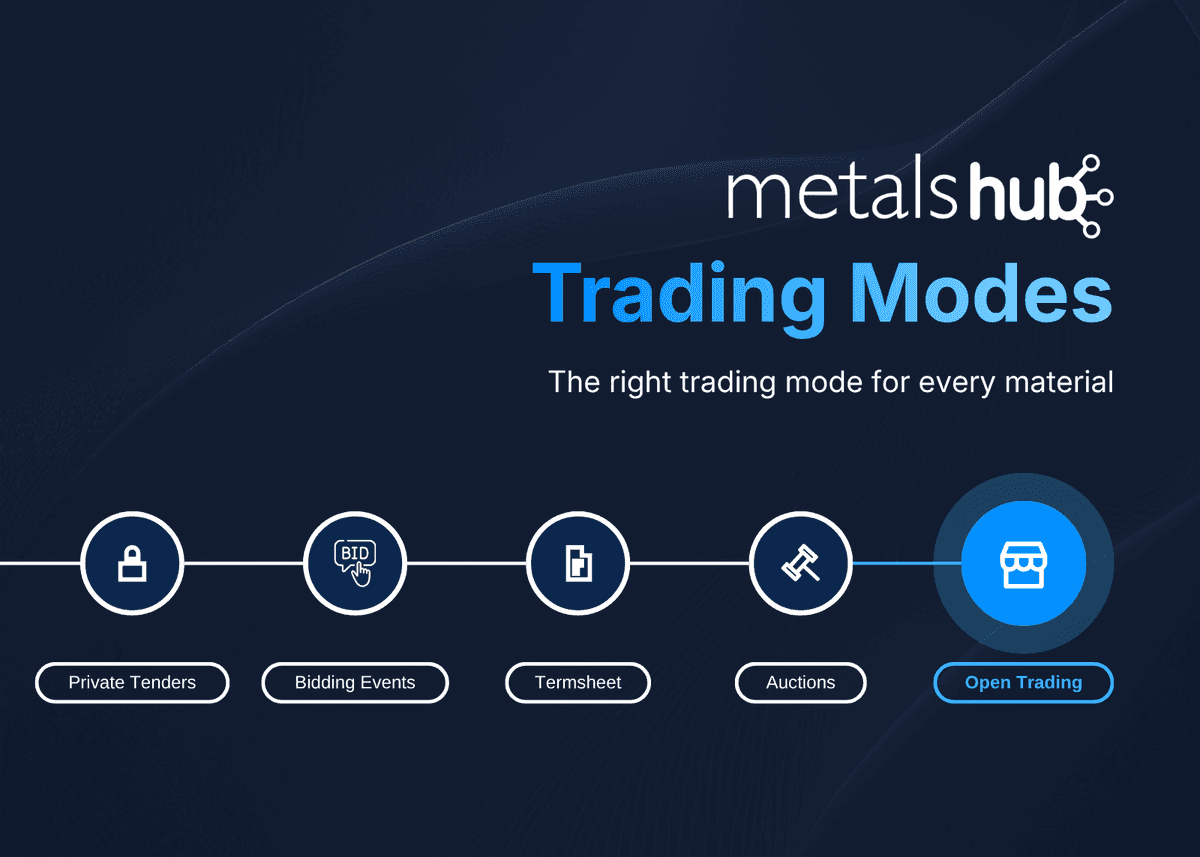
Metalshub offers three solutions across the supply chain:
Two features set Metalshub apart from general procurement software:
The platform also carries analytics and compliance features designed for commodities. Every RFQ, offer, negotiation round and award is stored as structured data, creating a complete and auditable record. Sustainability data such as CO₂ footprint and CBAM information is built into the workflow rather than bolted on afterwards.
“Metalshub offers us the opportunity to expand our supplier base globally.”
The differences between the two platforms come down to the kind of buying each is built around. Ivalua is designed for a company’s total spend, with real depth in BOM-driven direct materials. Metalshub is designed for how raw materials move through a market, priced by index, bought by specification and traded across a vetted supplier network.
The sections below work through where the two diverge, starting with sourcing itself, where a bill of materials and a commodity lot call for very different workflows.
The clearest divide between the two platforms is the unit of purchase they are designed around. Ivalua’s direct materials strength is built on the bill of materials. In BOM-driven sourcing, procurement works backwards from the product. A production forecast is multiplied by BOM quantities, current inventory is subtracted, and the result is the net requirement to source.
Sales forecasts and production schedules flow into MRP systems, which explode the BOM into component-level requirements that then drive purchase orders. This is the right model for automotive or electronics, where a BOM can span thousands of parts across multiple tiers.
Raw material procurement does not start from a bill of materials. A steel mill or foundry buys ferroalloys, scrap, pig iron or industrial minerals by specification and chemistry, in defined lots, priced against a market index or benchmark that moves daily. This is the model Metalshub is built around.
The buying decision turns on grade, quality tolerance, delivery terms and where the market sits that week, not on exploding a parts list into component demand.
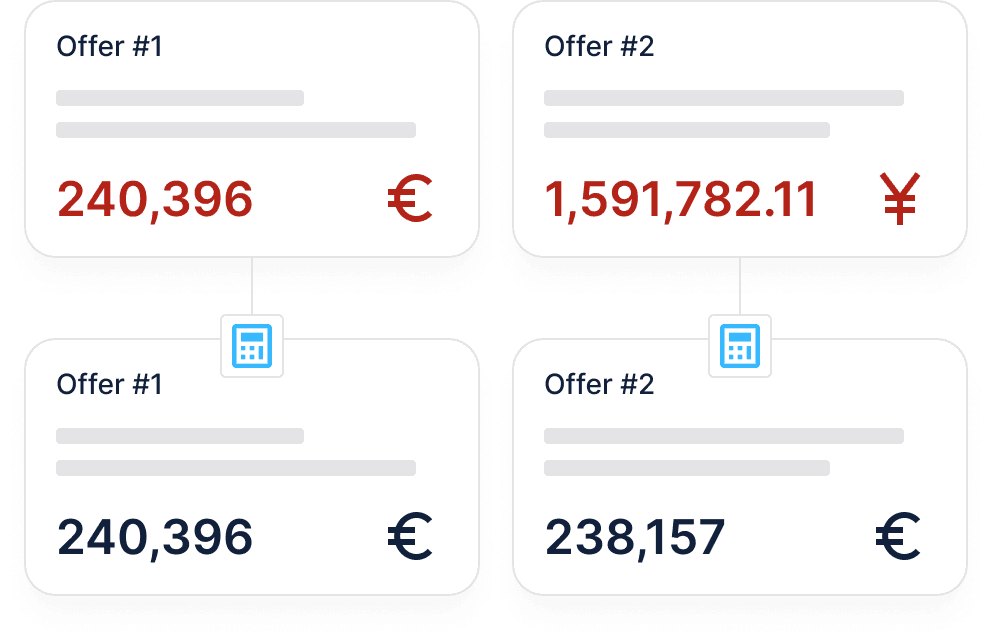
That changes what the software has to do well. A component has a part number, an approved supplier, and a negotiated unit cost that remains in effect until the next contract. A commodity has a specification range, several interchangeable sources, and a price that must be normalised across currencies, Incoterms, and quality before two offers can be compared.
“Metalshub is user-friendly and specifically developed for raw materials procurement with all its particularities. It saves us time and it gives me peace of mind that all compliance requirements have been met. We have even discovered new suppliers which resulted in cost savings.”
The two platforms take opposite approaches to where suppliers come from. Ivalua operates within a buyer’s existing supplier base. Its model is a branded supplier portal where an organisation invites, onboards, and manages vendors it already knows or has selected. Ivalua deliberately positions this as an alternative to third-party networks, arguing that a direct, company-specific portal gives buyers more control and a stronger relationship with their suppliers.
Raw material buyers often have the opposite need. A mill facing a supply disruption, a new grade requirement, or a volatile market wants to reach beyond its existing suppliers and put more offers in competition.
This is where an active network changes the workflow. Metalshub gives buyers access to a large ecosystem of pre-vetted counterparties, with KYC and company ratings applied before trading. Procurement teams can discover new suppliers and run competitive enquiries against them, rather than only administering the base they walked in with.
The vetting matters as much as the reach. In commodity markets, a new supplier is only useful if the buyer can trust its compliance standing and trade with it quickly. Pre-vetted onboarding removes the due diligence lag that would otherwise slow and risk opening the supplier pool.
Ivalua can, of course, hold and manage raw material suppliers in its portal. What it does not provide natively is an existing, vetted pool of metal and mineral sellers that a buyer can source from on day one.
Ivalua is a large, configurable suite, and that depth carries a setup cost. G2’s user data and independent reviews consistently describe the platform as complex to configure, with a long implementation and a steep learning curve for administrators and end users.
The complexity is not a flaw so much as a consequence of the model. A suite designed to handle every spend category across many industries has to be shaped to each organisation before it fits. Reviewers point to several things that lengthen a rollout:
For a procurement team whose priority is raw material sourcing, a multi-month, consultant-led rollout is a heavy way to reach a single use case.
A specialist platform starts from a narrower base. Because Metalshub is built only for raw material procurement, buyers can be live within weeks rather than months, without a consultant-led configuration project. The workflows for specification-based buying, offer normalisation, and index benchmarking are already in place, so there is less to build and less to learn.
Ivalua’s analytics are broad by design. Its spend analysis module classifies spend against UNSPSC codes and custom category hierarchies, then feeds dashboards that show spend by category, supplier, entity, and period. The strength of the model is a full spend cube across the organisation, enabling a team to spot consolidation opportunities, off-contract purchasing, and savings across every category.
That is the right lens for enterprise spend management. It is a category-and-supplier view, tuned to questions such as where money goes, which suppliers drive spend, and where duplication occurs.
Raw material buyers ask a narrower and more market-driven set of questions. Their performance is judged against a moving market, not a fixed budget, so the measures that matter are commodity-specific:
Reaching this level of commodity insight in a horizontal suite means configuration. The category framework, the index feeds and the normalisation logic all have to be built and maintained, because they are not the native unit the suite is designed around.
A specialist platform starts with them already in place. Metalshub embeds purchase price variance benchmarking, offer normalisation and supplier win-ratio analytics into the sourcing workflow, drawing on transaction-based price data through the Metalshub Price Index.
“We run a rigorous programme for continuous improvement and lean processes and with Metalshub we achieved high efficiency in our raw materials procurement management and have saved a significant amount because of the competitive nature of our tendering process.”
The right platform depends on what a procurement team spends most of its time and money buying. For most organisations, the two are not direct substitutes, because they are built around different kinds of spend.
For a large manufacturer, the two platforms often solve different problems simultaneously. Ivalua can manage indirect spend, services and BOM-driven direct materials across the business, while raw material sourcing runs on a platform built for index pricing, chemistry adjustments and a vetted commodity supplier network.
The two are not competing for the same workflow. One governs total enterprise spend. The other governs how metals, scrap and minerals are actually bought and benchmarked. Running both lets each do its job and lets procurement connect the specialist platform to the wider source-to-pay system through ERP integration.
Many companies keep their source-to-pay suite and add a specialist layer for raw materials. Book a demo to see where the Metalshub Procurement Solution fits alongside it.
Ready for More Information?
Discover how Metalshub can streamline your procurement, sales, or tolling processes. Contact us and book your demo now for a firsthand look.
Ivalua serves many sectors and has particular strength in discrete manufacturing, where bills of materials drive component sourcing. Metalshub is built for the metals, mining and recycling industry, covering iron and steel, copper, aluminium, battery materials, scrap and industrial minerals.
Ivalua sits in the source-to-pay suite category, so its closest alternatives are other horizontal suites such as SAP Ariba, Coupa, Jaggaer, GEP SMART and Zycus. These platforms compete on breadth of spend coverage, configurability and enterprise integration.
It depends on what else the organisation buys. A company with significant indirect spend, services, tail spend and BOM-driven direct materials will still want a source-to-pay suite to govern all of it. Metalshub covers the raw material sourcing within that picture, so the two are complementary for most manufacturers rather than mutually exclusive.
Both can support carbon reporting, but at different levels. Ivalua offers configurable ESG and supplier data as part of its broader platform. Metalshub builds transaction-level CO₂ and CBAM-ready data into the offer workflow, so emissions sit next to price and quality when offers are compared.
Newsletter