Iron & Steel
Aluminium
Copper
Industrial Minerals
Battery Raw Materials
Direct vs Indirect Procurement in Metals: A Practical Guide
 Written bySamir Jaber
Published on
Share Post
Iron & Steel
Aluminium
Copper
Industrial Minerals
Battery Raw Materials
Written bySamir Jaber
Published on
Share Post
In supply chain management, the distinction between direct and indirect procurement seems straightforward on paper. Yet, for metal buyers, steel mills, and heavy industrial operations, the line can be quite fuzzy.
Consider a single purchase order for refractories or graphite electrodes. Depending on which mill you ask, this same line item might land in the direct raw materials queue or deep within the indirect maintenance, repair, and operations (MRO) budget. Failing to establish a clear distinction between these categories is a costly mistake that directly impacts operational efficiency.
Below is the definitive guide to navigating direct vs indirect procurement, tailored specifically for the complexities of raw material-intensive industries.
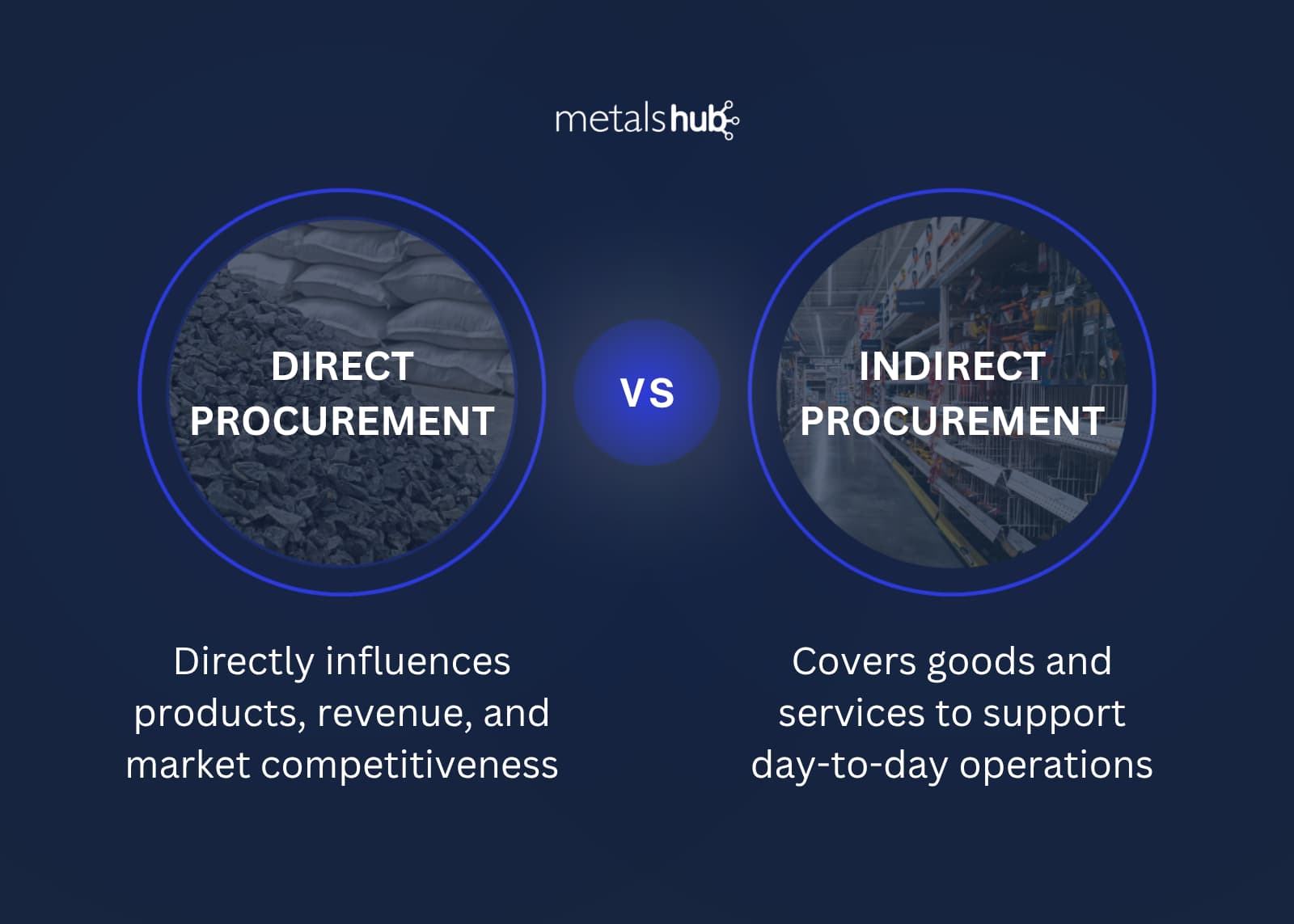
Direct procurement refers to the sourcing of raw materials, components, and physical inputs that enter the finished product or are consumed directly in the manufacturing process, directly driving the Cost of Goods Sold (COGS).
Indirect procurement covers the purchasing of goods, services, and operational supplies (such as IT, maintenance, and facility management) required to maintain day-to-day business operations but do not enter the final product, affecting Operating Expenses (OPEX).
At its core, direct procurement refers to the sourcing of materials, components, or physical inputs used directly in a company’s manufacturing process or final products. In a standard manufacturing environment, these are the items found strictly on the Bill of Materials (BOM).
However, in raw material-intensive sectors—such as steelmaking, foundries, mining, and battery manufacturing—defining direct procurement solely by what physically remains in the finished product is too rigid. Instead, direct procurement must be defined as any material or input that directly drives production volumes, heavily shapes the Cost of Goods Sold (COGS), and is essential for physical output.
In a metals business, direct spend follows the chemistry and metallurgy. Whatever the recipe calls for, procurement must deliver on specification, on time, and at a competitive price against highly volatile global markets.
Indirect procurement is the sourcing of goods, services, and operational supplies that support day-to-day business operations but do not become part of the finished physical product. Rather than driving COGS, indirect spend is treated as an Operating Expense (OPEX).
While direct procurement influences margin via raw material costs, indirect procurement supports overall profitability by maximising operational efficiency, preventing plant downtime, and maintaining corporate compliance. If administrative or IT systems fail, the plant’s productivity is bottlenecked; if site security or PPE is unavailable, operations must halt for safety compliance.
Across the entire metals and mining value chain—from steel and aluminium production to battery materials and industrial minerals—direct materials dominate the cost base to a degree few other industries match. Whether sourcing iron ore, lithium, or critical production inputs like refractories, these direct categories make up the large majority of total production costs. Consequently, for any industrial operation, direct procurement remains the primary lever for protecting margins and maximising EBITDA, as raw material and energy prices heavily shape the bottom line.
Successive editions of the Deloitte Global CPO Survey rank cost reduction and risk mitigation as top priorities for procurement leaders, and in a metals business, both priorities sit almost entirely in direct spend.
The table below shows some other key differences at a glance:
| Dimension | Direct Procurement | Indirect Procurement |
| Primary Categories | Scrap, iron ore, ferroalloys, base metals, battery materials, refractories, industrial minerals | MRO, facilities, IT, PPE, consulting, travel |
| Link to Production | Direct: Physically enters the product or is consumed proportionally to output | Supportive: Maintains the facilities and back-office operations |
| Financial Treatment | Cost of Goods Sold (COGS) | Operating Expenses (OPEX) |
| Price Mechanics | Volatile, index-linked, and formula-priced (e.g., LME, Fastmarkets) | Fixed list prices, corporate catalogues, and framework agreements |
| Volatility Exposure | Exceptionally high: Requires hedging, market timing, and index tracking | Low to moderate: Usually managed via annual inflation clauses |
| Supplier Relationships | Highly strategic, mid- to long-term alliances with qualified counterparties | Transactional, decentralised, or consolidated vendor models |
| Supply Failure Risk | Production stops immediately; massive contractual customer penalties | Minor inconvenience, back-office delays, or manageable workarounds |
| Typical KPIs | Cost vs. index, chemical assay conformance, On-Time & In-Full (OTIF), working capital | Cost savings vs. budget, catalogue compliance, process cycle time |
| Compliance Load | High. KYC, sanctions, origin tracking, CBAM emission reporting | Standard vendor onboarding and internal corporate governance |
| Tooling Required | Specialised raw-material platforms with offer normalisation and ERP ties | Generic procure-to-pay (P2P), expense management, and spend control suites |
Failing to draw a clear line between direct and indirect spend can be a costly mistake that directly impacts a company’s bottom line. When a critical production input is misclassified as an indirect MRO item, several structural risks emerge:
The operational differences between direct and indirect procurement extend directly into how suppliers are managed.
Direct procurement requires highly strategic, mid- to long-term relationships with a carefully vetted, qualified group of suppliers. Because a failure in scrap or alloying element quality can ruin an entire batch of steel, buyers conduct extensive audits and KYC checks. This is why leading producers like Outokumpu treat raw material suppliers as critical partners in their value chain.
Indirect procurement relies on a transactional, highly distributed network of suppliers. The goal here is consolidation, reducing the sheer number of vendors to lower transaction costs and streamline administrative workflows. Maverick (off-process) spend is notoriously difficult to track in highly decentralised indirect procurement. While direct procurement is not immune to off-contract buying, it is subject to far tighter inventory and quality controls.
Regulation is widening the gap between direct and indirect procurement, and CBAM is the clearest example for metals. The EU Carbon Border Adjustment Mechanism moved from its reporting-only transitional phase into the definitive regime on 1 January 2026. Importers of iron, steel, and aluminium goods into the EU must now be authorised CBAM declarants.
Under the 2025 Omnibus simplification (Regulation (EU) 2025/2083), a threshold of 50 tonnes net mass per importer per year exempts most small importers while keeping the large majority of embedded emissions in scope. Certificate sales open on 1 February 2027, priced on the quarterly average EU ETS allowance auction price for 2026 emissions and the weekly average from 2027 onwards, and the first annual CBAM declaration, covering 2026 imports, is due by 30 September 2027.
Because carbon costs now directly impact product pricing, direct procurement teams must collect precise Scope 3 emissions data and origin certificates at the transaction level. Indirect procurement, by contrast, faces only standard corporate ESG reporting without these heavy, transaction-by-transaction tariff penalties.
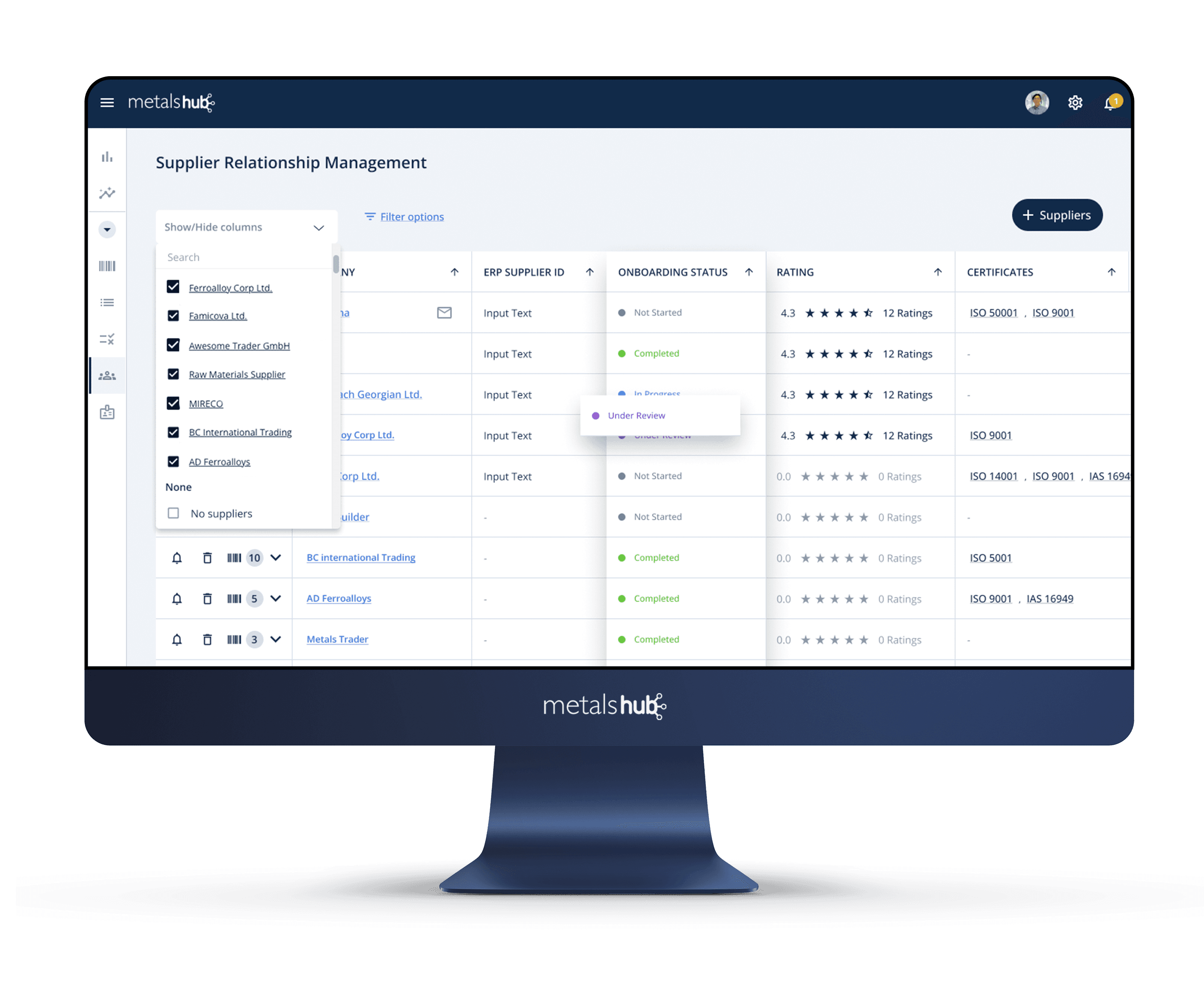
Generic e-procurement platforms are built for catalogue buying. Buyers can pick an item, route an approval, and raise a purchase order, but direct raw material procurement does not work that way. Rather than focusing on broad, generic administrative automation, raw material-intensive procurement requires technology designed as a category-specific enabler.
Attempting a “one-size-fits-all” approach by repurposing indirect procurement software for direct raw materials typically fails, resulting in immense sunk costs and a low return on investment for a spend category that controls 50% to 70% of your total cost base.
While more than half of the companies in the metals and mining sector still rely on manual offline methods, supply chain digitalisation may help to unlock 30-50% in productivity improvements and to significantly reduce costs.
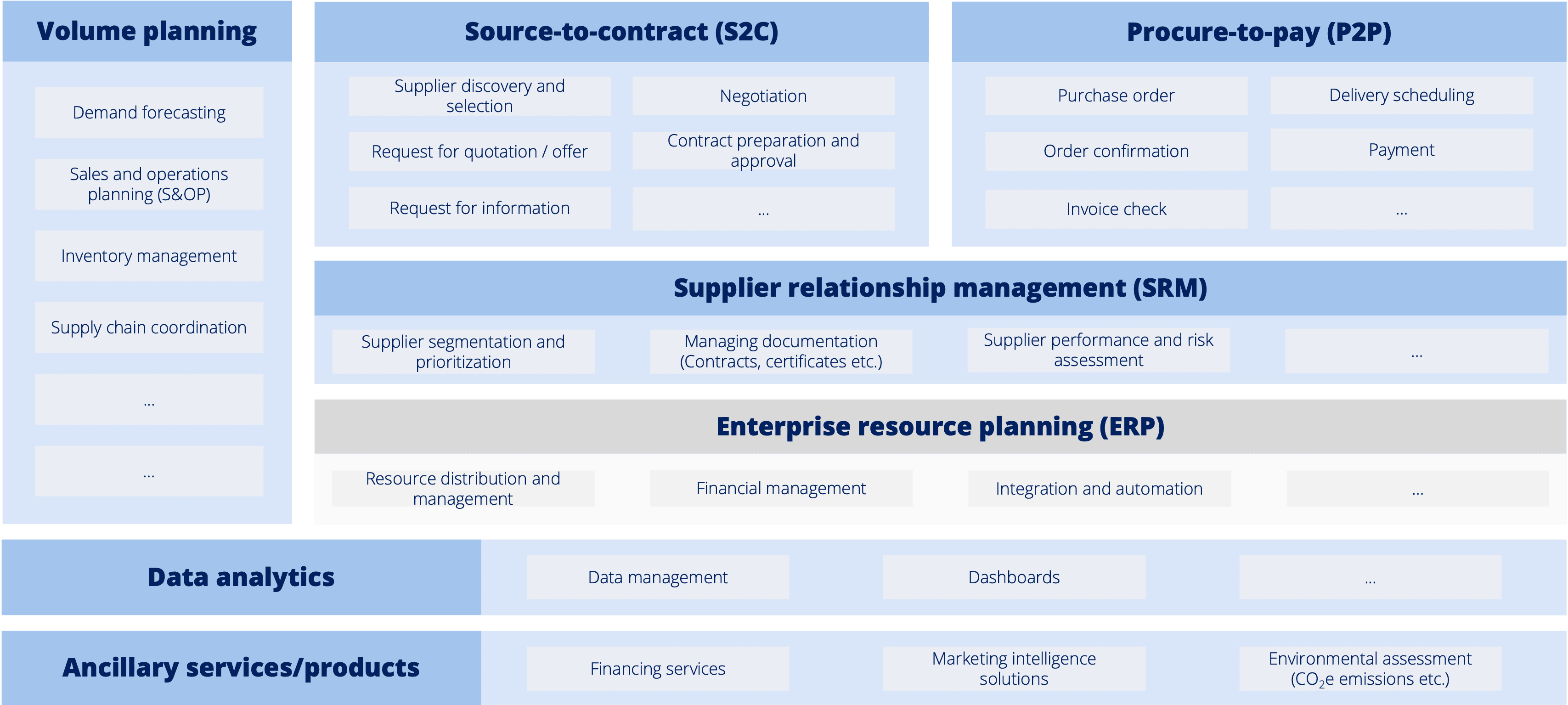
That is why Metalshub is built purposefully for the metals and mining industry, not adapted from generic sourcing platforms. The Procurement Solution handles the parts of direct raw material buying that generic tools cannot:
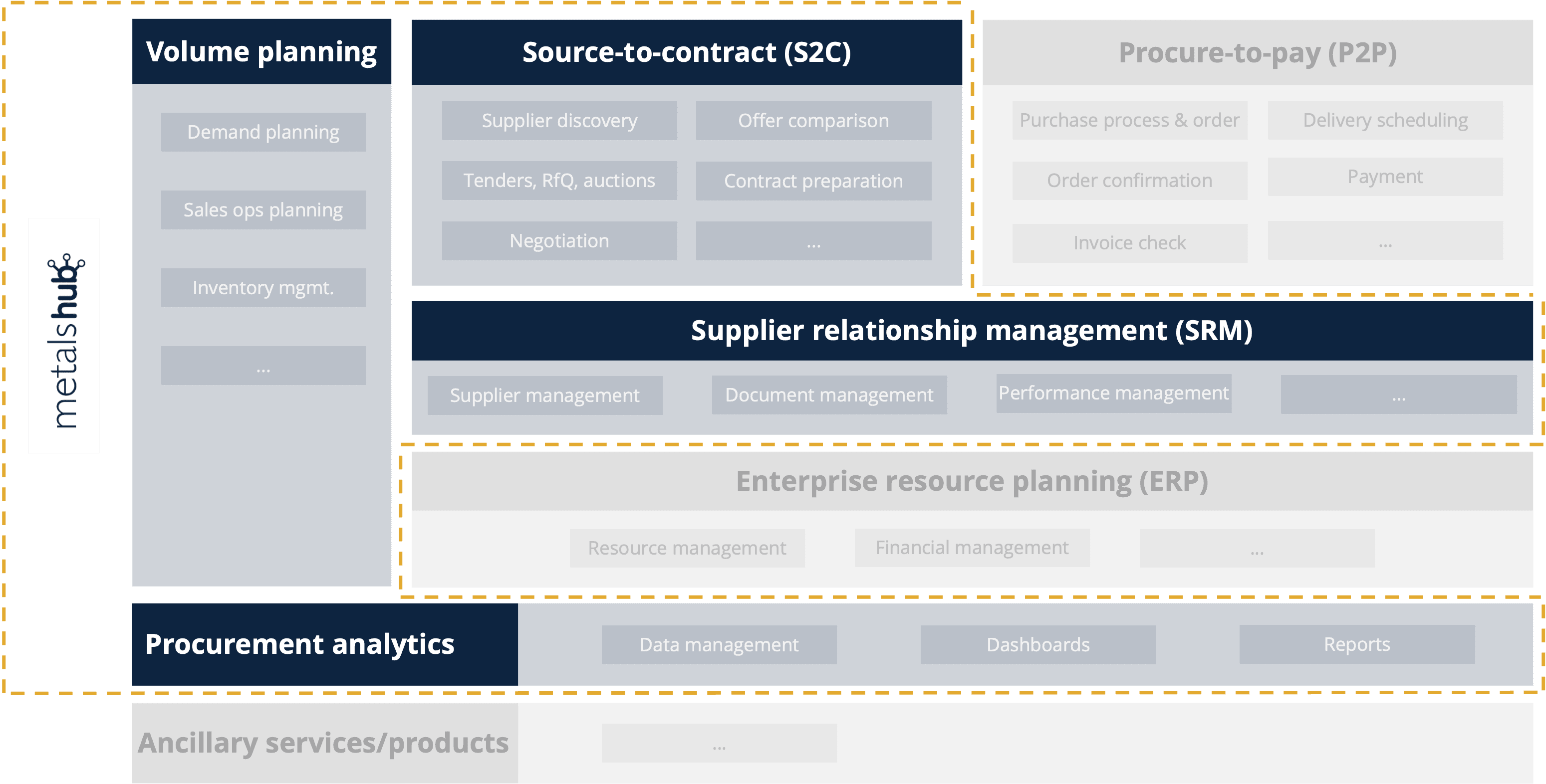
By replacing manual spreadsheets with a structured digital workflow, Metalshub enables buyers to:
Want to learn more?
Discover the untapped potential for profitability and operational efficiency in raw material procurement for metals, mining, & recycling.
Newsletter