Industrial Minerals
Battery Raw Materials
Why the West’s Critical Mineral Strategy Demands Price Transparency and How Metalshub is Building It
 Written byChenyu Zhao
Published on
Share Post
Industrial Minerals
Battery Raw Materials
Written byChenyu Zhao
Published on
Share Post
Over the last few weeks, the global conversation around critical minerals shifted from policy theories to hard financial realities. The European Union announced a €3 billion spending plan this year to build stockpiles and establish price floors, an aggressive move to reduce strategic dependence on concentrated supply chains driving the energy transition. Watching this unfold from my desk as Growth Lead at Metalshub, I see a massive contradiction at play. Governments are preparing to deploy billions of euros of taxpayer wealth into a market that remains, to a large extent, dark.
Sovereign intervention is a necessary step for raw materials policy, which was treated as a niche political afterthought for decades. However, executing a massive purchasing strategy without localised market data creates an immense risk.
When Dr Frank Jackel, Metalshub co-founder and managing director, spoke at The EIT RawMaterials Summit recently, his warning cut straight to the core of this operational blind spot: “If you don’t have a liquid and transparent market, the risk of wasting money ultimately as a government, as a legislator, is extremely high. I don’t understand how any of the governments would go into stockpiling without price transparency.”
True strategic autonomy requires more than just capital deployment. It needs the commercial infrastructure to discover what these materials actually cost.

Transparent pricing signals are essential for market efficiency. Currently, European critical mineral markets experience fragmentation and limited liquidity, heavily reflecting pricing benchmarks from external hubs with high processing concentrations. Because a vast majority of global refining capacity is geographically centralised, local market participants face challenges in establishing the baseline value for regional spot transactions.
This opacity creates a severe bottleneck for the entire ecosystem. Private investors are hesitant to fund new mining and refining projects in Europe because they lack clear visibility into long-term returns. When governments try to force supply security through artificial price floors or sudden stockpiling mandates without regional data, they risk overpaying, distorting local dynamics, and draining public funds. To build a resilient supply chain, policymakers and corporate buyers must develop a deep grounding in actual spot market fundamentals.
We are actively building the solution to this structural data gap. Through our strategic partnership with EIT RawMaterials, Metalshub is developing robust, independent European pricing benchmarks for critical minerals.
Our approach focuses on transforming the transaction layer itself. By moving fragmented, traditional negotiations onto a standardised digital platform, we capture anonymised, real-world spot transaction data as it occurs. This creates an undeniable data loop that provides private capital with the clear price signals needed to fund independent processing facilities.
Producers ➔ Transparent Spot Data ➔ Benchmarks ➔ Smarter Policy & Investment
This commercial data loop transitions industrial policy from speculative government forecasting into predictable, market-driven growth.
The argument for price transparency is a live operational shift occurring right now. In late May 2026, two of the world’s most vital supply chain participants chose to onboard their volume onto Metalshub, signalling a major transition toward digital trade infrastructure.
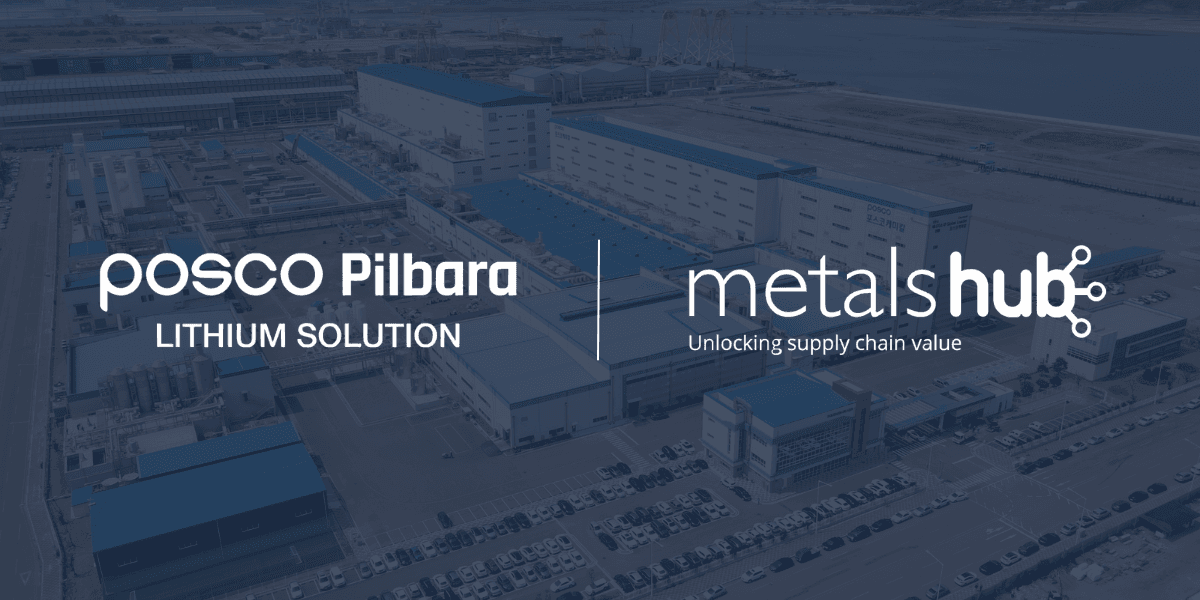
POSCO Pilbara Lithium Solution (PPLS), a massive joint venture between South Korea’s POSCO and Australia’s Pilbara Minerals, integrated with Metalshub to manage their lithium hydroxide allocations. Operating a large-scale chemical facility outside of China with an annual capacity of 43,000 tonnes, PPLS represents the exact type of diversification Western governments are trying to cultivate.
PPLS is utilising Metalshub to execute structured price discovery events. This application provides their commercial network with verified, localised price signals. As Byoungju Park from PPLS noted: “Transparent and reliable price discovery is essential for both producers and customers. By joining Metalshub, we can engage a broader network of qualified buyers.”
Simultaneously, Jervois Finland joined our digital marketplace to optimise the sale of cobalt sulfate. As an operator of one of the largest cobalt refining facilities in Europe, Jervois is a cornerstone of the continent’s battery material strategy.
By utilising our structured request-for-bid workflows, Jervois brings critical spot liquidity to the European market while streamlining its global commercial reach. Sami Kallioinen, Managing Director of Jervois Finland, summarised the objective clearly: “Partnering with Metalshub, we aim to strengthen price discovery for cobalt sulphate while expanding our reach to new customers globally.”
The entry of PPLS and Jervois highlights a growing regulatory reality for Western procurement teams. Under the strict mandates of the EU Critical Raw Materials Act, buyers must prove the precise origin, carbon footprint, and ESG compliance of their raw materials.
Metalshub solves this regulatory challenge by embedding auditable provenance data directly into the transaction workflow. We enable premium producers to capitalise on their sustainability investments while giving buyers verified compliance data alongside every spot price signal.
The era of setting critical mineral values behind closed doors or relying blindly on external benchmarks is concluding. The risks to sovereign taxpayers and corporate balance sheets are simply too high to tolerate market opacity any longer.
Building transparent, liquid markets in a traditionally opaque sector requires significant collective ambition. We are seeing the industry’s most forward-thinking producers step up to provide the data foundation necessary for a secure supply chain. I invite other producers, premium buyers, and industrial policymakers to move your sales and procurement workflows onto Metalshub. Let us build a transparent, resilient raw materials ecosystem together.
Newsletter